Co-Founder Agreements: Splitting Equity Without Fighting
Most co-founder problems do not begin with betrayal. They begin with vague expectations, lazy equity decisions, and hard conversations avoided too long. This guide shows how to structure founder agreements before pressure turns ambiguity into damage.
Strategy Framework: The Shotgun Clause & Equity Math

A founder agreement is not primarily a legal document. It is an operating clarity document. Its real job is to force two or more people to answer questions they would rather postpone: who owns what, who decides what, what happens if contribution levels diverge, and how the company survives conflict without paralysis.
We use the Shotgun Clause and Equity Math framework because most co-founder breakdowns are not caused by one dramatic moment. They are caused by small mismatches that accumulate until trust erodes. A good agreement makes those fault lines visible early enough to address them before they become existential.
The Core Mechanisms
The Shotgun Clause: In a serious deadlock, one founder proposes a buyout price. The other founder must either accept the sale or buy the first founder out at the same price. This mechanism discourages manipulative pricing because the initiating founder can be forced onto either side of the transaction.
Dynamic Equity Models: Instead of guessing a perfect split on day one, some teams track relative contributions of time, cash, prior assets, and opportunity cost until the business stabilizes enough to convert those contributions into a more fixed ownership structure.
Tie-Breaker Design: Teams need a deadlock strategy. That may mean an uneven control structure, a specific domain-based decision model, a board mechanism, or an agreed external tie-breaker.
What Equity Math Should Reflect
Equity should reflect more than enthusiasm. It should reflect:
Why Equal Splits Feel Safer Than They Are
A 50/50 split feels emotionally clean because it avoids immediate discomfort. But clarity delayed often becomes conflict amplified. Equal ownership without equal decision rights, equal contribution, or equal long-term commitment is not fairness. It is ambiguity disguised as fairness.
What Founders Usually Avoid Discussing
Before the company scales, founders should be able to answer:
Another Hard Truth About Equity
Founders frequently want equity to solve emotional fairness. But equity is not therapy. It is a governance and incentive instrument. If the team is using ownership to avoid uncomfortable truth about roles, commitment, or contribution, the cap table will eventually carry the cost.
Why Governance Has To Be Explicit
Strong founder teams do not rely on mind-reading. They make governance visible. That means specifying not just who owns shares, but who can make which decisions without permission, which decisions require consensus, and which decisions can escalate to a tie-breaker. Many disputes that feel personal are actually governance failures in disguise.
The Most Important Reframe
The agreement is not a sign of distrust. It is a system for preserving trust under stress. Founders should treat it as a business pre-nup: not because they expect failure, but because they understand pressure changes behavior.
Strategy: Vesting, Cliffs, and Accelerated Triggers
Equity is not a reward for saying yes at the beginning. It is a mechanism for aligning long-term contribution with long-term ownership. That is why vesting matters so much. Without vesting, startups often hand permanent ownership to people whose actual contribution lasts only a few months.
The Execution Rules
Why the Cliff Matters
The one-year cliff is not punishment. It is a filter. It prevents the cap table from filling with inactive ownership before the team has even proven it can survive a year of real work together.
When Founders Misuse Vesting
Founders misuse vesting when they:
A Better Way to Think About Acceleration
Acceleration should solve a specific fairness problem, not exist because it sounds founder-friendly. The question is simple: under what scenario would a founder lose the value they helped build through no fair fault of their own? That is the scenario acceleration should address.
What Founders Forget About Future Hiring
Bad founder equity design does not only affect the founders. It also affects future hiring, fundraising, and morale. A messy cap table creates invisible drag on every serious next step. That is why the company has to think beyond present emotions and design ownership for durability.
Equity Design Is Also Signal Design
How founders structure their own equity sends a signal to investors, early hires, and future executives. If the people closest to the company could not create a coherent ownership logic for themselves, outsiders will reasonably wonder how disciplined the company will be elsewhere.
The Final Vesting Standard
A founder equity plan should be understandable, enforceable, and emotionally survivable. If the team cannot explain it simply or live with it when circumstances change, it is not ready yet.
Tactic: Put the vesting logic into formal systems early so no founder has to rely on memory, emotion, or later reinterpretation. The more automatic the equity mechanics become, the fewer relationship problems they create.
Execution: Good Leaver vs. Bad Leaver
One of the most emotionally difficult founder questions is also one of the most important: what happens when someone leaves? If the agreement has no serious answer, the company becomes fragile exactly when it most needs structure.
The Leaver Framework
Why This Matters So Much
Without leaver clauses, founders end up negotiating from anger during crisis. That is the worst possible time to invent fairness. A good document defines the categories and consequences while relationships are still functional.
Questions the Agreement Should Resolve
Why Investors Care About This Too
Experienced investors are not only evaluating product and traction. They are also watching for founder governance risk. If the departure of one person can freeze the company or contaminate the cap table permanently, the business becomes harder to finance.
Another Founder-Level Concern
Departure rules also matter because founders rarely leave at neat moments. People burn out, family realities change, role fit breaks, or one person simply becomes misaligned with the company’s next stage. The agreement should be strong enough to absorb human reality without destabilizing the business.
The Real Goal
The goal is not to punish people. The goal is to keep the company governable after departure. A departed founder should not retain so much uncontrolled leverage that future investors, hires, or strategic moves become harder than they need to be.
Tooling: Standard venture templates are useful starting points, but the deeper value comes from using them to force real conversation, not from copying them blindly.
Case Study and Pitfalls: Zipcar vs. The 'Equal Split' Fallacy
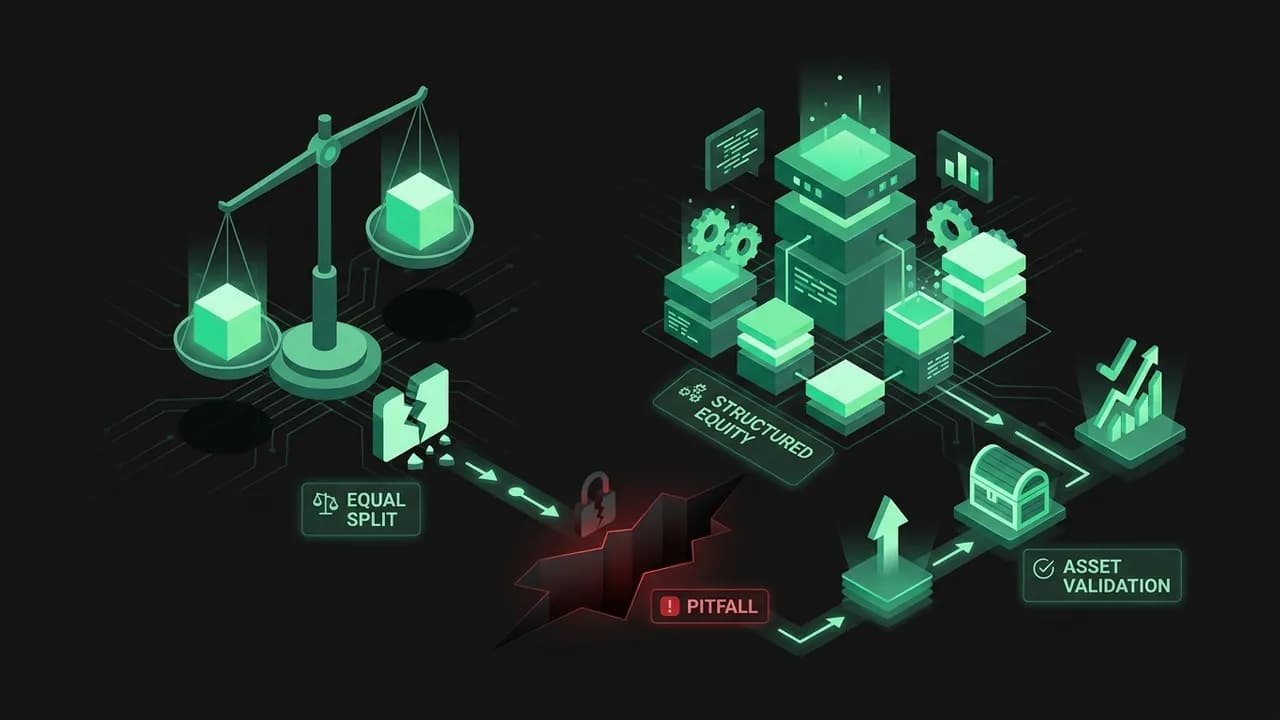
Case Study: The Zipcar Fallout
The Zipcar story is frequently referenced because it illustrates how dangerous equal splits can become once the company experiences real pressure. At the beginning, 50/50 ownership can feel morally elegant. Later, it can create power struggles, unclear authority, and governance friction exactly when the company needs decisive movement.
The deeper lesson is not that equal splits always fail. The lesson is that founders often choose equal splits to avoid a harder conversation about decision rights, long-term role weight, and conflict resolution. The split becomes a substitute for clarity. That is why it so often breaks later.
The Agreement Pitfalls
The Handshake Error: Trusting friendship or shared excitement more than written structure. Fix: good agreements protect relationships by reducing future interpretive fights.
Ignoring IP Transfer: A founder contributes critical work but ownership is never properly assigned to the company. Fix: every founder should execute clean assignment documents immediately.
No Removal Path: The company cannot remove a misaligned or underperforming founder without chaos. Fix: governance and termination rights must be defined before they are needed.
No Decision Architecture: Everyone owns everything equally, but nobody knows who decides what. Fix: assign clear domains, escalation paths, and deadlock rules.
What Mature Founder Alignment Looks Like
Mature founder teams usually make four things explicit:
The Real Test of a Founder Agreement
A good founder agreement should still feel fair during three uncomfortable moments:
If the agreement only feels good when everyone is optimistic, it is incomplete.
The Deeper Operating Lesson
Founder agreements are really agreements about future pressure. They do not show their value on easy days. They show their value when expectations diverge, performance slips, external stress rises, and somebody feels wronged. That is why specificity matters so much.
A Final Practical Standard
If a founder agreement cannot survive the team’s most awkward honest conversation, it probably will not survive the company’s first serious crisis either. Durable agreements are not the most elegant ones. They are the ones specific enough to stay useful when emotions rise.
The Last Founder Filter
Before signing, founders should ask: would this still feel fair if one of us became disappointed, exhausted, or resentful? If the answer is no, the agreement probably needs more work. Good documents are built for the days when trust is strained, not only the days when trust is easy.
The Final Principle
The agreement should protect both the mission and the relationship. If it cannot do both perfectly, it should at least prevent avoidable damage to either. That is what good founder structure actually achieves. In practice, that usually means clarity beats optimism. Strong structure protects momentum too. It also protects future decision-making quality. Clear agreements protect trust under pressure. They preserve operating continuity when emotions get expensive. They also make future financing conversations easier. They reduce ambiguity when the stakes rise. Mature teams document this before urgency forces them to improvise.
Why This Still Matters After The Documents Are Signed
A founder agreement is not the end of alignment work. It is the baseline. The team still has to revisit role clarity, contribution balance, compensation changes, and governance as the company evolves. Strong founders do not treat the signed document as the end of the conversation. They treat it as the structure that keeps future conversations productive instead of destructive.
The Best Founder Habit
Review the agreement whenever one of these changes materially: ownership expectations, time commitment, executive roles, fundraising plans, or strategic direction. Agreements fail not only because they were weak at the start, but because they were never updated as reality changed.
Practical Founder Challenge
Set aside time for a hard conversation with your co-founder and answer these questions in writing:
A founder agreement is successful when it makes future conflict smaller than it otherwise would have been. That is the bar.
Key Takeaways
Split equity on contribution, risk, and long-term commitment, not on who had the idea or a reflexive 50/50.
Always attach four-year vesting with a one-year cliff so equity is earned, not gifted.
In India, incorporate as a Private Limited company for venture-track startups and enforce vesting via a shareholders' agreement.
Define good leaver, bad leaver, and shotgun clauses before any dispute so a deadlock can't freeze the company.
Sign the co-founder agreement while the relationship is good, never wait for the fight.
Frequently Asked Questions
What is a co-founder equity split?
How do you split startup equity fairly?
What are vesting and a cliff, and why do they matter?
Should Indian co-founders use a Pvt Ltd or LLP, and how is equity handled?
What are good and bad leaver clauses, and what is a shotgun clause?
What are common co-founder equity mistakes?
Your Turn: The Action Step
Co-Founder Equity Split & Vesting Worksheet
Agree a fair, defensible equity split with vesting and leaver terms BEFORE the money or the fights arrive — and capture it in writing the same day.
Score each founder's contribution
Both of you score every factor 0-10. Don't average to be polite — be honest.
| Factor | Founder A pts | Founder B pts |
|---|---|---|
Compute the raw split
Add each founder's points, divide by total. Formula: Founder A % = A points / (A + B points).
Sanity-check the split
Could each founder defend their % to the other in 2 years without resentment? Adjust if not.
Set the vesting schedule
Define the cliff, total period, and any accelerated triggers (e.g. on acquisition).
| Term | Value |
|---|---|
Define good leaver vs bad leaver
Write what counts as each, and what happens to vested vs unvested shares in both cases.
| Scenario | Definition | What happens to shares |
|---|---|---|
Add the deadlock / exit clause
Write how a buyout or shotgun clause works if you two cannot agree later.
Before you close this
0/5 doneYour answers are saved in this browser only. Use “Download as PDF” to keep a copy.
The Hidden Risk That Can Destroy Any Business
Ready to apply this?
Stop guessing. Use the Litmus platform to validate your specific segment with real data.
Seal Your Partnership