Hiring Your First Engineer: Employee or Agency?
Your first technical hire can create leverage, velocity, and clarity, or lock the company into expensive confusion. This guide helps you decide when to use an agency, when to use freelancers, and when a real employee or founding engineer is the smarter bet.
Strategy Framework: The Hiring Risk Spectrum
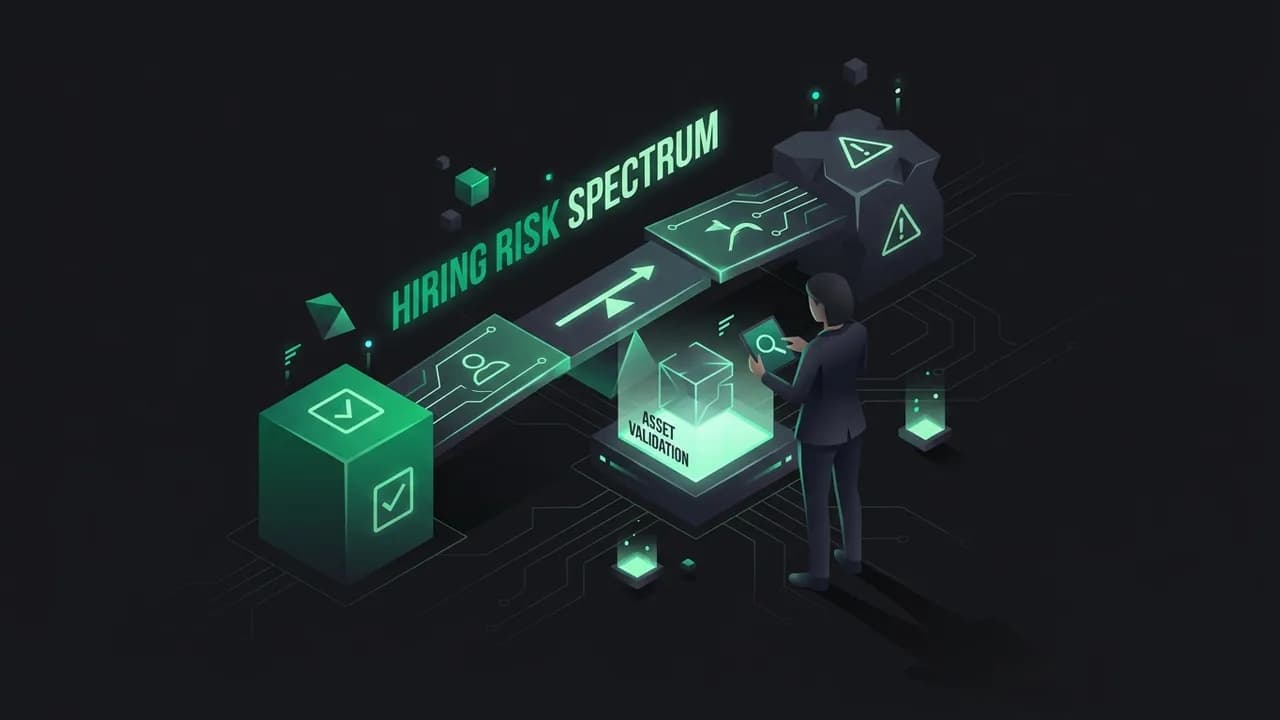
Founders often treat the first technical hire like a binary choice: either find a co-founder-level engineer or pay an agency to build everything. In reality, the decision is more nuanced. The right choice depends on product certainty, technical complexity, available capital, management bandwidth, and how permanent the capability needs to be.
We use the Hiring Risk Spectrum to evaluate not just cost, but trust, ownership, flexibility, and long-term leverage. In 2026, technical talent is globally available, but that does not mean it is easy to use effectively. The cheaper the engagement feels upfront, the more carefully you usually need to think about dependency, clarity, and oversight.
The Spectrum
Agencies: Agencies are often the lowest-management option and the highest direct-cost option. They can be useful when scope is clear, timelines matter, and the founder needs delivery machinery more than internal capability.
Freelancers: Freelancers offer flexibility and narrower cost commitments. They work best for bounded tasks, specialized work, or support around an already-defined product path.
Employees or Founding Engineers: These are the highest-trust and highest-commitment paths. They are harder to hire well, but they create the strongest long-term ownership when the company has moved beyond pure validation.
What the Spectrum Actually Measures
The spectrum is really helping you weigh these questions:
When Agencies Make Sense
Agencies are useful when:
When Freelancers Make Sense
Freelancers are useful when:
When Employees Make Sense
Employees or founding engineers make sense when:
The Hidden Variable: Founder Management Load
One of the most overlooked variables is how much management load the founder can absorb. Agencies reduce some supervision burden but require strong scope control. Freelancers require more direct coordination. Employees require hiring discipline, onboarding, and long-term leadership. The best choice is often the one that matches the founder’s actual operating capacity, not the one that sounds most impressive.
The Strategy: During asset validation, founders should usually prefer reversible technical choices. Agencies and freelancers can be excellent bridges to learning. Permanent hires become more attractive once the company knows it needs ongoing internal technical leverage.
Strategy: Vetting Technical Talent (For Non-Technical Founders)
The hardest part for a non-technical founder is not finding developers. It is knowing how to judge them. Résumés, logos, years of experience, and polished profiles are all weak proxies compared with real working behavior. In the AI era, presentation has gotten easier while signal has often gotten noisier.
The Core Rule
You should not hire based primarily on what a candidate says they can do. You should hire based on how they work, how they explain tradeoffs, and how they behave in a small amount of real collaboration.
The Execution Rules
What to Look For in a Trial
Look for:
What Weak Signal Looks Like
Weak candidates often:
Useful Questions for Founders to Ask
Why This Works
These questions surface judgment, not just fluency. They show whether the candidate can reason through ambiguity, not merely react to instructions. That distinction matters a lot in early-stage startups, where the work is rarely as clean as the brief suggests.
Another Simple Signal
Strong candidates usually improve the brief. Weak candidates usually only consume it. If the person asks sharper questions, identifies hidden risks, or reframes scope sensibly, they are already adding value before they have written a line of code.
The Best Founder Tactic
Ask the candidate to explain a previous complex project in simple language. If they cannot explain why they made certain decisions, they may not understand the deeper engineering principles behind their work. Strong technical people usually make complexity easier to understand, not harder.
For non-technical founders, the best protection is not pretending to become technical overnight. It is creating a process that makes quality, judgment, and communication visible before commitment becomes expensive.
Execution: Equity and the 'Founding Engineer' Offer
Early startups rarely win on salary alone. That means the first real technical hire is rarely choosing only between compensation packages. They are choosing between risk, meaning, upside, and quality of people.
The Incentive Playbook
What Founding Engineers Actually Want
A strong early engineer often wants:
What Undermines the Offer
Offers break down when founders:
The Best Framing
The first engineer is not joining for code alone. They are joining a trajectory. The more clearly the founder can explain the problem, the current stage, the roadmap uncertainty, and the upside, the more credible the offer becomes.
A Practical Offer Standard
A good early-stage offer usually makes four things clear:
The Offer Should Also Reduce Fear
Early hires are taking real risk. Clear language about role boundaries, vesting, review rhythms, and milestone expectations reduces ambiguity and increases trust. Great candidates do not only want upside. They want evidence that the company is being run with discipline.
What a Candidate Is Quietly Evaluating
Even when candidates sound enthusiastic, they are usually testing whether the founder is realistic, decisive, and trustworthy. They are asking themselves whether the company feels like a serious opportunity or an improvised gamble. Clear incentive design helps answer that question.
Why This Matters More in Early Teams
In a two- or three-person company, mismatched expectations become visible almost immediately. Clarity around ownership, compensation, and operating style is not a nice-to-have. It is one of the main reasons early teams either develop trust or fracture under pressure.
Tooling: Use sourcing platforms intentionally, and manage equity transparently from the beginning. Clarity around ownership is not legal polish. It is a signal of seriousness.
Case Study and Pitfalls: WhatsApp's Lean Team vs. The 'Hire-First' Trap
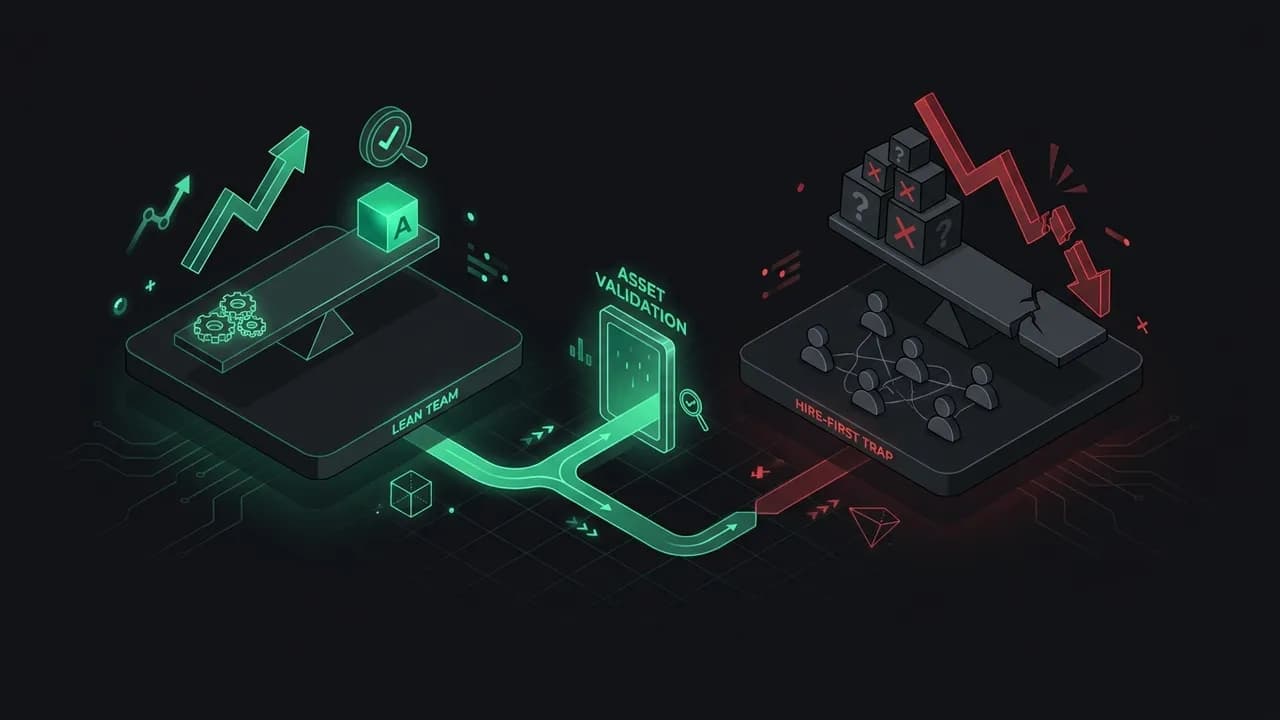
Case Study: WhatsApp's Lean Team Advantage
WhatsApp is often cited because it demonstrates a truth many founders resist: small, high-ownership teams can create extraordinary leverage when scope is disciplined and the technical core stays simple. The lesson is not that every company should avoid hiring. The lesson is that headcount is not the same thing as capability.
A startup can hire too early, hire too broadly, or hire in a way that increases coordination cost faster than output. That is the real danger.
The Hiring Pitfalls
The Co-Founder Title Error: Giving founder-level status to the first person who can write code. Fix: distinguish clearly between contractor, founding engineer, and co-founder-level commitment.
Ignoring Soft Skills: A technically strong but difficult early hire can distort the whole company. Fix: communication and trust matter disproportionately in tiny teams.
Delegating the What: Founders sometimes hand product decisions to technical vendors or early hires because they feel insecure. Fix: the founder still owns product intent and customer understanding.
Hiring Before Scope Clarity: Teams hire when the real problem is still that the product is underdefined. Fix: sharpen the product before assuming more people are the answer.
The Better Heuristic
Hire the minimum capability that allows the company to keep learning quickly. If an agency can help validate the MVP, that may be enough for now. If repeated product evolution is clearly ahead, a more permanent internal hire becomes easier to justify.
Another Hiring Mistake Founders Make
They often hire to reduce their own anxiety instead of to solve the company’s real bottleneck. That creates expensive motion without necessarily creating progress.
What Good Early Hiring Produces
A strong first technical hire usually creates:
What Bad Early Hiring Produces
A weak first technical hire often creates the opposite:
The Real Standard
The first technical hire should make the company more coherent. If the founder feels more confused, more dependent, and less able to reason about the product after the hire, something is wrong even if code is shipping. That clarity test is usually more valuable than résumé prestige.
A Final Founder Lens
The goal is not merely to add technical output. The goal is to add trusted technical judgment in a form the company can actually use. If the hire increases learning speed and reduces strategic confusion, it is working. If it only increases activity, it is probably the wrong setup. This is how founders avoid mistaking motion for traction. That distinction protects young companies from expensive drift. Strong hiring discipline compounds. Reliable judgment compounds too. Alignment compounds too. Long-term trust compounds most. Consistency matters too. Compounding matters. Always.
Practical Founder Challenge
Write a one-page feature spec. Create a short paid trial project around it. Then compare how candidates respond. The strongest people usually respond with questions, tradeoffs, and an approach. Weak candidates often respond with shallow certainty or only with price.
The first technical hire should reduce confusion, not multiply it. That is the standard that matters most.
Key Takeaways
Place every option on the Hiring Risk Spectrum: agency (low commitment, high cost), freelancer (flexible, transient), full-time engineer (high commitment, deep ownership).
For your core product, a full-time founding engineer is usually the cheapest per unit of real progress despite the higher fixed cost.
As a non-technical founder, vet with a small paid trial task and a trusted technical reviewer, not resumes.
Assign 100% of IP to the company from day one and put founding-engineer equity on a vesting schedule with a cliff.
Avoid the 'hire-first trap': don't build a full team before the product is validated.
Frequently Asked Questions
What is the first hire decision for a startup?
How do you hire your first employee for a startup as a non-technical founder?
What is the cost of full-time vs agency vs freelancer in India?
What are real first-hire examples?
What are common first-engineer hiring mistakes?
When should you offer equity to a founding engineer?
Your Turn: The Action Step
First Engineer: Employee vs Agency Decision Worksheet
Choose between a founding-engineer hire, an agency, or a contractor with eyes open — and draft the equity + vetting plan for whichever you pick.
Decide: is code your product or your plumbing?
If your moat is the code itself, lean employee. If it just runs the business, an agency may be fine.
Score your hiring risk spectrum
Rate each factor to see which path your situation pushes toward.
| Factor | Pushes to EMPLOYEE | Pushes to AGENCY |
|---|---|---|
Run the non-technical founder vetting plan
You can't read code — so design a paid trial task that proves competence anyway.
Draft the founding-engineer offer
Fill the comp table. Below-market cash is offset by meaningful equity + vesting.
| Component | Amount | Notes |
|---|---|---|
Calculate the true cost of each path
Compare a year of each. Formula: agency cost = monthly retainer x 12; employee cost = cash salary + (equity % x rough valuation).
Commit and write the deal-breakers
State your decision and the 2-3 things that would make you walk away from this hire/agency.
Before you close this
0/5 doneYour answers are saved in this browser only. Use “Download as PDF” to keep a copy.
Why Most Startups Don’t Need Patents
Ready to apply this?
Stop guessing. Use the Litmus platform to validate your specific segment with real data.
Build Your Team