Intellectual Property: Do You Really Need a Patent?
Founders often overestimate the value of patents and underestimate the power of trade secrets, contracts, and brand protection. This guide shows how to defend your moat intelligently without wasting early capital on legal theater.

Strategy Framework: The IP Protection Priority Pyramid
Founders often ask about intellectual property as if all protection tools are equally useful. They are not. In early-stage companies, different forms of IP have very different cost structures, enforcement realities, and strategic value. The most common mistake is spending scarce cash on the most prestigious-sounding protection instead of the most practical one.
We use the IP Protection Priority Pyramid to decide where legal attention should go first. The pyramid matters because the strongest protection for an early startup is often not the most expensive layer. In many cases, the best moat is built from secrecy, execution, trust, contracts, and brand position long before patents become useful.
The Layers (Bottom to Top)
Trade Secrets: This includes code, internal workflows, playbooks, prompt systems, pricing logic, proprietary data handling, and operational know-how. Trade secrets are often the highest-leverage protection available because they are cheap to maintain and difficult for outsiders to copy if the business protects them well.
Copyright: Copyright automatically protects original creative expression such as source code, design assets, documentation, and marketing content. It does not protect broad ideas, but it does protect how those ideas are expressed.
Trademarks: Trademarks protect the brand identifiers customers use to recognize you. In many startups, the earliest legally meaningful competitive asset is the name people remember and trust.
Patents: Patents can be powerful, but they are expensive, slow, and only strategically useful in specific contexts. They are often most relevant when the product includes a clearly novel technical invention that is both valuable and difficult to protect through secrecy alone.
Why the Pyramid Works
The pyramid forces founders to ask a better question than "Should we patent this?" The better question is: what exactly are we trying to protect, how copyable is it, and what is the cheapest effective layer of protection available right now?
What Early Startups Usually Need Most
Most early startups need:
When Patents Actually Matter
Patents matter more when:
When Patents Are Usually a Distraction
Patents are often a distraction when:
The Strategy: In most early-stage situations, start with trade secrets, contractual hygiene, and trademarks. Treat patents as a selective strategic tool, not as a default badge of seriousness.
Strategy: The Defensive Patent Strategy
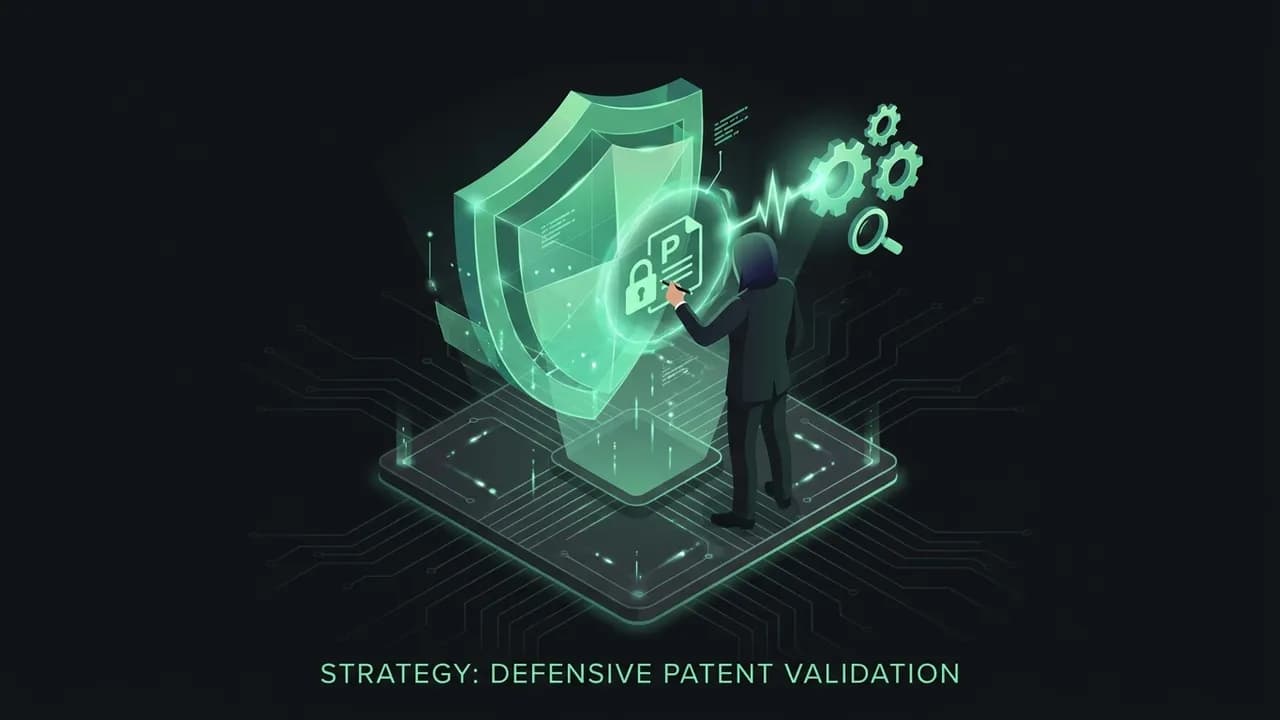
If you do decide to pursue patents, it helps to think about them as defensive tools first. Many founders fantasize about using patents offensively to dominate a category. In reality, early startups are more likely to use patents to improve strategic positioning, reduce future vulnerability, support diligence conversations, or preserve optionality than to launch expensive litigation.
The Execution Rules
A Better Patent Question
Instead of asking whether a patent sounds impressive, ask:
The Defensive Value of IP Awareness
Even if the company never builds a large patent portfolio, patent awareness can still be useful. It can help a startup avoid avoidable collisions, document novelty more cleanly, and make smarter decisions about what to disclose publicly.
When Defensive Publication Is Smarter
Defensive publication is often smarter when the company wants to block rivals from patenting a concept but does not want to spend heavily pursuing a full patent itself. In some categories, that is a far more rational move than filing simply because it feels strategic.
What Founders Commonly Misread
Founders often confuse novelty with protectability and protectability with business value. Something can feel original without being patentable. Something can be patentable without being strategically important. And something can be strategically critical without needing a patent at all. This is why disciplined legal framing matters more than emotional attachment to the idea.
Where Patent Strategy Intersects With Fundraising
Some investors care deeply about patent posture in categories like biotech, hardware, advanced materials, medical devices, or defensible infrastructure. In more common SaaS or workflow businesses, investors may care more about customer pull, data advantage, and speed of execution than about filings. The founder should match the legal strategy to the economics of the business, not to generalized startup mythology.
The Practical Founder Rule
If you cannot explain in simple language what the invention is, why it is novel, and why it matters commercially, you are probably not ready to spend heavily on patent strategy yet. Legal spend should follow strategic clarity, not replace it.
Tactic: Spend time periodically scanning relevant patent activity in your niche. You do not need obsession, but you do need awareness. Strategic ignorance becomes expensive when a large company later claims ownership over ground you assumed was open.
Execution: Building a 'Trade Secret' Culture
A trade secret is only valuable if the company behaves like it actually wants to keep it secret. Many startups claim their moat is proprietary while operating in ways that would never survive scrutiny. Shared drives are open, contractors lack clear IP clauses, credentials are loosely handled, and nobody can explain what the company actually considers confidential. That is not protection. That is wishful thinking.
The Security Playbook
What Counts as a Trade Secret in Startups
Trade secrets may include:
The Cultural Layer Matters
Trade secret protection is not only a legal issue. It is an operating culture issue. Teams need shared understanding around what is sensitive, why it matters, and how it should be handled. Without that, even strong contracts become weak in practice.
Common Failure Modes
Founders often fail here by:
The Real Startup Advantage
Many early-stage companies do not win because the underlying technique is impossible to understand. They win because they protect the operational learning around it better than competitors do. The trade secret is often not just the algorithm. It is the messy, compounding know-how around how the business actually works.
What Founders Should Operationalize Immediately
Founders should be able to answer these questions clearly:
Tooling: Use contract workflows, secret management tools, access controls, and disciplined repository practices. Trade secret protection is strongest when the company’s day-to-day operations already reflect the level of seriousness it claims to have.
Case Study and Pitfalls: Apple vs. Microsoft (The Look and Feel War)

Case Study: The 'Look and Feel' Battle
The Apple versus Microsoft dispute is a useful lesson because it shows how often founders misunderstand what IP law can actually protect. Apple argued that Microsoft had copied key interface ideas. But courts drew boundaries around which elements were protectable and which were considered functional or too general to monopolize. The broader lesson is that legal intuition and business intuition are not the same thing.
In startup language, this means many things that feel unique may not be protectable in the way founders hope. Customers may love your workflow, your UI style, or your market packaging, but the law may not treat all of those elements as exclusive property. That does not make them worthless. It simply means the moat may come more from execution, speed, ecosystem strength, and brand than from legal exclusion.
The IP Pitfalls
The Patent-First Trap: Spending early capital on legal filings before proving the market actually values the product. Fix: protect selectively and keep the business first.
Ignoring Open Source Compliance: Teams use libraries without understanding license obligations. Fix: know what code is entering the product and what legal terms come with it.
Trademark Laziness: A startup builds a name and identity before checking whether it can safely own them. Fix: clear names early and treat branding as a real asset, not a cosmetic decision.
Weak IP Assignment: Contractors or collaborators create critical assets without clean ownership transfer. Fix: make assignment language explicit from the beginning.
Another Practical Lesson
A lot of founders want the law to make their market defensible. Usually, the market becomes defensible because the company keeps executing, learns faster than imitators, and builds trust sooner. Legal protections can reinforce that position, but they rarely substitute for it.
The Founder-Level Lesson
IP works best when it supports a business that is already becoming valuable. It is rarely the thing that creates value on its own. A startup with weak demand and strong paperwork is still weak. A startup with strong demand, disciplined secrecy, clear ownership, and a defensible brand is often far stronger even with fewer filings.
The Most Useful Final Question
If a competitor copied us tomorrow, what exactly would still make customers choose us? The answer to that question usually reveals whether the real moat is legal, operational, brand-based, data-driven, or simply speed. Founders who know that answer spend far more wisely on IP.
The Operational Conclusion
Strong IP strategy is rarely about collecting documents. It is about translating business reality into the right mix of contracts, secrecy, naming discipline, compliance, and selective legal protection. The most mature founders understand that their real job is not to feel protected. It is to make the company genuinely harder to replace. That is the difference between legal theater and real strategic protection.
A Final Decision Rule
If the legal step you are considering does not clearly protect a real source of leverage, it is probably premature. The best IP spending usually follows clarity about where the company’s actual edge lives. This keeps legal strategy grounded in business reality. Good judgment matters. Strategic timing matters too. Discipline matters too.
Practical Founder Challenge
Conduct an IP audit with simple questions:
The right IP strategy is not the most expensive one. It is the one that protects the company’s real leverage while preserving cash, speed, and optionality.
Key Takeaways
Work the IP Priority Pyramid bottom-up: cheap trademarks, copyright, and trade secrets first; expensive patents last and only if invention is your moat.
Most software startups don't need a patent; execution, brand, and secrecy protect you better.
Get every founder, employee, and contractor to sign an IP assignment so the company clearly owns its work.
In India, Startup India gives an 80% patent fee rebate and fast-track examination; file a provisional first to lock a priority date cheaply.
Never publicly disclose a patentable invention before filing, and register your trademark early to avoid brand disputes.
Frequently Asked Questions
What is intellectual property for a startup?
Do you really need a patent for your startup?
How do you protect IP without filing a patent?
How much does a patent cost in India and how do you file one?
What are real startup IP examples?
What are common startup IP mistakes?
Your Turn: The Action Step
IP Protection Priority Worksheet
Decide what IP is actually worth protecting and how — so you spend on a patent only when it earns its cost, and lock down the cheaper, stronger protections first.
Inventory your IP assets
List everything someone could copy: code, algorithms, brand, designs, data, processes.
Map each asset to the protection pyramid
For each, pick the cheapest protection that actually works. Patent only if novel, defensible, AND visible to copy.
| Asset | Trade secret / TM / Copyright / Patent | Est. cost (₹) |
|---|---|---|
Run the patent gate
Answer for any asset you're tempted to patent. If you can't tick all three, don't file.
| Asset | Novel? (Y/N) | Worth ₹10L+ to defend? (Y/N) | Visible to copy? (Y/N) |
|---|---|---|---|
Lock the cheap, strong stuff first
List who must sign IP-assignment and NDA — every founder, employee, contractor, intern.
| Person | IP-assignment signed? | NDA signed? |
|---|---|---|
Build a trade-secret culture rule
Write the one operating rule that keeps your secret sauce secret (access control, no full-method docs to vendors, etc.).
Set the action list
Turn it into dated tasks with owners.
| Action | Owner | By when |
|---|---|---|
Before you close this
0/5 doneYour answers are saved in this browser only. Use “Download as PDF” to keep a copy.
Why Startups Lose Big Deals Without Security
Ready to apply this?
Stop guessing. Use the Litmus platform to validate your specific segment with real data.
Defend Your Moat