No-Code vs. Code: Building Your MVP in 2026
Most founders do not fail because they chose the wrong tech stack. They fail because they confused product validation with engineering ambition. This guide shows how to choose between no-code and code based on speed, learning, economics, and strategic leverage.
Strategy Framework: The Build, Buy, or Glue Matrix
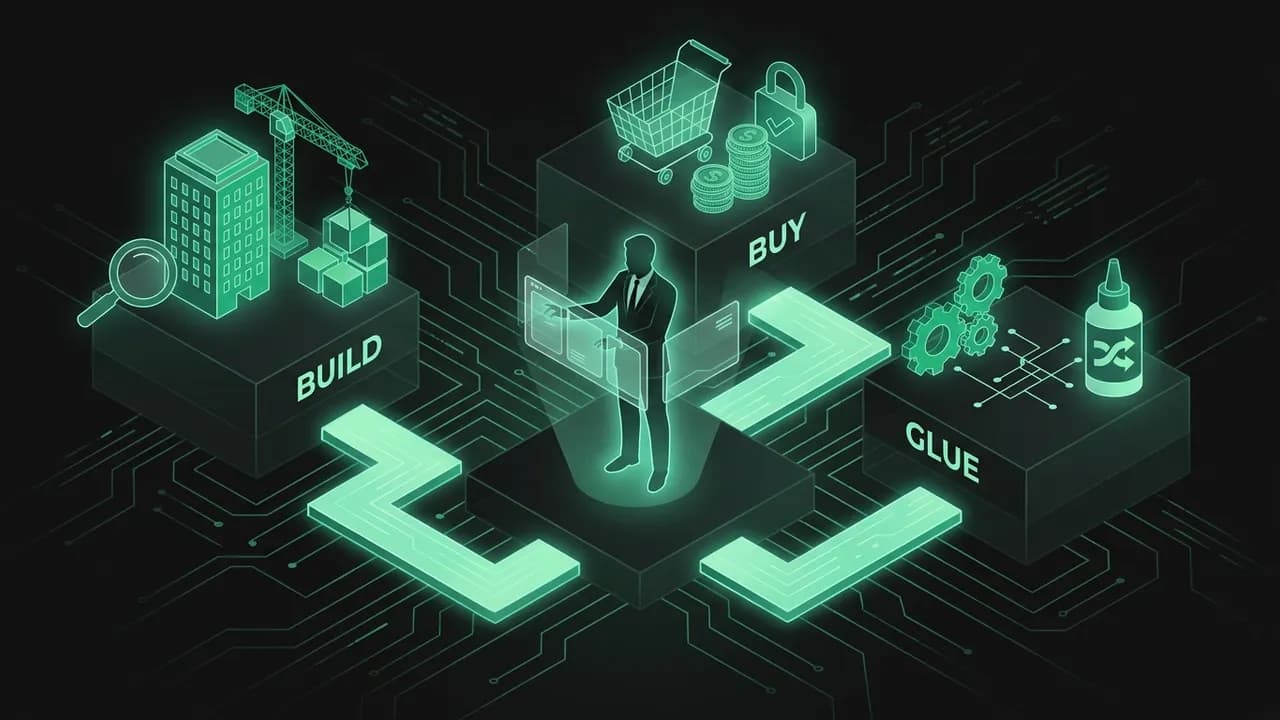
In 2026, the most important technical question for an early founder is rarely "Can we build this?" It is "What is the fastest, cheapest, least fragile way to learn whether this should exist?" That is a very different question, and it leads to very different technical choices.
We use the Build, Buy, or Glue Matrix because most startups overbuild far too early. Founders often assume that custom code is automatically more serious, more defensible, or more investable. In reality, custom code is only superior when the company genuinely needs the flexibility, performance, compliance, or technical control it provides. If the product is still being validated, speed of learning matters more than elegance of implementation.
The Quadrants
Buy (SaaS / Off-the-shelf): Use existing tools for non-core systems like payments, CMS, analytics, CRM, support, or storefronts. If it is not central to your unique value, buying is usually smarter than building.
Glue (No-Code / Low-Code Integration): Connect specialized tools using automations, spreadsheets, databases, and workflow platforms. This is ideal for operationally messy MVPs where humans still sit inside the loop.
Build (Visual Development): Use platforms like Bubble, FlutterFlow, Retool, Webflow, or other modern visual builders for frontends, internal tools, and product logic that needs more structure than simple integrations can offer.
Code (Custom Stack): Use full custom engineering when the actual business requires performance, security, deep technical differentiation, or infrastructure control that visual tools cannot reasonably support.
How To Choose Honestly
The right decision depends on four realities:
When Founders Choose Code For The Wrong Reason
Founders often choose code because it feels professional, permanent, or investor-friendly. But if the market is still unclear, code can become an expensive way to harden the wrong assumptions. The issue is not that code is bad. The issue is that code is durable, and durability is dangerous when the product is still fluid.
The Better Rule
Build the minimum technical system that allows the company to learn with credibility. That may mean buying infrastructure, gluing tools together, using visual builders, or coding only the narrowest part that truly needs to be custom.
Another Important Distinction
Founders often confuse three separate things: a prototype, an MVP, and a scalable product. A prototype proves interaction. An MVP proves customer behavior. A scalable product proves repeatable operations under load. These are different milestones, and they do not need the same stack. The biggest technical waste happens when founders build a scalable product architecture before they have MVP-level evidence.
Why Technical Purity Is A Luxury
Early startups should care about technical quality, but not worship it. Technical purity matters most after there is a product worth preserving. Before that, purity can become a socially acceptable excuse for delay. It feels disciplined while quietly postponing contact with reality.
The Strategic Cost Of Overbuilding
Every extra week spent engineering an unvalidated assumption has an opportunity cost. It delays customer conversations, revenue experiments, distribution learning, and pricing feedback. Founders who overbuild are not only spending more money. They are losing time against uncertainty, which is the more dangerous burn.
The Decision Standard That Actually Works
Ask one practical question: what is the cheapest architecture that still allows users to experience the core promise honestly? That question usually produces better technical decisions than broad debates about craftsmanship, status, or long-term optionality.
The Strategy: Stay in the Buy, Glue, and Visual Build layers as long as they continue to support trustworthy learning. Your early job is to validate the market, not to prematurely optimize technical purity.
Strategy: The 10-Day MVP Sprint
Velocity is not just a speed advantage. It is a strategic weapon against self-deception. The faster you can put a believable version of the product in front of real users, the faster you learn whether the problem is painful, whether the offer is clear, and whether anyone will actually change behavior.
The Execution Rules
What A 10-Day Sprint Is Really For
The purpose of a fast MVP sprint is not to ship something embarrassing. It is to compress the loop between assumption and evidence. That means the sprint should answer questions like:
Where Founders Waste Sprint Time
They waste it on:
The Best MVP Trick
Use a concierge layer whenever possible. Let the product appear more automated than it actually is, as long as the delivered outcome is real and the learning is honest. This is often the cheapest way to discover what truly deserves automation later.
How To Run The Sprint Better
A strong sprint has one clear success metric. Not ten. It may be completed workflows, paid conversions, booked demos, or repeated usage. Without a single dominant metric, founders end up arguing about vibes instead of learning from behavior.
The Founder Discipline That Matters Most
Do not ask whether the MVP feels impressive. Ask whether it produced signal. Impressive MVPs often fail quietly because they were built to look complete rather than to force market truth.
What A Good Sprint Debrief Looks Like
At the end of the sprint, founders should not mainly discuss what the team built. They should discuss what the market said. Which steps caused drop-off? What surprised users? What did people misunderstand? Where did manual work reveal the true product requirement? The debrief should convert behavior into next decisions.
Tactic: Treat the first build as an instrument for learning, not as the final product architecture. If it helps you discover real user behavior quickly, it is doing its job.
Execution: When to 'Eject' and Rewrite
The biggest fear founders have about no-code is not launching with it. It is getting trapped by it. That fear is understandable, but often exaggerated. The real question is not whether no-code can scale forever. The question is whether it can scale long enough to justify the next technical investment. In many cases, it can.
The Ejection Triggers
The Biggest Rewrite Mistake
Founders often rewrite too much, too early. They assume the right next step is rebuilding the entire product from scratch. Usually that is unnecessary and expensive. The smarter approach is often to migrate only the stressed layer first.
The Hybrid Play
Keep what still works. Move only what is under real pressure. Marketing pages, CMS workflows, internal admin surfaces, or back-office operations can often remain in no-code while the product engine, APIs, or data services move into custom code.
Signals That You Should Not Rewrite Yet
You probably should not rewrite if:
The Strategic Migration Mindset
A rewrite should follow validated pressure, not fear. If founders cannot name the exact bottleneck the rewrite solves, the project is probably still an emotional reaction rather than a business decision. The best teams migrate because reality forced them to, not because technical insecurity shamed them into it.
What Good Migration Planning Includes
Good migration planning identifies which user flows stay untouched, which data needs to move, which systems can remain no-code, and how to prevent the team from freezing feature learning during the rewrite. If the migration plan ignores product continuity, it is not a strong plan.
The Hybrid Play: Treat migration as a series of controlled extractions, not as a dramatic rebirth. The best rewrite is usually invisible to users and ruthless about only solving the bottleneck that actually exists.
Case Study and Pitfalls: Airbnb's Spreadsheet vs. The 'Dev' Trap
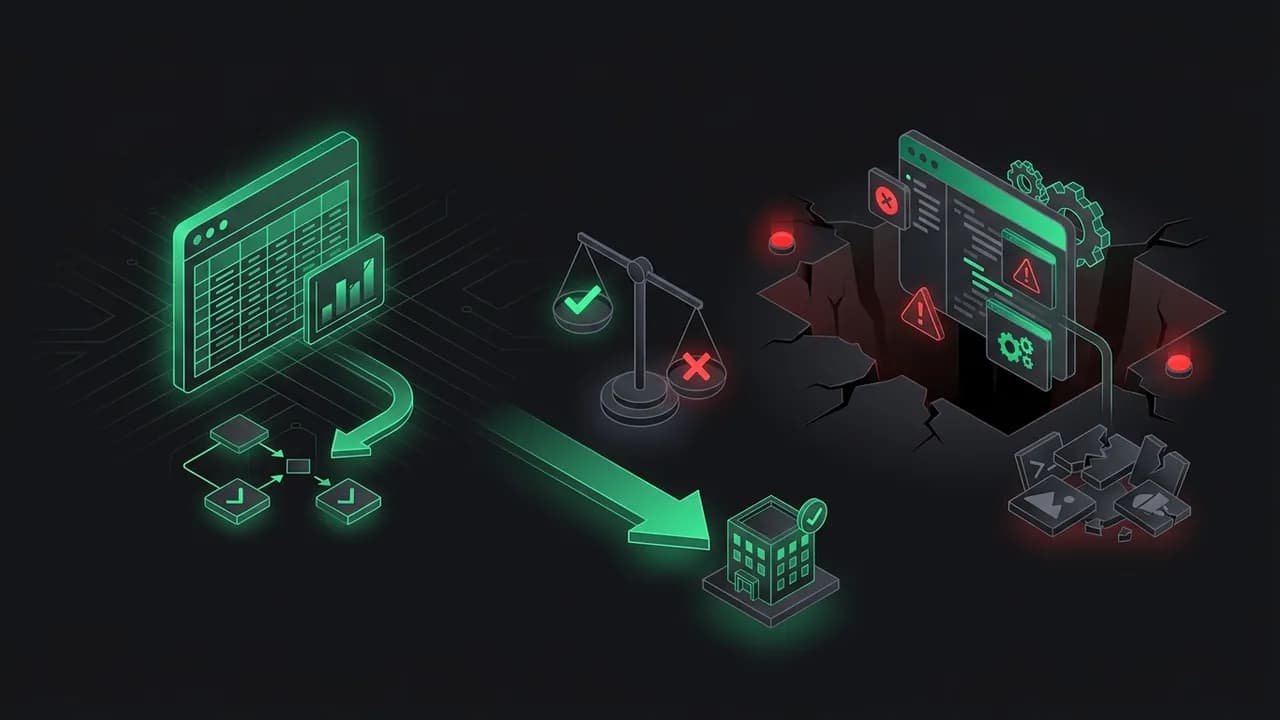
Case Study: How Airbnb Validated Without Overbuilding
Airbnb is useful here not because it was a no-code company in the modern sense, but because the founders validated behavior before they built scale machinery. They proved that strangers would trust the concept, that supply could be activated, and that demand existed before building the mature infrastructure people now associate with the business.
That is the deeper lesson for founders deciding between no-code and code: early software should exist to test whether reality cooperates. It should not exist mainly to satisfy the founder’s idea of what a real startup stack ought to look like.
The Build Pitfalls
The Learning Curve Fallacy: Founders underestimate the complexity of both code and no-code. Fix: choose tools based on the company’s actual learning goal, not based on fantasy about instant mastery.
The Security Oversight: Teams move fast and leave data, permissions, or keys exposed. Fix: fast builds still need real security hygiene.
The Wrapper Problem: Founders mistake interface assembly for durable value. Fix: distribution, proprietary workflow, data, and service design matter more than shallow packaging.
The Rewrite Ego Trap: Founders decide they must rebuild to feel legitimate, not because the product truly needs it. Fix: separate technical necessity from identity.
The Real Founder Lesson
Your first stack decision should optimize for evidence, not pride. If no-code gets you to truth faster, use it. If code is genuinely required because the product cannot be credibly tested otherwise, use it. The mistake is not choosing either path. The mistake is letting identity choose for you.
Another Operational Truth
A weak product with a sophisticated stack is still weak. A strong product with a messy but functional early stack can still win, because it has the more valuable asset: evidence of real demand. Founders should remember that markets reward useful outcomes far more than they reward beautifully overbuilt first versions.
The Most Useful Final Question
If this product succeeds, what part of it will actually deserve custom code? Many founders cannot answer that clearly at the start. That is exactly why they should avoid overcommitting to heavy engineering before the business teaches them where real value lives.
The Last Practical Principle
A founder does not earn points for choosing code too early, and they do not lose points for using no-code intelligently. The only serious question is whether the technical choice increases learning speed without breaking trust, quality, or credibility. That is the standard worth optimizing for.
Practical Founder Challenge
Audit your roadmap and identify the single feature delaying launch. Then ask:
The right technical choice is the one that helps you learn fastest without lying to yourself about what the business actually needs.
Key Takeaways
Use the Build, Buy, or Glue Matrix: code only the unique 20% that is your moat, buy or glue everything else.
Pick one no-code tool that fits your core workflow (Bubble for logic, Webflow for content, Glide for mobile) instead of forcing one tool to do everything.
A no-code MVP in India can cost a few thousand rupees a month versus lakhs for custom dev, so validate before you build.
Define your 'eject' triggers up front: performance limits, cost-revenue inversion, or investor code-ownership demands.
Build the single happy path first; resist recreating a full product before anyone has paid you.
Frequently Asked Questions
What is no-code vs low-code for building an MVP?
How do you build an MVP with no-code tools?
What are real no-code MVP examples?
How much does a no-code MVP cost in India versus custom code?
When should you 'eject' from no-code and rewrite in custom code?
What are common no-code MVP mistakes?
Your Turn: The Action Step
Build / Buy / Glue MVP Decision Worksheet
Decide — feature by feature — whether to build with code, buy an off-the-shelf tool, or glue no-code together, so you ship a learning MVP in 10 days instead of a 'perfect' one in 6 months.
List the jobs your MVP must do
Write the 5-8 concrete things a user must be able to do for the test to be valid.
Score each job: Build, Buy, or Glue
For every job, pick one. BUILD only if it is your unfair advantage; otherwise Buy or Glue.
| Job | Build / Buy / Glue | Tool or who builds it | Days |
|---|---|---|---|
Name your one secret sauce
If you marked more than 2 jobs as BUILD, you are over-engineering. Circle the single one that actually differentiates you.
Cost and time the plan
Add up days and rupees. Formula: total days = sum of the Days column; cost = days x day-rate.
Plan the 10-day sprint
Map what gets done each day so the MVP is testable by Day 10.
| Day | Deliverable | Build / Buy / Glue |
|---|---|---|
Write your eject trigger
Decide NOW the signal that means 'rewrite this properly' — so glue-code doesn't quietly become your production stack.
Before you close this
0/5 doneYour answers are saved in this browser only. Use “Download as PDF” to keep a copy.
Why Startups Lose Big Deals Without Security
Ready to apply this?
Stop guessing. Use the Litmus platform to validate your specific segment with real data.
Validate Your Asset