Hiring Strategy: Navigating the Generalist vs. Specialist Divide
Hiring a big-company specialist during your 'Chaos Phase' is the fastest way to kill your startup. This 3,000-word guide masters the 'Startup DNA' Hiring Map to build a team that thrives in uncertainty.
Strategy Framework: The Startup DNA Hiring Map

In 2026, the 'Job Title' is less important than the 'DNA.' We use the Startup DNA Hiring Map to match the right person to the right stage of your company. Startup hiring fails when founders copy the org chart logic of larger companies without respecting stage reality. The right hire for a 5-person company is often the wrong hire for a 50-person company, not because the person is weak, but because the operating environment is fundamentally different.
The Archetypes
The Pirates (Stage 0-1): These are 'Generalists' who thrive in chaos. They can write code, handle customer support, and design a logo in the same afternoon. They are motivated by Autonomy and Equity.
The Settlers (Stage 1-10): These are 'T-Shaped' employees (Topic 96). They have broad knowledge but deep expertise in one area (e.g., a Growth Marketer who can also write basic SQL). They are motivated by Impact.
The Specialists (Stage 10+): These are 'Navy Seals' who do one thing better than anyone else in the world (e.g., a Performance Marketing Lead). They require Structure and Process.
Why Stage Fit Matters
Startups do not merely need talented people. They need talent that matches the current problem set. Early-stage companies need people who can operate with ambiguity, build from nothing, and cross functional boundaries. Later-stage companies increasingly need depth, repeatability, and optimization. When founders mismatch the hire to the stage, both the company and the candidate suffer.
Pirates Are Built For Uncertainty
Generalists create value early because the business has more unknowns than systems. They can switch context rapidly, improvise tools, work across product and customer needs, and make progress without waiting for perfect process. They are not sloppy. They are adaptive. In discovery and early execution phases, that matters more than narrow specialization.
Settlers Turn Chaos Into Repeatability
The next hiring shift often requires people who can operate broadly but bring one area of real depth. These are the team members who start converting founder instinct into recurring practice. They can still survive ambiguity, but they also help create clearer workflows, definitions, and standards. This makes them ideal for the messy middle stage where the company needs both flexibility and increasing consistency.
Specialists Need A Defined Game To Win
Specialists can be extraordinarily valuable when the company has repeatable problems worth optimizing deeply. But they usually need clearer infrastructure: goals, systems, ownership boundaries, and measurable levers. If you hire a specialist too early and then ask them to invent the system they expected to optimize, they may underperform through no fault of their own.
Hiring Errors Often Come From Ego
Founders sometimes hire based on prestige rather than stage fit. A famous ex-big-tech manager or a recognizable brand name feels validating. But validation is not the same as usefulness. The question is not 'Would people be impressed by this hire?' The question is 'Can this person create outsized value in our current level of chaos?'
The Right Map Clarifies The Next Hire
A strong hiring map helps the company answer:
Stage Mismatch Is Expensive
A wrong hire costs salary, time, equity, manager attention, team morale, and lost momentum. That is why the hiring map is not just a conceptual tool. It is an anti-waste mechanism.
The Strategy: Don't hire a Specialist until you have a 'Repeatable Process' for them to execute. If you hire a Specialist and ask them to 'Figure it out,' they will likely fail and quit. Hire for the actual stage you are in, not the company image you want to project.
Strategy: The 'Repellent' Job Post
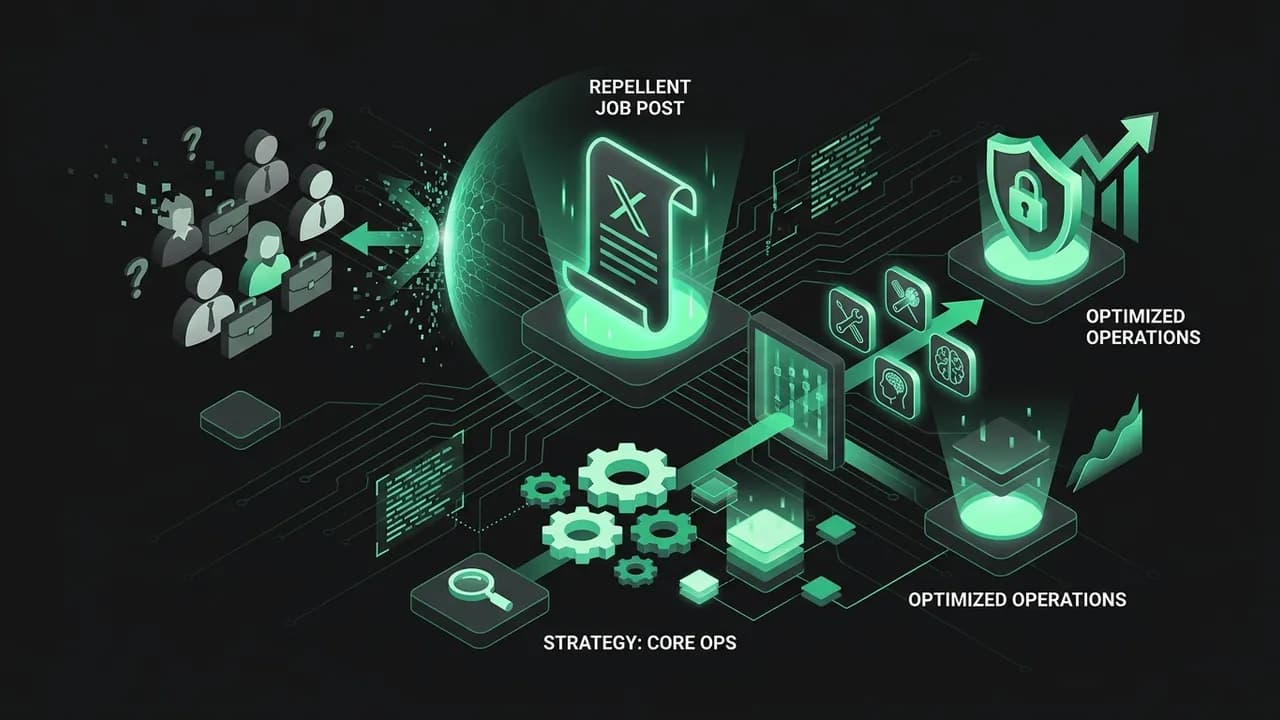
Most startup job posts try to sound like Google. This is a mistake. Your job post should be a filter that Repels 99% of people. Great hiring copy does not maximize applicant count. It improves applicant quality by making the role specific, demanding, and honest about the environment. A startup job post should not try to attract everyone. It should attract the people who will actually thrive.
The Execution Rules
Why Repellent Job Posts Work
Repellent posts work because they reveal the real job. They tell candidates whether the role involves ambiguity, ownership, speed, customer contact, weird problem-solving, or stage volatility. The wrong people self-select out. That saves time for both the company and the candidate.
Mission Beats Cosmetic Perks
Top startup candidates are usually more motivated by challenge, learning, ownership, and impact than by generic perk language. Perks are not irrelevant, but they are rarely the main reason strong operators join early-stage companies. Great candidates want clarity on the problem, the stakes, and the expected outcomes.
Describe Outcomes, Not Buzzwords
Role descriptions improve dramatically when they replace abstract requirement lists with concrete outcomes. 'Must know growth marketing' is vague. 'In your first quarter, you will improve demo-to-close conversion by 20% and build a repeatable outbound experiment system' is useful. Outcome framing helps candidates judge fit more honestly.
Trial Work Reveals Reality
Short, paid trial projects are often more predictive than polished interviews because they reveal how a person thinks, communicates, scopes work, handles ambiguity, and incorporates feedback. The point is not free labor. The point is realistic signal. Well-designed trials reduce hiring regret dramatically.
Honesty Creates Better Conversion
A job post should be candid about what is hard. If the company is early, under-resourced, fast-moving, and messy, say so. Hiding the difficulty may increase applications, but it will reduce fit and increase churn after hiring. Honesty is a recruiting advantage because many strong startup candidates actively prefer reality over employer-brand theater.
Filters Should Be Thoughtful, Not Gimmicky
Secret instructions and detail checks can be useful when they test care and reading discipline. But they should support the role rather than becoming arbitrary hazing. The best filters resemble the real work: clarity, attention, follow-through, writing quality, prioritization, or problem-solving.
The Job Post Is A Culture Artifact
Candidates infer culture from how the role is described. If the post is vague, inflated, or full of generic startup clichés, they expect the company to operate the same way. If it is sharp, honest, and outcome-oriented, it signals better internal thinking.
Tactic: Include a 'Secret Instruction' in your job post (e.g., 'Change the subject line to your favorite animal'). It instantly filters out 50% of people who don't read instructions. More importantly, write the post so it filters for the kind of thinking and ownership your stage actually needs.
Execution: Decoding the 'Startup DNA' in Interviews
Interviews are often 'Lying Contests.' You must move beyond the resume to find the truth. Interviews become misleading when they reward polish, confidence, and rehearsed narratives more than evidence of how the person actually works. Startup hiring needs signal on ownership, adaptability, judgment, learning speed, and execution under ambiguity.
The Interview Playbook
Why Past Behavior Matters Most
The most useful hiring question is not what someone says they would do. It is what they have already done in comparable conditions. Past examples reveal initiative, tradeoff quality, personal ownership, emotional steadiness, and actual contribution level far better than abstract hypotheticals.
Push Past Team Language
Candidates often hide behind collective language: 'we launched,' 'we improved,' 'we decided.' Interviewers need to separate contribution from association. Ask what the candidate specifically owned, what decisions they personally made, what went wrong, and what they would do differently now. Specificity is usually where truth appears.
Technical Evaluation Should Resemble Real Work
The best assessment often looks like the job. Code review, product critique, debugging, drafting a launch plan, prioritizing a backlog, or rewriting a messy customer response can reveal far more than generic interview puzzles. Realistic evaluation improves signal while also showing candidates how the company thinks.
Backchannel References Need Judgment
Backchannel references can uncover useful context, but they should be used carefully and ethically. The point is not gossip. The point is triangulation. Ask about reliability, collaboration, adaptability, and how the person behaved under pressure. One negative off-record opinion should not dominate the decision, but consistent patterns matter.
Look For Startup Traits, Not Just Prestige
Big logos can create false confidence. The better question is whether the candidate has demonstrated resourcefulness, speed, ownership, and comfort operating without complete instructions. Prestige without startup DNA often leads to expensive disappointment.
Structured Interviews Beat Vibes
Founders are especially vulnerable to hiring on chemistry, similarity, or excitement. Structured interview scorecards reduce that bias by forcing the team to evaluate the same dimensions across candidates. This improves fairness and sharpens comparison quality.
Red Flags Are Usually Behavioral
Some of the strongest warning signs are not technical at all: blame shifting, vagueness about personal contribution, disrespect to non-obvious team members, defensiveness under challenge, and inability to discuss mistakes clearly. Startups pay heavily when they ignore those signs because the team is too dazzled by resume quality.
Tooling: Use Ashby or Lever for tracking candidates. Use Metaview to record and summarize interviews using AI so you can focus on the person, not the notes. The real edge comes from designing interviews that surface evidence instead of rewarding performance.
Case Study and Pitfalls: The 'Big Tech' Hiring Trap
Case Study: The VP of Engineering from Google
A Seed-stage startup hired a VP of Engineering from Google who managed 200 people. They gave them $200k salary and 2% equity. The VP spent their first 3 months building a 'Strategy Deck' and asking for a $500k budget to hire 10 more people. They never wrote a line of code. The startup ran out of money. They proved that Managerial Excellence is not the same as Startup Execution.
Why Prestige Misleads Founders
Prestige creates narrative comfort. Hiring someone from a famous company makes the startup feel more legitimate. But legitimacy is not the same as utility. The company needs someone who can win in its current environment, not someone whose resume signals success in an environment with totally different systems, resources, and constraints.
The 'Hiring' Pitfalls
The 'Culture Fit' vs. 'Culture Add' Error: Hiring people who are just like you. Fix: Hire for people who share your values (Topic 102) but bring a different 'Skill-Set' or 'Perspective.'
Ignoring the 'Soft' Signals: The candidate was brilliant but treated the office manager poorly. Fix: If it's not a 'Hell Yes,' it's a 'No.'
Hiring Too Fast: Adding headcount to solve a problem that should have been automated (Topic 91). Fix: Attempt to automate every new role for 30 days before hiring a human.
Confusing Experience With Adaptability: Assuming years of experience automatically mean startup readiness. Fix: test for learning speed, ambiguity tolerance, and willingness to operate hands-on.
No Clear Success Definition: Hiring before the company can articulate what success looks like in 30, 60, and 90 days. Fix: define role outcomes before opening the search.
What Healthy Hiring Looks Like
Healthy startup hiring feels selective, evidence-based, and stage-aware. The company knows what kind of person it needs, what environment that person will enter, and how to test real fit. Hiring slows down enough to avoid obvious mistakes but stays practical enough to keep momentum.
Questions Before Opening A Role
The Final Principle
The best startup hiring strategy is not about copying elite-company talent patterns. It is about matching human DNA to company stage. When that match is right, ordinary-looking hires often create extraordinary leverage. When it is wrong, even impressive candidates can become expensive drag.
The 'Hiring' Challenge: Audit your current team. Who are your 'Pirates' and who are your 'Navy Seals'? If you have too many 'Settlers' but are still in 'Discovery Phase,' you have a misalignment. Focus your next hire on the DNA your stage requires today.
Key Takeaways
Hire generalists early for flexibility; bring in specialists only once a function becomes a repeatable bottleneck.
Screen for startup DNA (ownership, ambiguity tolerance, learning speed), not just skills or pedigree.
Write a 'repellent' job post that tells the hard truth so candidates self-select.
Beware the big-tech trap: ask whether a candidate thrived because of the system or in spite of it.
Use a structured scorecard tied to the role's real first-year work instead of gut-feel interviews.
Frequently Asked Questions
What is the difference between hiring generalists and specialists?
When should a startup hire a specialist instead of a generalist?
What is startup DNA in hiring?
What is a repellent job post and why use one?
What is the big tech hiring trap?
What are common startup hiring mistakes?
Your Turn: The Action Step
Hire Scorecard Worksheet
Define your next hire's exact scope, decide generalist vs specialist, and build the interview scorecard that screens for startup DNA.
Name the role and its outcomes
Forget the title. Write the 2-3 concrete outcomes this person must deliver in 90 days.
Pick the archetype
Generalist (breadth, ambiguity) or specialist (depth, a known bottleneck)? Justify it against your stage.
Write a 'repellent' job post
Add one honest line that scares off the wrong people (the comfort-seekers) and attracts the right ones.
Build the interview scorecard
List the competencies every interviewer will rate 1-5. Include at least one 'startup DNA' row.
| Competency | What 'great' looks like | Weight |
|---|---|---|
Decode startup DNA
Write the behavioural question and the answer that proves they thrive in chaos.
Set the decision rule
Define the bar before you meet anyone, so you don't talk yourself into a weak hire.
Before you close this
0/5 doneYour answers are saved in this browser only. Use “Download as PDF” to keep a copy.
Your Startup Data Is Useless Until You Do This
Ready to apply this?
Stop guessing. Use the Litmus platform to validate your specific segment with real data.
Build Your Team