Supply Chain 101: Mastering Inventory and Logistics
Stockouts cause lost revenue; overstock causes dead cash. This 3,000-word guide masters the 'Inventory Turn Optimizer' to help you build a lean, resilient physical goods empire.

Strategy Framework: The Inventory Turn Optimizer
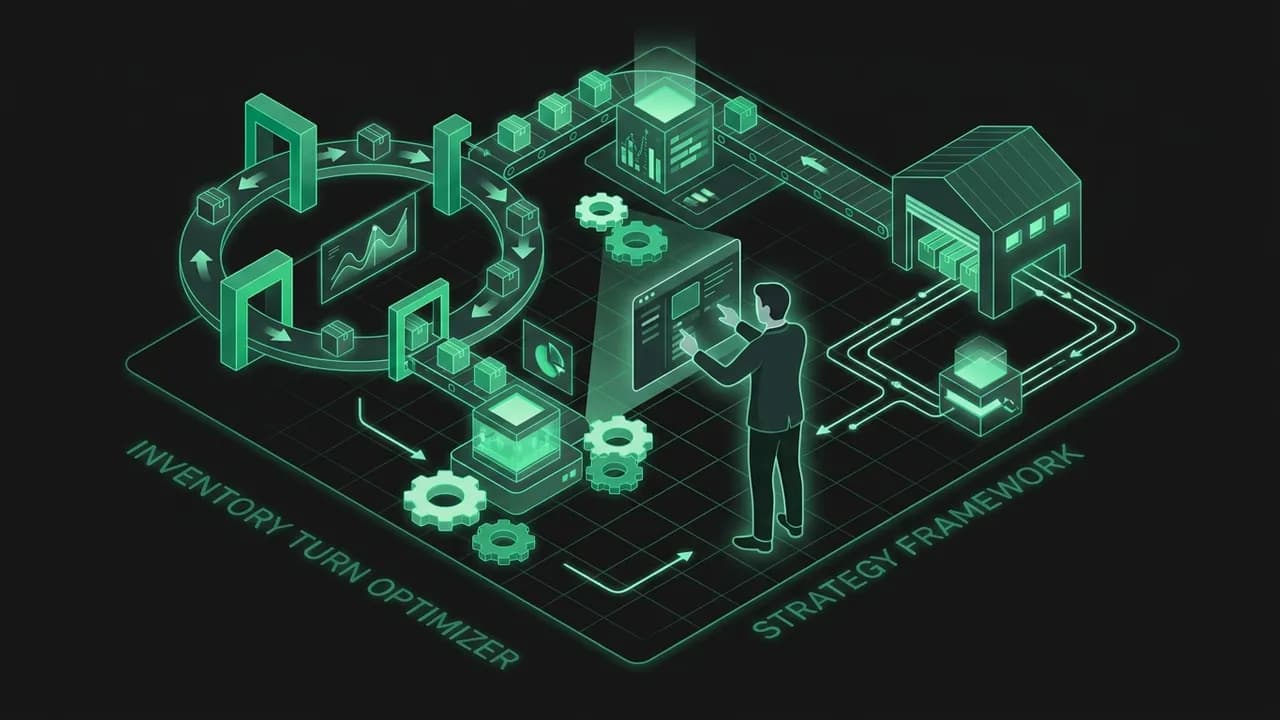
In 2026, 'Just-in-Time' is dead; 'Just-in-Case' is too expensive. We use the Inventory Turn Optimizer to find the profitable middle ground. The goal is not simply to keep shelves full. The real goal is to convert inventory into revenue quickly without creating service failures, margin leaks, or cash-flow stress. Inventory is one of the few business assets that can feel productive while silently weakening the company. Boxes in a warehouse can create the illusion of preparedness, but if they do not move at the right velocity, they behave more like trapped capital than operational strength.
The Components
Inventory Turnover Ratio: (Cost of Goods Sold) / (Average Inventory). A high ratio means you are selling fast; a low ratio means your cash is rotting in a warehouse.
Lead Time Buffer: The delay between clicking 'Order' from your factory and the product hitting your warehouse. In 2026, you must account for 'Geopolitical Volatility' in this buffer.
Safety Stock: The 'Insurance' inventory you keep to prevent stockouts during demand spikes.
The Reorder Point (ROP): (Lead Time Demand) + (Safety Stock). This is the 'Trigger' that automates your purchasing (Topic 91).
Why Inventory Is A Cash Problem First
Many founders initially treat supply chain as an operations function, but at startup stage it is really a capital allocation function. Every unit you buy before demand is proven competes with marketing spend, hiring capacity, product improvement, and runway. That is why inventory discipline matters even more for young ecommerce businesses than for mature retailers. Mature retailers may survive a bad seasonal buy. Startups often do not.
The Hidden Cost Stack
Unsold inventory hurts more than most spreadsheets show. The obvious cost is the cash paid to acquire the goods, but the real cost stack also includes storage fees, insurance, damage, shrinkage, obsolescence, discounting, and opportunity cost. Slow inventory also creates management noise because the team spends time rescuing bad purchases rather than improving the business. A strong operator learns to see inventory as a living financial instrument, not as a static warehouse count.
The Healthy Middle Ground
The phrase 'optimize turns' does not mean 'maximize turns at any cost.' Some founders push too hard toward lean inventory and end up paying through stockouts, emergency shipping, and marketplace ranking damage. Others overcorrect by buying too much in the name of certainty. The profitable middle is achieved when the team understands demand variability, lead-time reliability, and margin sensitivity by SKU. Different products deserve different inventory rules. A hero SKU with stable demand may support aggressive automation. A seasonal or trend-sensitive SKU needs much more caution.
Segment Inventory By Behavior
Not every SKU should be managed the same way. A practical model is to separate products into four groups:
This segmentation matters because reorder frequency, safety stock, and supplier strategy should vary across groups. Core winners deserve the most rigorous monitoring because they drive both cash generation and customer trust. Long-tail products should face harsher survival tests because they often consume disproportionate working capital for relatively little contribution.
Lead Time Is Not One Number
Founders often underestimate how messy lead time really is. It is not a single interval. It includes production time, inspection time, port delays, customs clearance, inland freight, receiving, put-away, and system updates. A product with a nominal 35-day lead time may behave like a 52-day lead time in reality once variability is included. That is why average lead time is less useful than lead-time range. Operational resilience depends on planning around variance, not optimism.
Safety Stock Should Be Earned
Safety stock is not random extra inventory. It should be based on real uncertainty. If demand is predictable and suppliers are consistent, safety stock can stay modest. If demand spikes unexpectedly or suppliers miss promised dates, safety stock must increase. Good operators revisit safety stock after each disruption rather than preserving the same assumptions forever. Every stockout and every overstock event is data that should improve the next planning cycle.
The Reorder Point As A Decision Trigger
The reorder point is powerful because it removes emotional purchasing behavior. Without a clear trigger, teams reorder when anxiety rises, not when the data says it is time. That leads to lumpy buys, overcorrection, and supplier confusion. A clean ROP process creates discipline: demand rate, lead-time expectation, and safety stock combine into a repeatable threshold. As the company matures, this threshold can be adjusted for promotional calendars, marketplace events, and freight capacity constraints.
The Inventory Review Rhythm
The best inventory systems are boring in a good way. They rely on a weekly rhythm where the team reviews stock coverage, inbound delays, margin by SKU, projected stockout dates, and planned purchase orders. Monthly reviews are often too slow for fast-moving ecommerce. Daily reviews are too noisy for strategic decisions unless the business has very high volume. Weekly is usually the right cadence for early-stage teams because it balances urgency and perspective.
What Good Inventory Operations Protect
Good inventory management protects:
The Strategy: Aim for 8-12 Turns per year. If you turn slower than 4 times, you are a 'Bank' for your supplier; if you turn faster than 15 times, you are likely losing sales to stockouts. The real win is not extreme lean inventory. It is controlled inventory that converts capital into revenue with minimal waste.
Strategy: The 3PL vs. Self-Fulfillment Matrix

As you scale, the 'Living Room Warehouse' will break. You must choose between Control and Scalability. This decision is less about pride and more about economics, service level, and operational focus. Founders often wait too long to formalize fulfillment because self-shipping feels cheaper. Sometimes it is cheaper in direct cash terms, but once order volume rises, the hidden cost appears in distraction, labor volatility, shipping inconsistency, and customer support friction.
The Execution Rules
What Self-Fulfillment Teaches You
Early self-fulfillment is not just a bootstrap tactic. It is customer research. You learn how long packing actually takes, which products generate return confusion, which packaging materials fail, which orders are error-prone, and where shipping costs become ugly. You also experience what customers actually receive, not what you imagine they receive. That operational intimacy is valuable and often missing when founders outsource too early.
When Self-Fulfillment Starts Breaking
The system usually breaks before founders admit it. Signs include:
When these symptoms appear, the real issue is not inconvenience. It is that fulfillment is beginning to distort the rest of the business. At that point the question is not whether to professionalize, but how.
How To Evaluate A 3PL Properly
Many brands choose a 3PL based on pitch decks and logo slides instead of operational fit. The right evaluation criteria are much more specific:
The worst 3PL decisions happen when teams optimize for headline shipping rates while ignoring error rates and exception handling. Cheap fulfillment that creates refunds, replacements, and customer distrust is not cheap.
The Economics Behind The Decision
A useful comparison is to evaluate fulfillment in fully loaded terms. Self-fulfillment cost is not just postage plus packaging. It also includes labor, managerial attention, software, space, error correction, and the cost of founders doing warehouse work instead of building distribution. Likewise, 3PL cost is not just storage and pick-pack. It includes integration work, onboarding time, minimums, and the discipline required to transmit accurate inventory and order data. The right decision depends on which model creates the better service level with the lower total cost of complexity.
Why Multi-Node Fulfillment Matters
Regional load balancing can be a major margin lever. If all inventory ships from one coast, delivery times rise and zone-based carrier charges eat into contribution margin. Splitting inventory across regions can reduce average shipping cost and improve delivery promises, but it must be managed carefully. If you over-fragment inventory, you increase transfer complexity and stockout risk by node. A good operator starts with a simple network and adds nodes only when order density justifies it.
The Transition Playbook
The move to a 3PL should be treated like a controlled migration, not an overnight switch. Start with a pilot SKU set or a limited region if possible. Validate receiving accuracy, pick accuracy, carrier selection logic, tracking synchronization, and returns flow before fully scaling volume. The point of a transition is not just to turn operations over. It is to preserve trust while changing infrastructure.
The Service-Level Metrics That Matter
Once outsourced, fulfillment should be managed by metrics rather than hope. Track:
If the company cannot see those metrics, it cannot really manage the relationship.
Tactic: Implement 'Regional Load Balancing.' Split your inventory across 3 warehouses (East Coast, West Coast, Central) to reduce shipping times and costs. In 2026, '2-Day Shipping' is expected, not a bonus. But only add network complexity when the order map and margin profile clearly justify it.
Execution: Navigating Global Sourcing and Customs
Buying from Alibaba is easy; building a reliable supply chain is hard. Global sourcing punishes naive optimism. The cheapest quote is rarely the cheapest outcome, and the smoothest first order often tells you very little about how the supplier behaves when demand increases, defects rise, or freight conditions deteriorate. That is why sourcing must be treated as an operating system made of supplier strategy, QC discipline, payment control, and logistics visibility.
The Sourcing Playbook
Supplier Evaluation Beyond Price
Good supplier selection balances price, consistency, communication quality, capacity, defect history, and willingness to solve problems. A factory that answers quickly, documents changes clearly, and escalates issues honestly may create more value than one that wins the quote sheet by three percent. The reason is simple: surprises in production and freight are inevitable. The supplier’s quality is revealed by how they handle variance, not by how they behave in perfect conditions.
The Importance Of Samples And Pilot Orders
Samples are necessary but insufficient. Many factories produce beautiful samples and inconsistent bulk runs. That is why pilot orders matter. A pilot order tests packaging quality, labeling discipline, carton specs, documentation accuracy, and lead-time reliability under more realistic conditions. Before placing a major PO, founders should ask: did the supplier deliver the pilot with the same discipline they promise for scale?
Quality Control As A System
QC should not depend on vibes or trust. It should include explicit defect thresholds, inspection checklists, packaging standards, barcode requirements, carton labeling rules, and approval gates. If those specifications are not written, the supplier will fill in the blanks with whatever is easiest operationally. Many startup quality issues come from ambiguity rather than malice. Clear written specs are one of the highest-leverage supply chain documents a company can create.
Landed Cost Is The Truth
The landed cost framework is essential because it stops founders from making false margin assumptions. Unit price alone is meaningless if duties, freight, packaging, prep fees, and domestic delivery radically change profitability. A product that looks highly profitable at factory-gate pricing may become mediocre once all downstream costs are included. Teams should calculate landed cost by SKU and revisit it every time freight conditions, tariffs, packaging dimensions, or supplier terms change.
Customs And Compliance Discipline
Customs is where sloppy operators lose both money and time. Inaccurate documentation, poor HS code classification, missing certificates, or unclear importer responsibilities can create delays that destroy availability plans. Founders do not need to become customs brokers, but they do need a documented chain of responsibility for commercial invoices, packing lists, broker coordination, and compliance requirements by region. The test is simple: if your operations lead disappears for a week, can the rest of the team still move a shipment through the system?
Freight Strategy Matters
Air freight, sea freight, and local replenishment should not be treated as interchangeable. Air can save revenue during emergencies, but it can also destroy margins if used routinely. Sea lowers cost but increases forecasting risk. A healthy supply chain often uses a blended strategy where core demand travels by planned ocean shipments while tactical top-ups are reserved for genuine exceptions. The founder’s job is to ensure that emergencies remain exceptional rather than becoming the business model.
Visibility And Exception Management
Supply chain visibility tools are useful only if they drive action. It is not enough to know that a shipment is delayed. The team must also know what to do next: reprioritize ad spend, throttle promotions, split stock across channels, notify customers, or place an emergency reorder. Visibility without decision pathways creates dashboards, not operational resilience.
Tooling: Use Anvyl or SourceDay for supply chain visibility. Use Flexport for freight forwarding. Use Skubana or Linnworks to sync inventory across Shopify, Amazon, and your 3PL. The software matters less than the discipline to treat sourcing, freight, and customs as a managed system rather than a sequence of hopeful transactions.
Case Study and Pitfalls: The 'Bullwhip Effect' and the $1M Overstock
Case Study: The Viral Gadget Failure
A startup had a viral TikTok hit. They panicked and ordered 100,000 units from China to avoid stockouts. By the time the ship arrived (3 months later), the trend was over. They were left with $1M in inventory they couldn't sell. They proved that Unvalidated demand is the most dangerous input to a supply chain. The real failure was not enthusiasm. It was treating short-term signal as stable demand and converting a marketing spike into a long-duration balance-sheet commitment.
Understanding The Bullwhip Effect
The bullwhip effect happens when small shifts in consumer demand become exaggerated as they move upstream through the supply chain. A modest spike in orders can cause a brand to overforecast, a distributor to overreact, and a supplier to allocate capacity based on inflated assumptions. By the time reality corrects, everyone is holding too much stock or the wrong stock. Startups are especially vulnerable because they often have weaker data, less historical context, and more emotional decision-making around growth spikes.
Why Founders Overbuy
Overbuying is rarely just a math error. It is often driven by fear:
Those fears are understandable, but if purchasing is driven by fear rather than scenario planning, inventory quickly becomes a liability. Strong operators respond to upside by modeling several demand cases rather than committing to a single heroic forecast.
The 'Supply Chain' Pitfalls
The 'Single Point of Failure' Error: Relying on one factory in one city. Fix: Use the 'Rule of Three' and diversify your geographic risk.
Ignoring 'Dimensional Weight': Selling a light but bulky product and getting killed on shipping costs. Fix: Optimize your packaging (Topic 87) to fit the smallest possible Tier.
The 'Stockout' Spiral: Losing your Amazon ranking because you ran out of stock for 5 days. Fix: Set 'Low Stock Alerts' (Topic 91) at 20% above your ROP.
Promotion Without Capacity Planning: Launching creator campaigns or discounts without confirming inventory and fulfillment readiness. Fix: align marketing calendars with procurement and warehouse capacity reviews.
Channel Conflict In Allocation: Letting one marketplace consume all available stock while higher-margin channels starve. Fix: create explicit inventory allocation rules by channel and contribution margin.
What Recovery Looks Like
When a team is already sitting on too much inventory, the answer is not always a panic discount. Recovery can include bundling, channel reallocation, packaging adjustments, revised reorder cadence, negotiated payment relief with suppliers, and selective liquidation of the weakest SKUs. The goal is to free cash without damaging the brand more than necessary. The best recovery plans treat excess inventory as a portfolio problem, not a single markdown event.
Practical Operating Questions
Ask these questions every month:
The Final Principle
Great supply chains are not built on certainty. They are built on measured assumptions, scenario planning, and disciplined review. The founders who win are not the ones who avoid every disruption. They are the ones who can detect risk early, rebalance quickly, and protect cash while maintaining service.
The 'Supply Chain' Challenge: Calculate your 'Landed Cost' for your top SKU today. Compare it to your sale price. Is your margin healthy enough to survive a 20% increase in shipping costs? If not, you need to renegotiate with your supplier or optimize your packaging immediately.
Key Takeaways
Track inventory turnover (COGS / average inventory) and benchmark it against your category.
Set reorder points and safety stock on proven movers to avoid both stockouts and dead stock.
Self-fulfill early for control; switch to a 3PL once fulfillment complexity distracts from growth.
Forecast to real demand, not optimism, to avoid the bullwhip effect and overstock cash drains.
Plan inventory ahead of sale spikes (e.g. Big Billion Days) so bestsellers never go out of stock.
Frequently Asked Questions
What is inventory management?
How do you calculate inventory turnover?
Should an ecommerce startup use a 3PL or self-fulfill?
What is the bullwhip effect?
What are good inventory management examples?
What are common inventory management mistakes?
Your Turn: The Action Step
Inventory & Reorder Worksheet
Calculate the reorder point and safety stock for your key SKUs so you never stock out of a bestseller or drown in dead inventory.
Pull demand and lead time per SKU
For your top SKUs, record average daily sales and the supplier's real lead time in days.
| SKU | Avg daily sales | Lead time (days) |
|---|---|---|
Set safety stock
Decide a buffer per SKU to cover demand spikes and supplier delays.
| SKU | Safety stock (units) | Why this much |
|---|---|---|
Compute reorder points
Formula: Reorder Point = (avg daily sales x lead time) + safety stock. Fill it for each SKU.
| SKU | Reorder point (units) | Reorder qty |
|---|---|---|
Calculate inventory turns
Formula: Turns = annual COGS / average inventory value. Below 4x usually means cash is trapped.
Decide 3PL vs self-fulfilment
Score both on cost-per-order, speed, and your time. Pick the one that scales.
| Factor | 3PL | Self-fulfil |
|---|---|---|
Flag the bullwhip risk
Note where over-ordering on a hype spike could leave you with dead stock.
Before you close this
0/5 doneYour answers are saved in this browser only. Use “Download as PDF” to keep a copy.
Stop Hiring Talent. Start Building It.
Ready to apply this?
Stop guessing. Use the Litmus platform to validate your specific segment with real data.
Optimize Your Chain