Blue Ocean Strategy: Creating New Customer Segments
Stop bleeding out in highly competitive, commoditized markets. Learn how to invent a new category where you are the only option.
The Problem: Bleeding Out Massively in the Terrifying Red Ocean
Most incredibly promising, highly funded startups die a incredibly slow, utterly agonizing, highly expensive death entirely because the founders willingly, foolishly choose to aggressively fight a massive war they can absolutely mathematically never win.
Imagine you are a highly ambitious founder in 2026, and you excitedly decide to launch a brand new, incredibly sleek email marketing software. You confidently look at the absolutely massive, incredibly deeply entrenched incumbents like Mailchimp, Klaviyo, and ConvertKit, and you excitedly say to your small, highly talented engineering team: "Our amazing new software will simply have exactly 10% more incredibly cool features, a slightly significantly better, modern UI, and we will incredibly confidently charge exactly 10% less than all of them!"
You have absolutely just willingly, foolishly jumped entirely headfirst into an incredibly terrifying, totally boiling Massive Red Ocean.
A massive Red Ocean is a completely existing, highly strictly defined, incredibly heavily saturated market space. The absolute boundaries of the massive industry are completely accepted by absolutely everyone, the exact rigid rules of the highly competitive game are entirely known, and the incredibly massive market is totally crowded with incredibly massive, incredibly heavily funded incumbents who completely have massive economies of scale that you absolutely, fundamentally cannot ever possibly match.
In a terrifying Red Ocean, massive companies incredibly fiercely, totally violently compete constantly for the exact same incredibly shrinking pool of highly exhausted existing customers. Because the core, fundamental products are completely, largely identical, highly commoditized utilities, the absolute only actual way to successfully win is to wildly engage in a terrifying, totally destructive race to the absolute bottom on pure price, or foolishly spend hundreds of massive millions of incredibly precious venture capital dollars on highly expensive advertising simply to desperately shout slightly louder than the incredibly loud competition. The dangerous water turns incredibly "red" entirely from the massive blood of companies deeply engaged in completely cutthroat, incredibly margin-destroying, totally useless competition.
The Incredibly Fatal Feature-Matching Trap:
When you bravely enter a massive Red Ocean as a tiny, highly scrappy startup, you immediately, inevitably fall entirely into the incredibly fatal Feature-Matching Trap. If massive Salesforce or massive HubSpot happily releases a highly advanced new AI analytics dashboard on a random Tuesday, you incredibly quickly feel immense, utterly terrifying pressure from your board to frantically spend the entire next 3 massive months completely building a highly similar AI analytics dashboard simply just to barely maintain the absolute illusion of "parity." You are completely letting your massive, uncaring competitors absolutely dictate your entire precious engineering roadmap. You are entirely playing their incredibly established, highly expensive game, but with an incredibly tiny fraction of their massive budget and huge team size. You will absolutely, invariably, completely lose your entire company.
Key Concepts: The Incredibly Powerful Blue Ocean Philosophy

The completely brilliant, highly strategic alternative to this terrifying, incredibly bloody bloodbath is the incredibly famous Blue Ocean Strategy, based entirely on the highly influential, incredibly seminal business framework brilliantly developed by W. Chan Kim and Renée Mauborgne.
An incredible Blue Ocean is an entirely brand new, completely utterly uncontested, highly massive market space. In a beautiful Blue Ocean, you absolutely do not ever try to pointlessly beat the massive competition on their own deeply entrenched terms—you completely make the massive competition completely, totally, and utterly irrelevant. You brilliantly invent an entirely new, incredibly massive category where you are the absolute, totally undisputed, highly lucrative monopoly on absolute Day 1, entirely simply because absolutely no one else is currently playing your completely new game.
Incredible Value Innovation: Completely Breaking the Value-Cost Tradeoff
In a highly traditional, incredibly bloody Red Ocean, completely conventional corporate strategy strictly dictates that you absolutely must clearly choose a definitive side: either actively create significantly higher value at a significantly much higher cost (the highly exclusive luxury tier), or actively create somewhat reasonable value at a significantly much lower cost (the highly competitive budget tier).
Brilliant Blue Ocean Strategy strongly argues for a completely revolutionary concept called Incredible Value Innovation: successfully achieving a truly massive, undeniable leap in total value for the actual buyer while incredibly simultaneously drastically driving down your own massive operational costs. You successfully do this completely counter-intuitive, highly brilliant maneuver by incredibly aggressively eliminating the entirely bloated, incredibly expensive features the stagnant industry falsely blindly considers "absolutely standard," and massively, incredibly increasing the very few core, essential features your highly specific niche absolutely actually desperately cares about.
The Completely Classic, Highly Brilliant Cirque du Soleil Example:
The massive circus industry in the highly competitive 1980s was a completely dying, highly incredibly unprofitable, terrifying Red Ocean. Massive Ringling Bros was absolutely bleeding massive money constantly trying to highly expensively maintain highly controversial, incredibly expensive animal acts, constantly exhaustingly touring globally, and totally fruitlessly competing desperately for distracted children's fleeting attention against the massive, unstoppable rise of highly addictive home video games.
Brilliant Cirque du Soleil looked deeply at the incredibly dying industry and completely created a massive, highly profitable Blue Ocean. They completely, entirely eliminated the highly expensive, highly controversial animals (massively slashing incredibly massive operational costs and terrible controversy). They completely eliminated the incredibly expensive, highly demanding star human performers. Instead, they beautifully added highly artistic, entirely original music, incredibly sophisticated theatrical, highly emotional storylines, and completely adult-oriented, highly mature themes. They completely stopped foolishly competing for easily distracted children and entirely started successfully competing with highly expensive, incredibly popular Broadway shows. They confidently charged exactly 3x the high price of a totally normal, incredibly cheap circus ticket, massively dramatically lowered their total operational costs, and incredibly successfully completely captured an entirely brand new, highly massive demographic of highly wealthy adults who had absolutely never intentionally been to a standard circus in their entire lives.
The Strategy: Flawlessly Executing The Brilliant ERRC Grid (Eliminate, Reduce, Raise, Create)
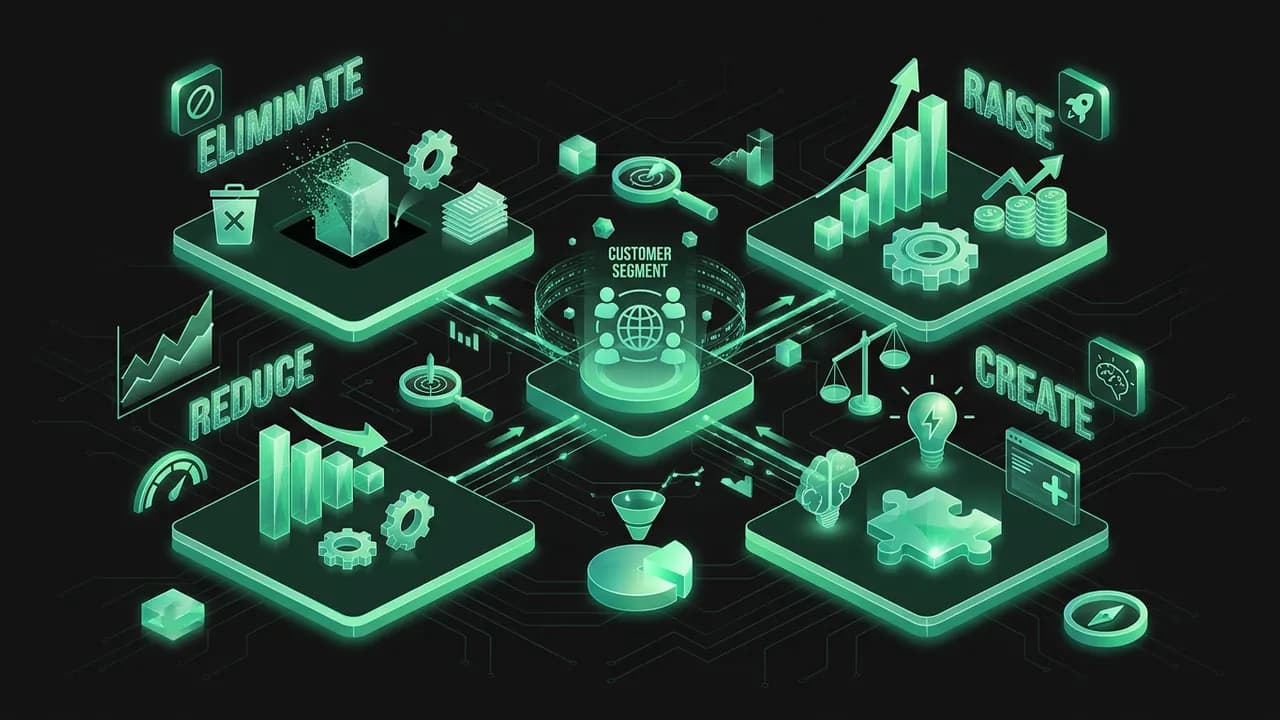
Exactly how do you successfully, practically, highly effectively engineer a massive, highly profitable Blue Ocean for your entirely modern B2B SaaS or highly ambitious B2C startup? You absolutely cannot just casually brainstorm on a whiteboard; you absolutely must rigorously, heavily run your entire core product concept entirely through the highly rigorous, completely objective Brilliant ERRC Grid.
You look incredibly deeply at the totally standard, completely unquestioned, highly bloated assumptions of your incredibly current massive industry and ask exactly four absolutely ruthless, highly structural questions:
1. COMPLETELY ELIMINATE: Exactly what massive factors should be completely, entirely eliminated that the massive industry has foolishly long entirely taken completely for granted?
Look incredibly closely at the absolutely massive legacy competitors. Exactly what highly expensive, totally useless features are they foolishly spending massive millions of dollars constantly maintaining that their highly frustrated customers actually completely secretly hate or entirely, totally ignore?
Absolute Incredible Example: When brilliant Yellow Tail wine originally launched in the highly saturated, totally snobby US market, they completely eliminated the highly snobby, incredibly complex wine terminology right on the actual bottle and the highly expensive, totally time-consuming aging process. They brilliantly realized most totally average Americans simply just completely wanted a highly fun, incredibly easy-to-drink alcoholic beverage, absolutely not a highly complex, totally intimidating sommelier lesson. They completely eliminated the entire pretension and massive cost.
2. DRASTICALLY REDUCE: Exactly what massive factors should be incredibly drastically reduced well completely below the bloated industry standard?
What are massive competitors currently hopelessly over-engineering just to completely pointlessly beat each other in highly complex, totally useless feature-comparison charts?
Absolute Incredible Example: A totally modern, highly minimalist B2B CRM might aggressively, drastically reduce the incredibly heavy, highly complex reporting dashboards and massive permission settings that absolutely only Fortune 500 CFOs actually care about, completely stripping the UI entirely down to pure, highly unadulterated, incredible speed specifically for solo, highly fast-moving founders who hate complexity.
3. MASSIVELY RAISE: Exactly what specific factors should be incredibly massively raised well entirely above the completely terrible industry standard?
What highly specific, incredibly important element of the total customer experience has been entirely, completely neglected by the massive incumbents entirely because they are entirely too heavily focused on massive enterprise feature bloat?
Absolute Incredible Example: Incredibly massively raising the absolute quality of total human customer support. While absolutely massive tech companies heavily force highly frustrated users into absolutely infuriating, completely endless AI chatbot loops to strictly save money, a brilliant Blue Ocean startup might entirely guarantee a highly perfect, totally human 5-minute actual human response time directly via Slack for every single incredibly important customer.
4. ENTIRELY CREATE: Exactly what entirely new factors should be brilliantly created that the massive industry has absolutely never, ever offered?
This is exactly where true, entirely uncontested, highly massive category innovation actually happens.
Absolute Incredible Example: When massive Robinhood originally launched, they absolutely didn't just slightly reduce incredibly high trading fees; they brilliantly created a completely, entirely commission-free, totally mobile-first, incredibly game-like trading experience, immediately successfully pulling in a truly massive demographic of millions of totally young people who had absolutely never bought a single corporate stock before.
Execution: Aggressively Targeting the Highly Ignored 'Non-Customers'
In a highly bloody, entirely terrifying Red Ocean, massive companies incredibly fiercely fight endlessly over the exact same exhausted existing customers directly in the absolute center of the highly saturated market. In a highly profitable Blue Ocean, you absolutely must totally turn your back entirely on the completely crowded center and incredibly aggressively focus entirely on the completely ignored Non-Customers quietly hovering entirely on the absolute distant edges of the massive market.
There are exactly three highly distinct, completely different tiers of Non-Customers you absolutely must deeply, heavily analyze in incredibly modern 2026:
Tier 1: "Soon-to-be" Non-Customers (The Highly Reluctant Users)
These highly frustrated people currently completely use your massive industry's incredibly standard product, but they absolutely, passionately hate it. They use it entirely purely out of absolutely absolute professional necessity, and the exact second a slightly better, completely simpler alternative beautifully arrives, they will immediately jump ship completely without absolutely any hesitation.
Exactly how to capture them: Read the incredibly angry 1-star reviews of the massive industry leader. Exactly what is the highly specific, incredibly agonizing friction point constantly making them deeply want to desperately leave? Brilliantly build a highly lightweight tool that exclusively only solves that one single massive friction point beautifully perfectly.
Tier 2: "Refusing" Non-Customers (The Completely Intimidated)
These incredibly cautious people have actually actively considered finally using your massive industry's core product in the past, but deeply decided entirely against it completely because it was entirely too incredibly expensive, entirely too highly complex, or totally too incredibly intimidating to actively learn.
Exactly how to capture them: This is the absolute exact brilliant Robinhood strategy. Millions of totally young millennials entirely refused to ever use Charles Schwab entirely because the incredibly complex UI was deeply terrifying, the highly massive minimum balances were far too high, and the incredibly complex fees were totally confusing. Robinhood completely eliminated the totally confusing fees and beautifully created a totally simple UI a 10-year-old could totally easily understand. They successfully entirely captured all the massive Refusers.
Tier 3: "Unexplored" Non-Customers (The Completely Ignored)
These incredibly massive groups of people have absolutely never even remotely considered using your massive industry's standard product entirely because they absolutely don't completely realize it actively applies to their highly specific daily life or incredibly small business.
Exactly how to capture them: Look incredibly closely at entirely, completely different massive industries. Can you brilliantly take a highly incredibly complex B2B workflow tool originally designed exclusively for massive enterprise logistics and incredibly simplify it so beautifully much that a normal high school student eagerly organizing a small local club could happily use it? That completely creates a truly massive, entirely totally untouched, absolutely incredibly beautiful ocean of new, highly loyal users.
Conclusion: Completely Stop Pointlessly Competing, Start Brilliantly Inventing
The absolute ultimate, most incredible flex of a highly successful, incredibly brilliant startup founder is absolutely not pointlessly beating a massive, highly funded competitor in an incredibly exhausting, highly expensive feature war. The absolute ultimate flex is brilliantly making the massive competitor totally look like an incredibly outdated, totally irrelevant, completely slow dinosaur.
Absolutely completely stop entirely compulsively reading your massive competitor's entirely boring release notes. Absolutely stop entirely trying to constantly undercut their massive pricing by exactly $5 just to sadly steal a single customer. Take a massive, brilliant step back, look highly objectively at the incredibly bloated, completely exhausted, deeply entirely complex state of your massive industry, and brilliantly use the highly rigorous ERRC grid to entirely strip it down completely to its absolutely most highly valuable, incredibly powerful essence.
Find the completely terrified people who are absolutely terrified of the highly bloody Red Ocean, beautifully build them a totally simple, incredibly elegant, highly intensely specialized raft, and completely sail away happily into the beautiful, highly profitable Blue Ocean.
Key Takeaways
Win by creating uncontested space, not out-competing rivals in a crowded red ocean.
Use the ERRC grid — Eliminate, Reduce, Raise, Create — to reshape value and cost together.
Target non-customers the industry ignores (Jio's first-time data users; Wii's non-gamers).
Pair a leap in buyer value with lower cost — a different-looking product alone isn't a blue ocean.
Frequently Asked Questions
What is Blue Ocean Strategy?
How do you create a blue ocean with the ERRC grid?
What is the difference between a red ocean and a blue ocean?
What are examples of blue ocean strategy?
What are common blue ocean strategy mistakes?
Your Turn: The Action Step
Blue Ocean ERRC Grid & Non-Customer Map
Use the ERRC grid (Eliminate, Reduce, Raise, Create) to design an offer that opens a new segment of non-customers instead of fighting in a bloody 'red ocean' of rivals.
List the industry's standard factors
What does EVERY competitor in your space offer and compete on?
Run the ERRC grid
Fill all four boxes. The Eliminate box is where blue oceans are born.
| Move | What / which factor |
|---|---|
Map the non-customers
Who is NOT buying in your category today, and why do they refuse?
| Non-customer group | Why they don't buy today |
|---|---|
Sketch the new value line
Write the one sentence that makes a non-customer say 'now I'm in'.
Plot the strategy canvas (low/high)
Rate yourself vs. the industry on each factor to confirm you've diverged.
| Factor | Industry (low/high) | You (low/high) |
|---|---|---|
Before you close this
0/5 doneYour answers are saved in this browser only. Use “Download as PDF” to keep a copy.
Airbnb Did This Before Becoming a Billion-Dollar Brand
Ready to apply this?
Stop guessing. Use the Litmus platform to validate your specific segment with real data.
Perfectly Map Your Incredible Blue Ocean in Litmus