How to Talk to Users Without Being Awkward (The Mom Test)
Stop collecting compliments and start collecting data. Learn how to ask questions that even your mom can't lie to you about.

The Problem: The 'Compliment Trap' and the Illusion of Validation
"Do you like my startup idea?"
This is the single most dangerous, destructive question in the history of entrepreneurship.
Why? Because human beings are fundamentally, biologically wired to be polite and avoid social friction. If you show a friend or a stranger your ugly baby, they will not tell you it is ugly; they will say, "Aww, look at his nose!"
The exact same psychology applies to your startup. If you pitch your brilliant new SaaS idea to a potential customer and excitedly ask if it's good, they will absolutely lie to you to protect your feelings. They will offer effusive compliments like, "That sounds incredibly useful!" or "I would definitely pay $20 a month for that once it launches."
The Fatal Danger of the False Positive:
When a founder hears these polite compliments, they walk away buzzing with dopamine. They run back to their co-founders, open up Jira, and declare, "We have Product-Market Fit! Everyone I talked to loved the idea!"
They proceed to spend the next six months of their lives, and $50,000 of their savings, building the product based entirely on this "validation." But when launch day finally arrives, and the founder emails those exact same people asking them to enter their credit card information... the prospects suddenly ghost them. They stop replying.
The founder didn't ask for the brutal truth; they asked for social validation. And the market delivered social validation, which is entirely different from commercial validation.
Compliments are not data. Facts, historical behaviors, and financial commitments are data. Compliments are fluffy, feel-good vanity metrics that kill early-stage startups by sending them down incredibly expensive blind alleys. If your customer discovery process consists of pitching your idea and waiting for applause, you are not doing market research; you are just seeking expensive therapy.
Key Concepts: The Core Philosophy of The Mom Test
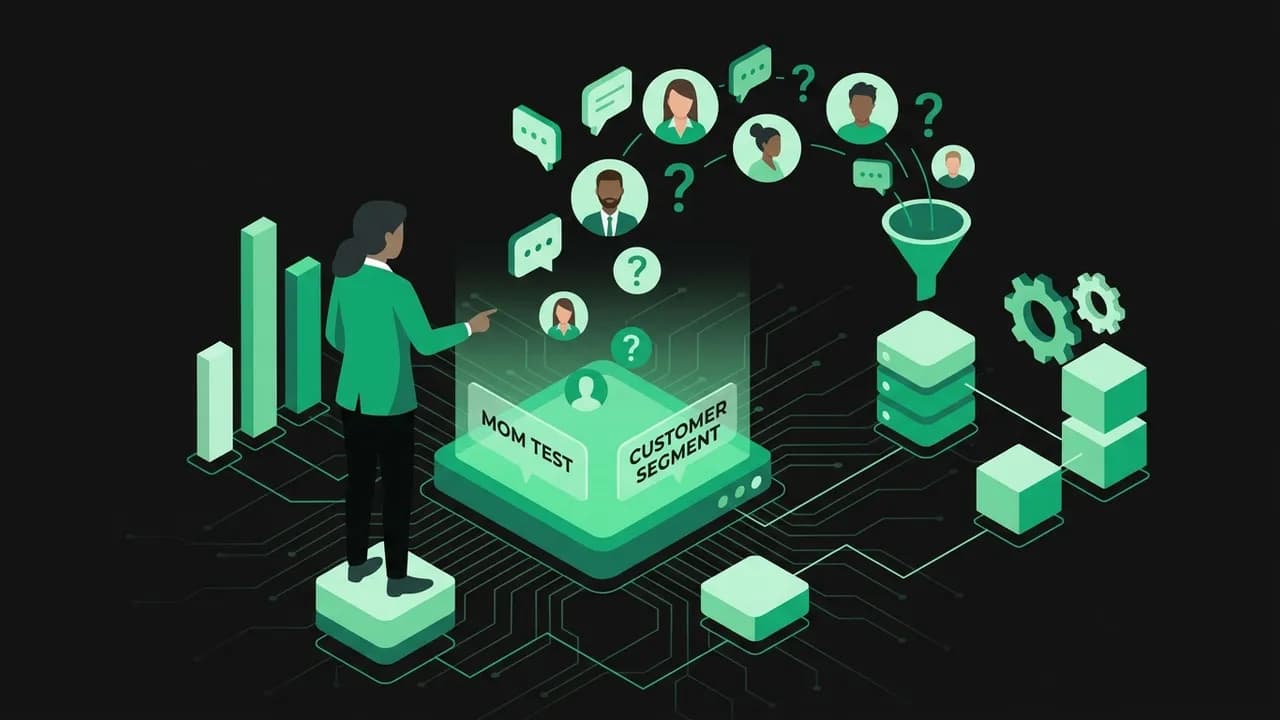
Based on Rob Fitzpatrick's legendary book, The Mom Test is a framework for crafting questions that are so objective, so deeply rooted in historical fact, that even your own mother couldn't lie to you about the answers.
The core philosophy of The Mom Test is brutal but ultimately liberating for a founder: It is not your customer's responsibility to tell you the truth; it is your responsibility to ask good questions.
The 3 Golden Rules of Customer Interviews:
1. Talk about their life, not your idea.
The exact second you mention your "startup idea" or your "solution," the interview is completely compromised. The user's brain instantly switches into one of two unnatural modes: "Critic Mode" (looking for flaws just to sound smart) or "Compliment Mode" (saying it's great to protect your feelings). Hide your idea for as long as humanly possible. Treat the interview like an anthropological study of their daily workflow, not a pitch for your software.
2. Ask about specifics in the past, not generics in the future.
Predictions about the future are polite lies; historical actions are brutal, undeniable facts. Never, ever ask a hypothetical question like, "Would you use this feature?" or "How much would you pay for this?" Human beings are terrible at predicting their own future behavior. Instead, ask, "When was the last time you dealt with this exact problem?" If they haven't actively tried to solve it in the last 6 months, it's not a real problem. They won't buy your solution, no matter how cheap or elegant it is.
3. Talk less, listen more.
Founders love to pitch. They love the sound of their own voice explaining the brilliance of their vision. You must aggressively stop pitching. Ask an open-ended question and embrace the awkward, heavy silence. Let them ramble. The absolute best insights come from the weird, unexpected tangents they go on when you just shut up and listen. Your job is to gently guide the conversation, not dominate it. If you are talking for more than 20% of the interview, you are failing the test.
The Strategy: The 'Bias Filter' for Bad Questions
How do you know if you are about to ask a terrible question? You must run every single question through the Bias Filter before you open your mouth. If the question triggers any of these three biases, rewrite it immediately.
Bias 1: The "I'm a Genius" Bias (Seeking Ego Validation)
Bias 2: The "Feature Request" Bias (The Infinite Roadmap)
Bias 3: The "Hypothetical Wallet" Bias (Fake Money)
The Golden Rule of the Filter:
If the question asks them to imagine the future, delete it. If the question mentions your specific idea, delete it. If the question asks about their past behavior, their actual financial history, and documented struggles, keep it.
Execution: How to Get Strangers on a Call in 2026
You know the rules. You have the right questions prepared. But how do you actually get busy, high-level professionals on a Zoom call without sounding like a sleazy outbound sales rep?
1. The "Student/Researcher" Opening
People instinctively hate salespeople. They put up defensive walls immediately. But human beings universally love feeling smart, and they love helping "students," "researchers," or people seeking their specific expertise.
Frame your outreach strictly as industry learning, never as a sales pitch.
The Cold Email Template:
"Hi [Name], I'm currently researching how modern HR agencies handle the complexities of [Specific Problem]. I'm not selling anything at all—I just want to learn from the best operators in the industry. Your background at [Company] is exactly what I'm studying. Would you have 15 mins next Tuesday for a quick chat? I'd love to hear your perspective."
2. The "5 Whys" Digging Technique
When you finally get them on the call, they will give you surface-level, generic problems. They will say, "Reporting takes too long." Do not stop there. You must dig until you hit bedrock. Use the Toyota "5 Whys" root-cause method.
Now you have struck gold. You know the real problem isn't "reporting time"—the real problem is a cheap CFO refusing to buy APIs. That completely changes your product and pricing strategy.
3. The 'Documented Pain' Threshold
During the call, listen very carefully for active verbs. Did they "Google for a solution"? Did they "hire an intern" just to handle the mess? Did they "build a hacky Zapier integration"?
If they have not taken physical or financial action to solve the problem, the pain is simply an annoyance, not an emergency. You cannot build a startup around an annoyance.
Advanced Tactics: Deflecting Compliments and Feature Creep
Even if you follow the rules perfectly and ask brilliant questions, customers will still naturally try to give you compliments or request bizarre features. You must learn how to parry these safely without alienating the user.
Deflecting the Compliment
If a customer sees your prototype and says, "Wow, this looks amazing! I love it!" do not celebrate. Anchor them violently back to reality.
Your response: "I really appreciate that. But looking critically at your current workflow, where exactly would this tool break? What is the number one reason you and your team would stop using this after a week?"
Force them to take off the rose-colored glasses and put on their critic's hat. You need them to find the fatal flaws before they become reasons for churn.
Handling the Feature Request
If a customer says, "Can you add an integration with Salesforce?" do not say yes. Do not say no. You must unpack the motivation behind the request.
Your response: "That's a really interesting idea. Can you walk me through exactly what you would do with that integration on a Tuesday morning? What specific data are you trying to move, and how often?"
Often, you will find that their requested feature is just a terrible solution to a completely different, simpler problem that you can solve much easier. Customers are experts in their pain, but they are terrible software architects.
The "Magic Wand" Question
To uncover ultimate priorities, use the Magic Wand technique at the end of the interview.
Your question: "If I could wave a magic wand and completely eliminate one frustrating task from your daily routine, what would it be?"
This removes constraints from their thinking and highlights the most emotionally draining part of their job. If your product solves the Magic Wand problem, you have a monopoly.
The Ultimate Commitment Test: Exposing the Truth
The interview has gone well. They talked for 30 minutes about how much they hate their current process. They seem like the absolute perfect customer.
Now, at the very end of the interview—and only at the end—you are finally allowed to reveal what you are building.
But you cannot just say, "I'm building a tool for that, what do you think?" That puts you right back in the Compliment Trap.
You must ask for a Hard Commitment to prove they actually care. A hard commitment proves that their pain is real and they are willing to trade something valuable for your solution.
There are three types of Hard Commitments:
1. Time Commitment
"We are launching the beta next week. It will take about an hour to set up properly. Can we schedule a 60-minute onboarding session for next Tuesday at 2 PM for me to migrate your data?"
(If they suddenly say "I'm too busy next week," they don't actually care about the problem).
2. Reputation Commitment
"This sounds like exactly what your team needs. Would you be willing to introduce me to your VP of Operations tomorrow so I can show them how this affects the budget?"
(If they refuse to make the intro, they don't trust you, or the pain isn't a real priority for the company).
3. Financial Commitment (The Holy Grail)
"We are doing an early-bird beta access program for our first 10 design partners. It's a one-time fee of $50 to lock in lifetime pricing. I can send you the Stripe link right now to reserve your spot."
(If they fumble for their wallet, you have officially validated your business. If they say "Let me think about it," you have a hobby, not a startup).
If they hesitate or back out when asked for a hard commitment, they were lying to you during the entire interview. Their pain was just an annoyance. Thank them for their time, and move on.
Conclusion: Empathy Over Algorithms
In an era where founders are obsessed with AI-generated landing pages, automated outbound sequences, and programmatic SEO, the simple, unscalable act of talking to a human being with deep empathy is your ultimate competitive moat.
The Mom Test isn't just a tactical interview technique; it is a fundamental philosophy of building. It forces you to respect the customer's actual, lived experience rather than your hypothetical, ego-driven vision.
Stop seeking validation. Seek the truth. Every single time a customer tells you "No, I wouldn't pay for that," they just saved you six months of pointless engineering work. Embrace the rejection, refine your questions, and keep digging until you find the bleeding neck. True startup validation does not feel like a warm hug; it feels like cold, undeniable, historical facts.
Key Takeaways
Ask about the customer's past and present behavior, never about your idea or hypotheticals.
Treat compliments as a red flag — look for actions taken and money already spent.
Use short, specific cold DMs to book 15-minute calls; talk less, listen more.
Decode feature requests into the underlying job-to-be-done before you build anything.
Frequently Asked Questions
What is the Mom Test?
How do you interview customers for a startup?
What are good vs bad Mom Test questions?
How do you get strangers on a customer interview call?
What are common customer interview mistakes?
How do you handle compliments and feature requests during interviews?
Your Turn: The Action Step
Mom Test Script Generator & Question Bank
Produce a ready-to-use interview script with zero leading questions, so you collect facts about your customer's life instead of polite compliments about your idea.
Dump your current questions
Write the questions you were about to ask — including the bad, leading ones.
Run them through the Bias Filter
Rewrite each into a question about their past life, not your idea or their opinion.
| Bad / leading question | Mom Test rewrite (about the past) |
|---|---|
Assemble the 5-part script
Fill each slot. Keep your idea OUT of the first three sections.
| Section | Your question(s) |
|---|---|
Write the commitment close
End with an ask for time, intro, or money — the real test of interest.
Set your truth-tracking
Define what counts as a 'signal' vs a 'compliment' before you start calling.
Before you close this
0/5 doneYour answers are saved in this browser only. Use “Download as PDF” to keep a copy.
Why Most Startups Fail Before They Even Launch
Ready to apply this?
Stop guessing. Use the Litmus platform to validate your specific segment with real data.
Log Your Interviews in Litmus