How to Validate a Customer Segment for $0
Founders think they need a finished product or an ads budget to test a market. Learn how to validate your segment using nothing but your time and free tools.
The Problem: The 'Build It and They Will Come' Fallacy and the Cost of Comfort
Human beings naturally default to their comfort zones. For startup founders, this biological instinct is incredibly expensive and often fatal to the company.
If you are a highly talented, introverted software engineer, your natural comfort zone is opening VS Code, putting on noise-canceling headphones, and spending 12 hours a day building incredibly complex, elegant backend features. You feel productive because you are typing code. If you are a brilliant product designer, your comfort zone is opening Figma, obsessively arranging color palettes, and creating pixel-perfect, interactive mockups that look beautiful on a 4K monitor.
This entirely natural human tendency to seek comfort leads directly to the single most expensive, heartbreaking, and pervasive fallacy in the entire global startup ecosystem: The deeply held, completely incorrect belief that you need a finished, polished software product, a beautiful brand identity, or a massive $10,000 Facebook advertising budget just to test whether a market actually exists.
This is a high-cost gamble that almost always ends in silent, agonizing failure. The typical story goes like this: You spend 4 months and your entire life savings on development. You spend another $5,000 on Google ads. You finally launch your masterpiece on Product Hunt... and you are met with absolute, deafening crickets. You realize, far too late, that nobody actually wants what you just built.
Why did this happen? Because you successfully validated your code (it compiles without errors), you validated your design (it looks pretty), but you completely, disastrously failed to validate the market intent. You built a beautifully engineered bridge to a town where absolutely nobody lives.
The Brutal Reality of Startup Validation in 2026:
Validation is entirely about testing Intent, not Features.
In 2026, modern consumers and B2B buyers are ruthlessly, aggressively protective of their time, their overflowing email inboxes, and their personal data. They suffer from massive subscription fatigue and app overload. If you cannot get a specific, targeted customer to simply give you their email address, or agree to 15 minutes of their time for a free discovery call on a Tuesday afternoon, they will absolutely never, ever give you $100 a month for your complex software later.
You do not need a single line of production code to validate a massive problem. You need a targeted conversation, deep, radical empathy, and a hard, undeniable commitment from the buyer.
Key Concepts: Understanding the Currency of Validation
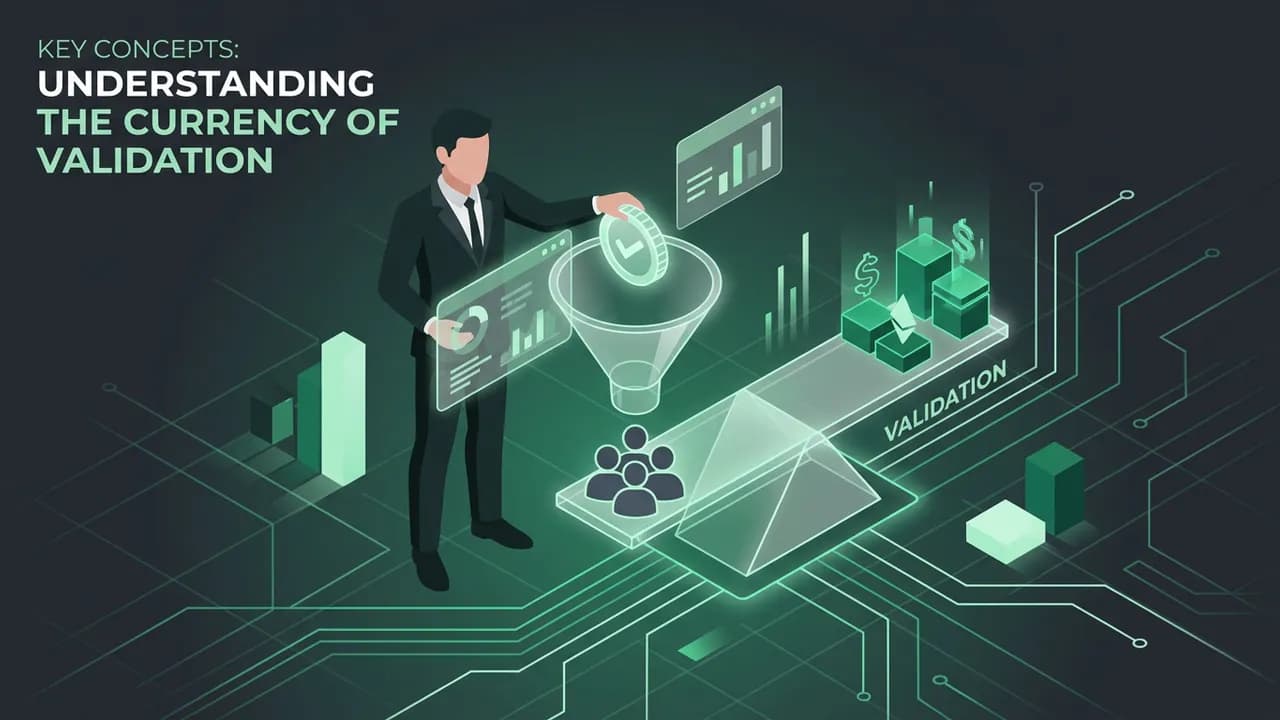
Validation does not strictly require a credit card swipe on day one. It requires extreme resourcefulness, emotional intelligence, and the ability to read behavioral signals. But to effectively measure whether you are actually validating a billion-dollar idea or just collecting polite, useless lies from strangers, you must deeply understand the different tiers of "Startup Currency."
Polite compliments from your friends and family are absolutely worthless. "Likes" and "Retweets" on your Twitter announcement are completely worthless. You are aggressively looking for escalating, costly commitments from a stranger who owes you nothing.
Level 1 Currency: Attention (The Weakest Signal)
They clicked your ad link on Facebook or briefly read your LinkedIn post. This proves that your headline copywriting works, and it proves they find the topic mildly intellectually interesting for 3 seconds, but it does absolutely nothing to prove that your product is a necessity. It is a vanity metric designed to make marketers feel busy. Do not build a startup based purely on clicks.
Level 2 Currency: Data (The Moderate Signal)
They actually gave you their verified, corporate work email address or took 5 minutes to fill out a detailed, 7-question Typeform survey. They are willing to trade a small piece of their personal privacy and inbox sanity because the specific problem you are describing resonates deeply with their daily frustrations. This is the absolute minimum viable signal required to keep exploring an idea.
Level 3 Currency: Time (The Strong Signal)
They proactively agreed to a 20-minute Zoom call during their busy working hours. Time is the single most precious, non-renewable asset a professional has. If a highly paid VP of Marketing or a stressed-out agency founder is willing to get on a video call with a random, unproven startup founder who has no finished product to show, it means their hair is actively on fire regarding the specific problem you claim to solve. They are desperate for a lifeline, and they hope you are holding it.
Level 4 Currency: Reputation or Money (The Absolute Signal)
In B2B enterprise sales, this is a signed, legally binding Letter of Intent (LOI) or a warm, written introduction to their boss (putting their own reputation on the line) to secure future budget. In B2C or SMB sales, this is a literal pre-order, an annual contract paid upfront, or a $50 non-refundable deposit to "reserve their highly exclusive spot in the beta."
Your absolute, singular, obsessive goal in $0 validation is to successfully move a stranger from Attention (Level 1) all the way to Time/Money (Levels 3 & 4) without writing a single line of production code. If you can do that, you have a business.
The Strategy: Executing The '$0 Validation Sprint'
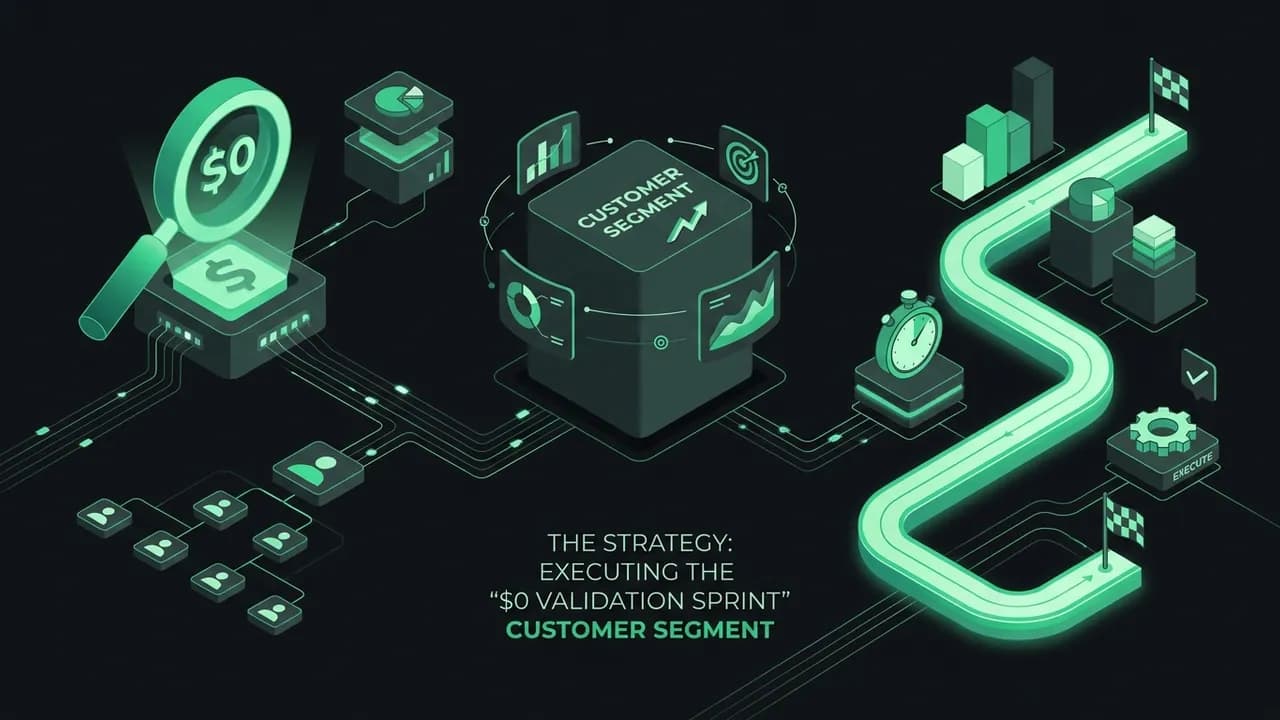
Validation is not a vague, ongoing, 6-month philosophical process where you casually chat with people at networking events; it should be a tight, aggressive, highly structured 5-day sprint. The goal is to mathematically and behaviorally prove that a highly specific segment has a severe pain point and is willing to take physical action to solve it today.
Day 1: The Razor-Sharp Hypothesis Formulation
You absolutely cannot validate a broad, fluffy concept like "helping small businesses grow faster." You must define an extreme, painful, highly constrained niche.
Example Hypothesis: "Boutique Shopify marketing agency owners are actively losing at least 5 hours a week manually compiling client analytics reports from four different, disconnected dashboards, and they will gladly give me 15 minutes of their time if I explicitly promise I am building a solution to automate it."
Day 2: The Safari (Active, Silent Listening)
Go to where these specific people congregate organically on the internet. In 2026, this means hyper-niche, invite-only Slack communities, specific highly technical Subreddits (e.g., r/PPC, r/ShopifyDevelopers), or the LinkedIn comment sections under major industry influencers.
The Golden Rule of the Safari: Do not pitch. Do not post links to your website. Do not ask them to fill out a survey. Just read. Document the exact, emotional vocabulary they use when they complain bitterly about this problem. Do they say "it takes too long" or do they say "I'm bleeding profit margin and my clients are angry"? Steal their exact words. You will use them later.
Day 3: The Smoke Test (Building the Fake Door)
Build a "Fake Door" or a "Painted Door" test. Use a free, no-code tool like Carrd, Framer, Webflow, or even a highly stylized Google Form.
Write a highly aggressive, polarizing H1 headline using the exact vocabulary you scraped on Day 2.
The Offer: Describe the product as if it already exists and is functioning beautifully. Show a mockup if you have one. But make the Call-to-Action (CTA) button say "Request Early Access," "Join the Private Beta Waitlist," or "Check Availability for Your Agency."
Day 4: The Outbound Scalpel
Direct outbound outreach is entirely free if you are willing to hustle. Send 50 highly personalized, meticulously crafted LinkedIn Direct Messages or cold emails to your exact target persona (e.g., the Agency Owners).
The Message: Focus entirely on their pain, never your product. Ask for their industry expertise, stroking their ego. (e.g., "I'm currently researching how modern, top-tier agencies handle the absolute nightmare of cross-platform reporting...")
Day 5: The Ruthless Review and the Pivot Decision
Look at the resulting data dispassionately. Remove your ego completely from the equation.
Execution Part 1: The 'Problem-First' Smoke Test Playbook
Here are the exact, step-by-step playbooks you can run today with absolute zero dollars in your bank account. Stop making excuses about needing funding.
Playbook 1: The 'Problem-First' Smoke Test
Do not waste three weeks building a beautiful 5-page website detailing all your hypothetical future features, complex pricing tiers, and "About Us" team bios. Nobody cares about your team yet. Build a single, brutal landing page that focuses 100% of its visual real estate on the agonizing pain.
If you drive 100 highly targeted clicks to this landing page from a specific Reddit post or a targeted LinkedIn Outreach campaign, and you get absolutely 0 emails... the idea is fundamentally dead. Move on. Celebrate the failure. You just saved yourself 4 months of stressful, unpaid coding and immense heartache.
Execution Part 2: Outbound Hustle and the Concierge MVP
Playbook 2: The LinkedIn 'Expert' Outreach
Search LinkedIn Sales Navigator (using the 30-day free trial) for your exact target SOM (Serviceable Obtainable Market).
Playbook 3: The Concierge MVP (Do Things That Do Not Scale)
If you find someone who desperately needs your software to solve their problem, do not tell them it will take you 3 months to build the backend infrastructure. Do the work for them manually behind the scenes, and charge them actual money for it.
Conclusion: Validation is Elimination
The ultimate, overarching goal of early-stage validation is absolutely not to prove to the world that your original whiteboard idea is brilliant. The goal of validation is to aggressively, scientifically kill bad ideas as quickly and as cheaply as humanly possible.
Every single time a $0 validation sprint fails, you should celebrate with your co-founders. You successfully eliminated a massive, dangerous dead end without spending your life savings, taking on burdensome debt, or burning out your engineering team on useless features. You simply reset the hypothesis, change the landing page copy, and start a brand new 5-day sprint on Monday.
By the time you finally sit down to write your first line of production code, you should already have a Google Sheet containing a list of 50 specific human beings who have actively begged you to finish the product, given you their personal emails, and are waiting with corporate credit cards in hand. That is the only logical, defensible way to build a sustainable software company in 2026.
Key Takeaways
Validation means proving intent (clicks, pre-orders, deposits), not collecting opinions.
Run smoke-test landing pages and concierge MVPs before writing any code.
For India, validate inside existing WhatsApp/Telegram/Reddit/LinkedIn communities for free.
No commitment is a result: silence and zero sign-ups are honest 'no' signals.
Frequently Asked Questions
What is customer validation?
How do you validate a startup idea for free?
What are the best free customer validation methods?
Where can Indian founders validate an idea for free?
What are common validation mistakes?
Your Turn: The Action Step
5-Day $0 Validation Sprint Plan
Lay out a day-by-day, zero-budget sprint that proves (or kills) your segment using real currencies of commitment — time, reputation, and money — before you build anything.
Set the pass/fail bar FIRST
Define the exact number that means 'validated' before you start, so you can't move the goalposts.
Pick your currency of validation
Rank the signals you'll chase from weakest to strongest.
| Signal | Weak / Medium / Strong |
|---|---|
Plan the 5 days
One concrete action per day — smoke test, outbound, concierge, hard ask.
| Day | Action | Channel / who |
|---|---|---|
Build the $0 smoke test
Describe the fake-door page and the single action you're measuring.
Log results and decide
Tally commitments vs your bar, then write the verdict: persevere, pivot, or kill.
Before you close this
0/5 doneYour answers are saved in this browser only. Use “Download as PDF” to keep a copy.
Why Most Startups Fail Before They Even Launch
Ready to apply this?
Stop guessing. Use the Litmus platform to validate your specific segment with real data.
Log Your Validation Experiments in Litmus