Pivot or Persevere: Signs You're Targeting the Wrong Audience
Founders stick with a dead-end segment too long due to the Sunk Cost Fallacy, or pivot too early due to Shiny Object Syndrome. Learn the data points that signal it's time to move.

The Problem: The 'Sunk Cost' Trap vs. The 'Shiny Object' Syndrome
Founders are notoriously, historically bad at knowing exactly when to strategically quit and when to stubbornly push harder.
Every early-stage startup lives in a permanent state of constant, low-level friction and ambient anxiety. Absolutely nothing works perfectly on the first try, early customers are highly skeptical and demanding, bugs are frequent, and revenue growth is always painfully slower than the initial financial models predicted. Because this extreme friction is widely accepted as "normal" in the startup world, founders deeply struggle to accurately diagnose the root cause of their pain: Is this just the normal operational friction that I need to bravely push through, or is this the market actively, loudly screaming at me that I am targeting the completely wrong group of people?
This fundamental confusion leads directly to two distinct, fatal traps for founders in 2026:
Trap 1: The Sunk Cost Fallacy (Persevering Too Long in a Dead Market)
You spent six grueling months and $50,000 of your own money building an incredibly complex, feature-rich data dashboard specifically for enterprise HR teams. You finally launch it, and the HR teams give you lukewarm, indifferent feedback. They complain heavily about the price, they demand endless custom security features before they will even agree to a free trial, and they take an agonizing 8 months to sign a simple contract.
But instead of walking away and admitting defeat, you tell yourself and your worried investors: "We've already come this far. We already spent $50k building the backend architecture. The code is good. We just need to educate the market. We just need to hire a better, more aggressive sales rep."
You proceed to spend another entire year fighting a losing, expensive battle because you are deeply, emotionally attached to the code you wrote, rather than the brutal reality of the market. You are actively protecting your ego and your past effort, not building your future business.
Trap 2: Shiny Object Syndrome (Pivoting Too Early Without Validation)
The exact opposite extreme is just as dangerous. You launch a lightweight SaaS tool for real estate agents. You run Facebook ads for exactly two weeks, spending $500. You get zero conversions. You immediately panic, declare on Twitter that "Real Estate Tech is a dead market," and completely pivot your entire company to building an AI tool for crypto day traders because that is what is currently trending on Hacker News.
You never actually reached the threshold of true validation. You abandoned the segment before giving it a realistic chance to succeed because you fundamentally lacked the discipline to do the unscalable, highly uncomfortable hard work of getting on the phone and talking to real estate agents to refine your message.
The Reality of the Pivot:
A pivot is absolutely not a failure; it is a highly calculated, intelligent, necessary course correction based on superior, newly acquired data. The ultimate goal of a startup founder is not to remain blindly "loyal" to your original whiteboard hypothesis from six months ago; your singular goal is to be aggressively, unapologetically loyal to the Market Signal.
Key Concepts: Understanding the Physics of 'Pull' vs. 'Push'

How do you accurately measure Market Signal without lying to yourself or artificially massaging the vanity metrics to look good for your team? It comes down to analyzing the basic, undeniable physics of your daily operations: Are you experiencing true Market Pull, or are you executing exhausting Market Push?
The Push (You are targeting the wrong segment):
If you are targeting the wrong customer segment, every single interaction feels like you are manually pushing a massive, heavy boulder up a steep hill in the mud.
If this is your daily reality, you do not have a marketing problem or a pricing problem; you have a fatal Segment Problem. You must pivot immediately.
The Pull (You are targeting the right segment):
When you finally find the exact right customer segment, the market physics invert completely. It feels like the market is violently, aggressively pulling the product out of your hands faster than your engineering team can build it.
If you feel the Pull, even slightly, you must persevere. Double down immediately, systematically fire your other distracting customer segments, and completely ignore all other ideas.
The Classic Pivot: Slack's Origin Story
Stewart Butterfield and his team were building a highly ambitious, beautifully designed multiplayer video game called Glitch. They spent years and millions of venture capital dollars on it. But they were pushing a boulder uphill; the gaming market just didn't care enough to play it.
However, while building the game, the internal engineering team had hacked together a rough, ugly IRC-style chat tool to help them communicate across different time zones. Other developer friends outside the company saw it and started begging to use it for their own teams.
There was massive, undeniable Pull for the internal chat tool, and fatal Push against the flagship game. Butterfield made the hardest decision in business: They killed the beloved game, fired the game artists, pivoted entirely to the chat tool, and birthed Slack. They followed the pull, completely ignoring their sunk cost.
The Strategy: Executing The 'Pivot Proficiency Scorecard'
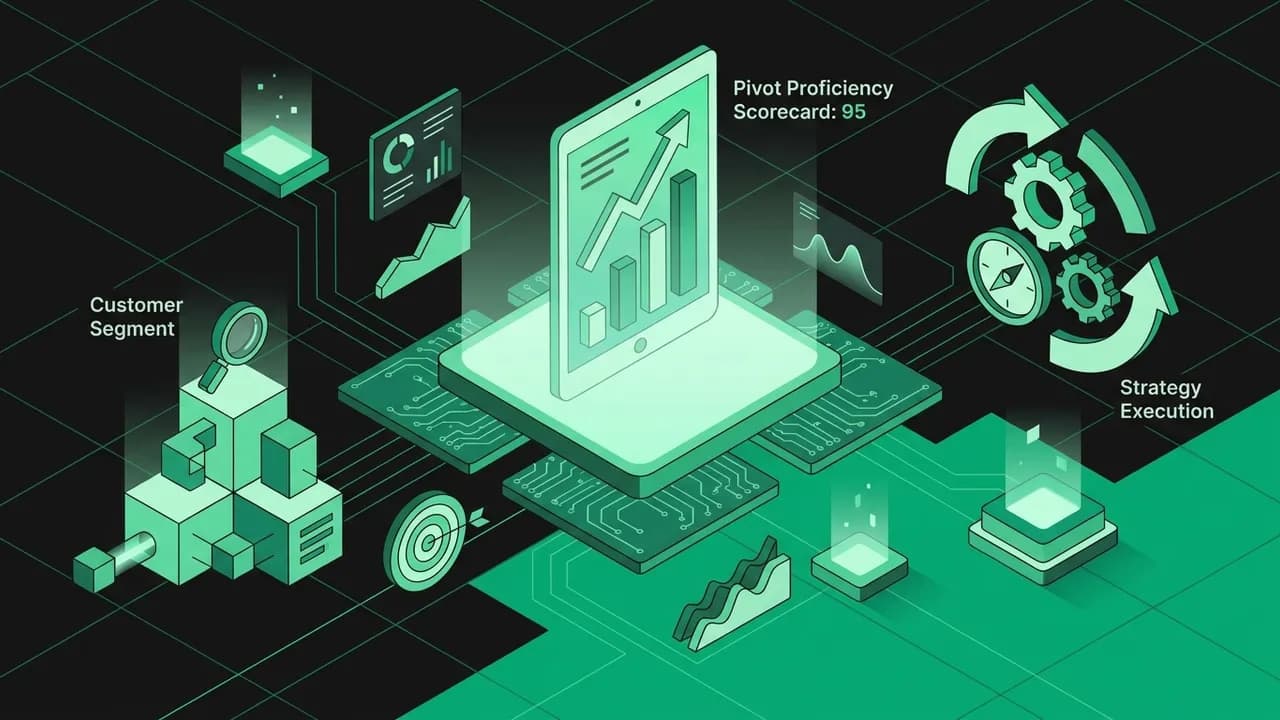
How do you completely remove emotion, ego, and sunk cost bias from the incredibly stressful pivot decision? You use hard, objective, ruthless data.
In 2026, the best founders use a quantitative framework we call the Pivot Proficiency Scorecard. This specific scorecard helps you definitively determine if your lack of traction is a fixable "Product/UI Problem" or a fatal "Market Segment Problem."
Evaluate your current primary target customer segment against these four specific metrics every 30 days. Grade each out of 10.
Metric 1: The Churn-to-Bug Ratio (1-10)
When your early-stage product inevitably breaks, goes offline for an hour, or lacks a basic expected feature, what exactly does the customer do?
Metric 2: Sales Velocity and CAC (1-10)
How much kinetic energy, time, and capital does it take to extract a single dollar from this demographic?
Metric 3: The 'Resentful User' Index (1-10)
Are your customers actively working against you and draining your limited startup resources?
Metric 4: The 'Magical Pull' (The Unintended Segment)
Look closely at your current active user database. Is there a small, highly active cluster of users who do not fit your Ideal Customer Profile at all, but who use the product obsessively?
The Golden Rule: If your scorecard averages below a 5/10 across your primary segment for 90 consecutive days, your emotional attachment is actively blinding you. You must pivot.
Execution: How to Pivot Safely Without Destroying Your Company
Pivoting is incredibly dangerous if executed poorly. It can easily alienate your engineering team, terrify your investors, and completely destroy whatever small revenue base you currently have. Here is the strict operational playbook for shifting your target audience safely in 2026.
Step 1: The 'Unintended Use' Data Audit
Before you lock yourself in a room, panic, and guess what your new segment should be, look at the behavioral data you already possess. Open your database, Mixpanel, or Stripe dashboard. Sort your active users by "Most Logins" or "Highest LTV."
Step 2: The 'Fire Your Worst Customers' Stress Test
If you know deep down you need to pivot, but you are completely paralyzed by the fear of losing your current meager $2,000/month in revenue, you need to deliberately run a stress test.
Identify the bottom 20% of your customers—the ones who complain the most, demand the most free support time, threaten to leave constantly, and pay the absolute least.
Step 3: The Clean-Slate Brand Pivot
The single biggest mistake founders make when pivoting is trying to cautiously, awkwardly drag their old brand baggage into the completely new market.
Conclusion: Survival of the Most Adaptable
Startups absolutely do not die because they fail to hit magical Product-Market Fit on their very first try. Almost no founder in history hits it on their first try. Startups die because the founder runs out of money or emotional energy while stubbornly, arrogantly refusing to accept that their first whiteboard hypothesis was mathematically wrong.
Perseverance is a highly valued virtue only when you are actively pushing in the correct direction. If you are blindly, exhaustingly pushing against a solid brick wall, perseverance is just stupidity disguised by ego. Use the objective data. Follow the intense market pull. Pivot aggressively when the market demands it, and persevere relentlessly when the users are actively begging you not to quit.
Key Takeaways
A pivot reuses your hard-won insight on a better-fit market — it is not failure.
Read the data: stalled retention, weak conversion, and 'likes but no pays' signal a wrong audience.
Give a strategy a fair, time-boxed test before pivoting — but don't let sunk cost trap you.
Decide on trends and pain depth, not boredom or ego.
Frequently Asked Questions
What does it mean to pivot a startup?
What are the signs you're targeting the wrong audience?
How do you decide whether to pivot or persevere?
What are examples of successful pivots?
What are common pivot mistakes?
Your Turn: The Action Step
Pivot Proficiency Scorecard & Decision Matrix
Get an honest, scored read on whether your traction is real 'pull' or forced 'push' — so you decide to pivot or persevere on evidence, not emotion.
Score the 5 pull signals
Rate each 1-5 for your CURRENT target audience. Be ruthless.
| Pull signal | Score (1-5) | Evidence |
|---|---|---|
Total the pull score
Add the scores. Formula: sum of 5 signals (out of 25).
Spot the adjacent pull
Is anyone you DIDN'T target showing up unprompted? Name them.
Place yourself on the matrix
Plot current-segment pull (low/high) against adjacent pull (low/high).
| Axis | Low / High | Reading |
|---|---|---|
Write the decision + what you keep
Pivot, persevere, or zoom-in. State exactly what changes and what stays.
Before you close this
0/5 doneYour answers are saved in this browser only. Use “Download as PDF” to keep a copy.
Why Your “Validated” Idea Failed
Ready to apply this?
Stop guessing. Use the Litmus platform to validate your specific segment with real data.
Log Your Pivot Decision in Litmus