The Early Adopter Myth: Finding People Who Actually Pay
Founders confuse 'users who like free stuff' with 'Early Adopters.' Learn how to identify the pragmatists who will actually pay for your unfinished product.

The Problem: The 'Free User' Trap and the Devastating Illusion of Traction
There is a deadly, pervasive misconception in the modern startup world about what an "Early Adopter" actually is, and it is quietly killing companies before they even officially launch.
Most first-time founders follow a highly predictable, entirely flawed playbook. They build a rough, buggy beta version of their SaaS product, slap together a nice landing page, post it on Product Hunt, Hacker News, or Tech Twitter, and offer it entirely for free. Because it is free, and because internet users absolutely love novelty, they get 500 signups over a single weekend.
The founder celebrates wildly. They screenshot their Google Analytics dashboard and post it on LinkedIn, talking about explosive growth. They mentally declare that they have found their Early Adopters and achieved the holy grail: Product-Market Fit.
Three months later, the free beta ends. The founder introduces a highly reasonable $15/month pricing tier just to keep the AWS servers running. Instantly, 495 of those 500 users churn. They delete their accounts and vanish back into the internet. The founder is devastated, utterly confused, and suddenly completely out of money.
What exactly went wrong here?
The founder completely confused "people who casually like trying free new software" with actual, highly valuable "Early Adopters."
If you offer absolutely anything for free on the internet, you will always get signups. Always. But these people aren't validating your business model; they are just consuming free value. They are tourists. In the classic technology adoption lifecycle, these people are "Innovators." They just like playing with the newest UI, the latest design trend, or the newest generative AI wrapper. They love testing things, but they have absolutely no intention of ever swiping a credit card.
The Reality of the True Early Adopter:
A true Early Adopter is absolutely not a tech enthusiast looking for a shiny toy. They are a desperate, highly focused pragmatist experiencing a business or personal emergency.
An Early Adopter is someone who is in so much daily operational pain regarding a specific problem that they are entirely willing to pay cold, hard cash for a broken, unfinished, bug-ridden, visually ugly version of your product—just to get 10% relief from that agonizing pain.
If a user adamantly refuses to pay a "Charter Member" fee for your beta, they do not have a big enough problem. You must immediately stop building your product roadmap to satisfy the noisy tourists and start aggressively hunting the quiet, bleeding-neck pragmatists who actually control corporate budgets.
Key Concepts: Re-evaluating the Technology Adoption Lifecycle for SaaS
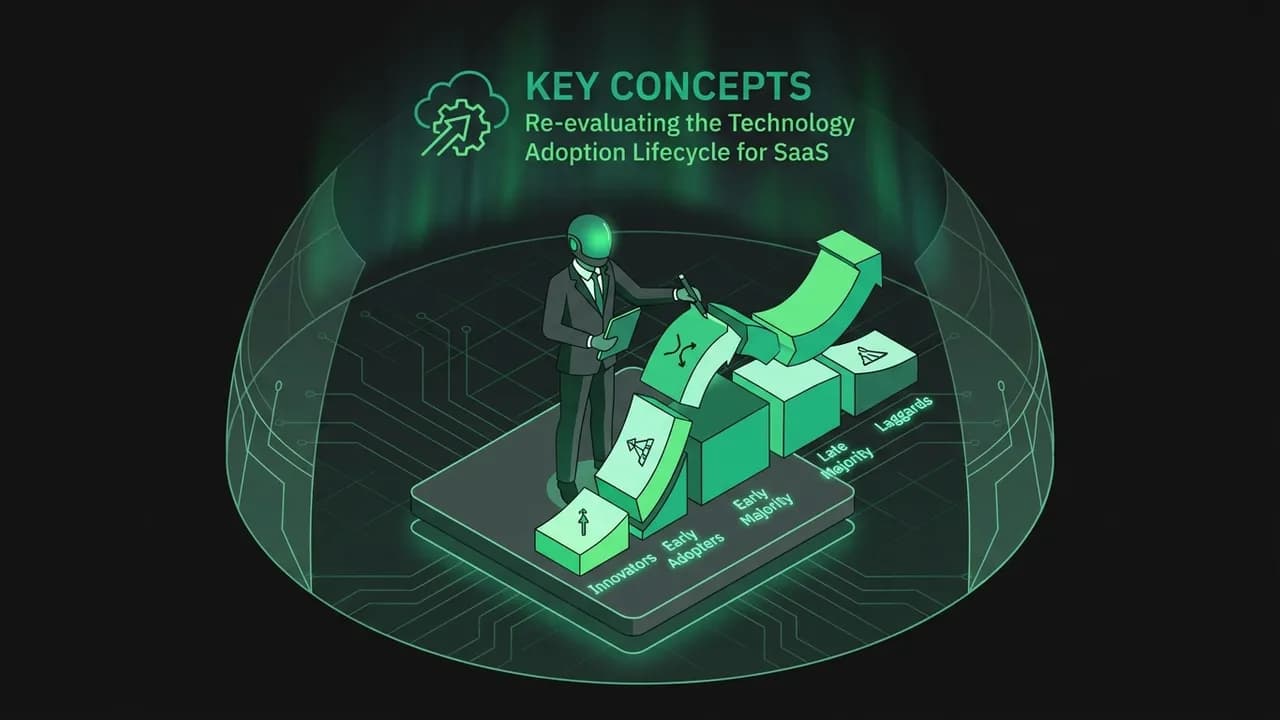
To successfully find the specific people who actually pay, we must deeply revisit Everett Rogers' famous Diffusion of Innovation theory, specifically filtering it through the brutal, highly competitive modern lens of 2026 B2B and B2C SaaS. For an early-stage startup, you only care about the very first 16% of the market. Everyone else is a fatal distraction that will drain your resources.
1. The Innovators (2.5%) - The Dangerous Trap
These are the people constantly hanging out on Hacker News, Product Hunt, and Tech Twitter. They will eagerly sign up for everything you build. They will give you fantastic UI feedback. They will complain loudly if your app doesn't have a perfectly implemented Dark Mode or keyboard shortcuts. But they will absolutely not pay you. They will churn the exact second the next cool tool launches on a Tuesday. Do not ever build your product roadmap based on their feature requests, because building exclusively for Innovators leads directly to bankruptcy.
2. The Early Adopters (13.5%) - The Golden Revenue Cohort
This specific demographic is your entire world for the first two years of your startup's life.
True Early Adopters have four distinct, non-negotiable defining characteristics:
Why Early Adopters Radically Forgive Bugs:
Early Adopters do not care about your beautiful logo, your smooth CSS animations, or your perfectly rounded corners. They are not buying "polish." They are buying a specific, financial "outcome." If your software successfully saves a highly stressed Logistics Manager 10 hours of manual data entry a week, but your server crashes every Friday afternoon due to bad load balancing, they will not churn. They will just email you, ask you nicely to fix it, and keep paying you, because even with the annoying crashes, your tool is infinitely better than their previous manual nightmare.
3. The Early Majority (34%) - The Premature Scaling Zone
These are the mainstream pragmatists who want a completely finished, highly polished, zero-risk product. If you try to sell to the Early Majority too soon, they will demand SOC2 compliance, 24/7 dedicated phone support, native Salesforce integrations, and absolutely zero bugs. When your MVP inevitably crashes or slows down, they will instantly fire you, demand a loud refund, and go back to a massive incumbent. Ignore them completely until you have crossed at least $1M to $3M in Annual Recurring Revenue (ARR).
The Strategy: The Ruthless 'Early Adopter Qualification Checklist'

How do you accurately and mathematically filter the noisy tourists from the quiet, highly valuable true Early Adopters? You force every single potential inbound lead through a ruthless, objective 4-point checklist. They must check every single box before you spend a single minute of your valuable time onboarding them or writing custom code for them.
1. The Unprompted Awareness Test
Can the prospect clearly articulate their pain point without you leading the witness or fully explaining it to them?
Fail: "Yeah, I guess writing these weekly reports does take a while if you really think about it."
Pass: "My team spends 40% of their week just rewriting client updates, and it is actively destroying our profit margins and causing burnout."
2. The Active Workaround Test (The 'MacGyver' Metric)
Have they already spent significant time or actual money trying to fix this problem themselves? This is the single most crucial test of buying intent.
Fail: "We just deal with it. It is what it is. It's just the accepted cost of doing business."
Pass: "I paid a developer on Upwork $500 to build a custom Zapier integration that connects a Google Sheet to our CRM, but it keeps breaking every time the API updates." (This person is practically begging for a reliable SaaS tool).
3. High Search Intent
Are they actively looking for a better way right now, before you even reached out?
Fail: They only briefly thought about the problem today because you happened to send them a clever cold email.
Pass: They are actively posting in private Reddit communities or LinkedIn groups explicitly asking their peers for software recommendations to solve this exact issue.
4. Independent Purchasing Authority (Budget Access)
Do they actually have the corporate power to say "Yes" to a price tag, or do they need permission from three layers of management?
Fail: A junior marketing coordinator who absolutely loves the tool but has to get approval from a CFO who notoriously hates spending money on new subscriptions.
Pass: The founder of a 10-person boutique agency who has their own corporate Amex card and can easily authorize a $2,000 expense instantly.
The Golden Intersection of Survival:
If you target people who check boxes 1, 2, and 3 (Awareness, Workaround, Intent), but lack box 4 (Budget), you will get massive, viral user engagement but absolute zero revenue. You will die a very slow, highly popular death.
If you target people with Budget (4) but absolutely no Awareness (1), you will spend an entire year and $50k on "marketing education campaigns" trying to convince them they even have a problem.
The absolute intersection of all four traits is the only place an early-stage startup can actually survive, thrive, and reach profitability.
Execution Part 1: How to Hunt the Golden Cohort
Stop launching broadly to the general public. Start actively hunting specifically for the bleeding necks. Here is the exact 2026 playbook for acquiring true, paying Early Adopters.
Step 1: The 'Competitor Churn' Hunt
Do not try to invent new demand from scratch; simply siphon off existing, highly concentrated frustration.
Step 2: Introduce Massive Friction to the Beta Signup
Founders make their early betas far too easy to join. If you want to successfully filter out the freebie-seeking tourists, you must intentionally introduce massive friction into the signup process.
Execution Part 2: The Pricing Filter and Concierge Strategy
Step 3: The 'Charter Member' Pricing Strategy
Never, ever launch for free. Free implies your product has absolutely no value, and it automatically attracts the exact wrong crowd.
Step 4: The Concierge Upgrade
For these paying Charter Members, do absolutely not rely on a generic, self-serve automated onboarding flow. Get on a personal Zoom call and meticulously set everything up for them. They paid you for a highly unfinished product; your intense, personal manual labor makes up the massive difference in value. Format their data, integrate their APIs manually, and answer their texts at midnight. This cements their extreme loyalty and turns them into fanatical evangelists who will single-handedly bring you your next 100 paying customers.
Conclusion: Protect Your Roadmap from the Tourists
The hardest, most vital skill for a technical founder to learn is how to confidently ignore a loud user.
When you finally launch, you will receive hundreds of feature requests. If you listen to the Innovators and the free tourists, you will build a bloated, complex, totally free tool that goes bankrupt in six months.
Your product roadmap must be a highly guarded fortress, completely inaccessible to anyone who has not swiped a credit card. By identifying and serving only the true Early Adopters—the highly stressed pragmatists who pay for outcomes, forgive bugs, and demand utility—you build a resilient, highly profitable foundation. Stop seeking applause from the internet, and start seeking hard financial commitments from the desperate.
Key Takeaways
True early adopters have the problem, are actively searching, and have budget (Problem + Search + Budget).
Filter out freebie-seekers early by asking for a commitment or a price.
Find them where the pain is discussed: communities, competitor reviews, and paid workarounds.
Urgency and willingness to pay matter more than enthusiasm or buzz.
Frequently Asked Questions
What is an early adopter?
How do you find early adopters who actually pay?
How are early adopters different from freebie-seekers?
What are examples of early adopters?
What are common mistakes when targeting early adopters?
Your Turn: The Action Step
Early Adopter Qualification Checklist
Build a scoring filter that separates true early adopters (who feel the pain and will pay) from 'tourists' (free users who churn and distort your roadmap).
Define your 5 qualification criteria
What MUST be true for someone to be a real early adopter of YOUR product?
Set the pre-payment filter
Name the exact 'put money/time on the table' test you'll use.
Score 5 real prospects
Rate each prospect against your criteria. Only 4+/5 qualify.
| Prospect name | Score (/5) | Qualified? (Y/N) |
|---|---|---|
List the tourist red flags
Write the signals that mean 'reject' — even if they're enthusiastic.
Lock your invite list
Who's in the first cohort, and what you'll ask of them in week 1.
| In-cohort name | First ask (feedback/payment/intro) |
|---|---|
Before you close this
0/5 doneYour answers are saved in this browser only. Use “Download as PDF” to keep a copy.
Airbnb Did This Before Becoming a Billion-Dollar Brand
Ready to apply this?
Stop guessing. Use the Litmus platform to validate your specific segment with real data.
Identify Your Adopters in Litmus