Why "Everyone Needs This" is a Startup Death Sentence
Building for everyone leads to a 'Swiss Army Knife' product that is mediocre at everything. Learn why saying 'No' is your biggest competitive advantage.

The Problem: The 'Swiss Army Knife' Syndrome and the Dilution of Value
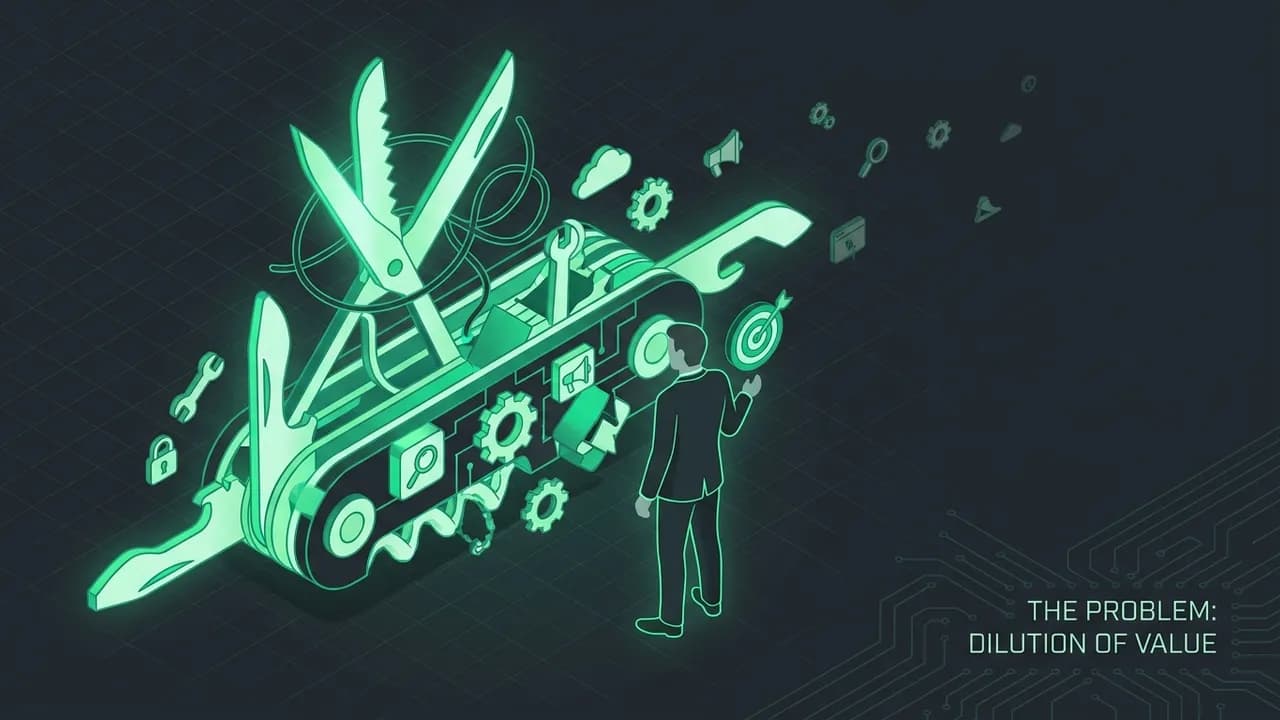
"Our underlying technology is so fundamentally good, so revolutionary, that literally everyone needs it. Moms, college students, enterprise CEOs, small business owners—everyone can use this!"
When a highly optimistic founder enthusiastically says this during an investor pitch or a team meeting, it feels incredibly safe and ambitious to them. It makes the Total Addressable Market (TAM) look absolutely astronomical on a slide deck. It makes the founder feel like they are actively building the next Google, Amazon, or Apple. But to an experienced investor or a highly seasoned startup operator, this exact sentence is a catastrophic, screaming red flag that signals impending doom.
When you set out to build a product for everyone, you inevitably, mathematically build a product for absolutely no one in particular.
The Curse of Capability vs. Marketability:
As a brilliant engineer or a visionary founder, you see the raw, underlying potential of your technology. You realize that your new AI-driven scheduling tool could theoretically be used by a freelance graphic designer to quickly book client calls, and it could also technically be used by a massive 500-person logistics company to rigorously manage complicated shift workers.
But there is a massive, incredibly dangerous difference between what a product can technically do and who a product should practically sell to. Just because your product can theoretically help 5 different types of users does absolutely not mean you should market to 5 different types of users simultaneously.
Every single new customer segment you mistakenly add to your target list has a compounding, highly lethal effect on your early-stage startup:
It completely dilutes your engineering product roadmap: The solo freelancer desperately wants a cheap mobile app with highly colorful widgets and simple iCal syncing. The enterprise logistics company demands strict SOC2 compliance, rigid role-based access control, complex API integrations, and an audit trail. You end up trying to frantically build half of each feature set, satisfying neither user base, and completely running out of engineering runway before you finish either.
It totally destroys your copywriting and brand voice: You absolutely can't write a sharp, highly aggressive, highly converting headline on your landing page because you are utterly terrified of alienating one of your broad segments. So you inevitably end up watering down the language until it becomes meaningless, highly corporate word soup like, "Empowering teams and individuals to seamlessly optimize their daily workflows for maximum synergy." (Translation: We do absolutely nothing specific, please do not buy this).
It bankrupts your marketing budget instantly: Bidding on Google Ads or LinkedIn for a generic, incredibly broad term like "Project Management Software" is literal financial suicide in 2026; you are directly fighting billion-dollar giants like Asana, Monday.com, and ClickUp who possess bottomless ad budgets. Bidding on a hyper-niche, highly specific long-tail keyword like "Project Management for Commercial Landscaping Firms in Texas" is a highly profitable, incredibly low-CAC (Customer Acquisition Cost) strategy.
The Swiss Army Knife Metaphor
A Swiss Army Knife is a truly great tool to have in a highly generic, non-threatening survival situation in the woods. It has a tiny knife, a tiny saw, a tiny screwdriver, and a tiny pair of scissors. It is generally "okay" at many different things. But if you personally need to undergo emergency open-heart surgery, you absolutely do not want the skilled surgeon pulling out a Swiss Army Knife. You desperately want a highly specialized, perfectly balanced, incredibly hyper-focused scalpel.
In the modern, highly saturated B2B and B2C landscape of 2026, consumers and massive businesses are incredibly tired of generic tools that are just "okay." They are actively, eagerly willing to pay a massive, highly profitable premium for the exact scalpel.
Key Concepts: The Incredible Power of Intentional Exclusion and Polarization
The most financially successful, culturally relevant, and highly valued startups of the last decade are defined entirely not by who they warmly included, but by exactly who they aggressively and highly intentionally excluded from their platform.
The Slack Case Study (Excluding the World to Win the Deep Niche)
When Slack originally launched, they absolutely did not market themselves as a highly generic "Communication app for the entire world." They started entirely as an internal, highly obscure tool for a struggling gaming company (Tiny Speck). When they finally spun it out into a standalone commercial product, they ruthlessly targeted hardcore engineering and highly technical development teams who absolutely despised traditional email and clunky IRC chat.
By explicitly, intentionally excluding "general office workers," "HR departments," and "non-technical marketing teams" in the crucial early days, they successfully built a fanatical, highly cult-like following among incredibly influential developers. They built incredibly deep, highly native integrations specifically with GitHub and Jira. They fundamentally didn't care if a traditional advertising agency didn't understand the highly technical command-line interface. Once they established a total, entirely undeniable monopoly in that incredibly specific developer niche, only then did they slowly, highly strategically expand to the rest of the massive enterprise world.
The Startup Exclusion Manifesto:
Your brand identity is fundamentally not defined by what you happily say "Yes" to. It is defined entirely, exclusively by the strict conviction and incredible discipline with which you boldly say "No."
Every single time you bravely say "No" to a massive distraction or a highly lucrative but incredibly bad-fit customer, you are powerfully saying "Yes" to completely dominating your core, highly profitable niche.
Polarization as a Core, Essential Growth Mechanism:
Marketing that effectively, incredibly strongly attracts the exact right person should simultaneously, actively, and purposefully repel the exact wrong person. If nobody confidently looks at your startup landing page and immediately thinks, "Wow, this isn't for me at all," then your marketing messaging is far, far too weak. If absolutely nobody genuinely hates your product's specific, highly intentional constraints (like having absolutely no free tier), nobody will ever love it enough to actually pay for it. Powerful polarization is the absolute fundamental engine of early-stage startup growth.
The Strategy: The 'Focus Funnel' Framework for Finding Your Specific Scalpel

Most highly intelligent founders incorrectly believe that "focusing" merely means politely looking at a list of five great options and easily picking the one that looks slightly best. That is completely incorrect. True, incredibly powerful focus is the violent, emotionally painful act of ruthlessly, permanently eliminating four legitimately good ideas so you can execute completely perfectly on the single great idea.
The Focus Funnel is a highly systemic, completely objective process of filtration that strictly forces you to systematically choose the single, highly specific segment most likely to eagerly yield a "Yes" and a fast credit card swipe today, rather than a polite, completely useless "Maybe later" tomorrow. Run your startup idea through these three incredibly brutal layers:
Layer 1: The Infinite Realm of Possibility (Top of Funnel)
Aggressively list every single human group or massive industry your product could theoretically help if you had absolutely infinite time and infinite venture capital money.
Example for a highly advanced new generative AI Writing Tool: Novelists, College Students, High School Teachers, Marketing Agencies, SEO Bloggers, Real Estate Agents, Highly Paid Corporate Lawyers.
Layer 2: The Brutal Profitability and Access Filter
Ruthlessly eliminate any group from that massive list that absolutely does not have the actual, available financial budget to consistently sustain a high-LTV (Lifetime Value) SaaS business, or groups that are notoriously, historically difficult/expensive to reach through modern digital ad channels.
Eliminations: College Students (they unfortunately have absolutely no disposable income). Novelists (they very rarely pay for expensive monthly SaaS; they simply buy Microsoft Word once). High School Teachers (school district software procurement easily takes 2 highly painful years).
Remaining: Marketing Agencies, SEO Bloggers, Real Estate Agents, Corporate Lawyers.
Layer 3: The "Hair on Fire" Absolute Urgency Filter
Look very closely at the remaining, highly profitable groups. Who is currently experiencing this specific writing problem as a minor, highly passing annoyance, and who is currently experiencing this massive problem as a terrifying bleeding neck wound that actively threatens their entire livelihood today?
Eliminations: Lawyers (they care entirely about extreme legal accuracy and historical precedent, not raw writing speed, so an AI writing tool is a massive, terrifying legal liability and an incredibly tough sell). SEO Bloggers (the market is incredibly heavily saturated, and highly unpredictable Google algorithm updates make their businesses entirely too volatile).
The Absolute Winner: Mid-sized Boutique Marketing Agencies. They absolutely have to rapidly churn out hundreds of demanding client emails, ad copy variations, and social posts daily just to survive the week. Time is incredibly literally money for them. Their hair is actively on fire.
You must now strictly, completely ignore absolutely everyone else on earth and intensely build your product exclusively for the incredibly specific Marketing Agency. The other segments effectively, entirely do not exist to your company.
Execution Part 1: Operationalizing Extreme Messaging Polarization
Once you have successfully, rigorously run your target market through the challenging Focus Funnel and clearly identified the single burning niche, you must aggressively align your entire company's daily operations around that single, definitive choice.
Step 1: The "Kill Your Darlings" Complete CRM Audit
Open your CRM (Customer Relationship Management) tool, your massive email list, and your currently running ad campaigns. Look extremely closely at every segment you are currently targeting. Rank them strictly, entirely by hard data:
Step 2: Intensely Polarized Copywriting on the Landing Page
Completely rewrite your website's main H1 header and subheadline to explicitly, loudly state exactly who the product is FOR, and more importantly, exactly who it is NOT for.
This completely counter-intuitive approach instantly makes your actual highly targeted user (the boutique agency founder) feel immense, immediate, unshakeable trust. They strongly feel like you built the incredibly powerful software just for them, and because it is highly specialized, they will very happily pay a massive 50% premium over the incredibly generic tools.
Execution Part 2: The Brutal 90-Day Feature Lockdown
Step 3: The Highly Strict 90-Day Feature Diet
For the incredibly critical next 3 months, your entire engineering and highly stressed product team is on an incredibly strict feature diet.
Saying "No" to incredibly early, fully guaranteed revenue that strongly pulls you off course is absolutely the hardest, most physically painful thing a highly stressed founder has to do. It feels incredibly irresponsible. But it is absolutely the only way to effectively prevent fatal Feature Bloat and guarantee you remain the absolute sharpest, most essential tool in your highly specific niche's toolbox.
The Incredible Danger of the Angry Pivot Request
When you intentionally focus incredibly intensely on one specific segment, the confused users outside that segment who accidentally try your highly specialized product will inevitably, loudly complain. They will aggressively submit incredibly angry support tickets loudly saying, "Why doesn't this tool do X? Your massive competitor does X!"
Do not ever let this negative feedback break your strong resolve. Very politely reply directly to the ticket: "Thanks so much for the feedback. Our tool is specifically designed strictly for highly fast-paced boutique agencies who deeply value complete simplicity over incredibly complex integrations. It strongly sounds like [Competitor Tool] might actually be a much better fit for your highly specific enterprise needs. Here is a link to their site."
Confidently sending bad-fit, loudly complaining customers directly to your massive competitors is the absolute ultimate act of true strategic focus. It entirely frees up your customer support queue, drastically, permanently lowers your future churn rate, and guarantees that the customers who stay are incredibly, fanatically loyal.
Conclusion: Small is an Incredible Feature, Not a Bug
In the incredibly fragile beginning stages of a startup, being incredibly small and hyper-niche is absolutely not a massive disadvantage; it is your absolute greatest, most devastating competitive weapon against the incredibly slow incumbents. The massive, billion-dollar corporate players like Microsoft or Salesforce literally, mathematically cannot afford to care about a highly niche market of exactly 10,000 specific agency users. They must frantically build for "everyone" simply to satisfy their demanding shareholders and aggressively maintain their massive revenue targets.
By confidently, intentionally refusing to build for everyone, you successfully offer a level of perfectly tailored perfection, incredibly deep empathy, and highly specialized utility that the massive big players can never mathematically match. Truly master the incredibly sharp scalpel, completely dominate the highly profitable tiny niche, thoroughly achieve a true monopoly, and only ever consider slowly expanding when the current incredibly lucrative market is entirely, definitively conquered.
Key Takeaways
'For everyone' means 'for no one' — broad targeting dilutes message, product, and growth.
Win a narrow beachhead completely before expanding (Amazon: books first).
Run prospects through a focus funnel: urgency, reachability, willingness to pay.
Saying no to off-target customers is a strategy, not a missed opportunity.
Frequently Asked Questions
What is the 'everyone trap' in startups?
Why is a niche better than a broad market for a startup?
How do I narrow down my market with a focus funnel?
What are examples of startups that won by narrowing focus?
What are common focus mistakes founders make?
Your Turn: The Action Step
Focus Funnel & Exclusion Manifesto
Turn a do-everything 'Swiss Army knife' product into a sharp scalpel by deciding — on paper — exactly who and what you will refuse to serve.
State your current 'everyone' claim
Write the too-broad version honestly so you can cut it.
Run the Focus Funnel
Drop a layer of 'everyone' at each step until one specific user is left.
| Funnel step | Who you drop | Who's left |
|---|---|---|
Write the Exclusion Manifesto
List who you will NOT serve and what you will NOT build. This is the whole point.
Draft the polarizing tagline
Write a line that the right person loves and the wrong person scrolls past.
Lock the 90-day build list
Only 3-5 features your scalpel-user needs. Everything else is parked.
| Feature to build (max 5) | Why this exact user needs it |
|---|---|
Before you close this
0/5 doneYour answers are saved in this browser only. Use “Download as PDF” to keep a copy.
Stop Building. Validate First. The ₹0 Startup Validation Method
Ready to apply this?
Stop guessing. Use the Litmus platform to validate your specific segment with real data.
Refine Your Incredible Focus in Litmus