Forecasting: How to Build a Financial Model That Isn't a Lie
Ditch the fantasy 'Hockey Stick' graphs. Learn how to build a dynamic, driver-based simulation that actually helps you navigate your startup's survival.

The Problem: The 'Hockey Stick' Delusion
The $10M Fantasy
“We built a financial model for our Seed deck, and it showed us hitting $10M in revenue by the end of year two. We're now 6 months in, and we're at $5k. We realized our model was based on 'Top-Down' guesses (e.g., 'We will capture 1% of a $100B market') rather than 'Bottom-Up' reality. We have no idea when we'll actually run out of money because our expenses are higher than planned and our revenue is lower. Every time we look at our spreadsheet, we feel like we're lying to ourselves.”
A financial model isn't a 'Crystal Ball'—it is a 'Simulation.' It's not supposed to predict the future perfectly; it's supposed to show you which 'Levers' (like conversion rate or traffic) have the biggest impact on your survival.
To scale, you must move from 'Static Guessing' to 'Driver-Based Modeling'—where every number in your spreadsheet is tied to a real-world activity you can control.
Why Forecasting Fails So Often
Most startup models fail because they are built to impress, not to inform. They are designed to look tidy in a fundraise or board deck rather than to help founders make daily decisions about hiring, marketing, pricing, and runway.
Top-Down Models Usually Hide Operational Ignorance
Saying that a company will capture 1% of a huge market sounds ambitious but reveals almost nothing about how customers will actually be won. Forecasts become useful only when they connect revenue to concrete activities like traffic, demo volume, close rates, average contract value, retention, and sales cycle timing.
A Model Should Reduce Surprise, Not Eliminate Uncertainty
Good forecasting does not make the future certain. It helps the team understand which assumptions matter most and what happens if those assumptions are wrong. The goal is preparedness, not perfection.
Forecasts Break When They Ignore Timing
Many spreadsheets assume that spending, hiring, lead generation, onboarding, and revenue happen instantly. In reality, there are lags everywhere: recruiting time, sales cycle delays, implementation periods, invoice collection gaps, and marketing payback windows. Ignoring timing creates false confidence.
False Precision Is More Dangerous Than Rough Honesty
A model with many decimal points and polished tabs can still be nonsense. It is better to have a rough, driver-based model that reflects how the business actually works than a beautifully formatted spreadsheet full of unsupported assumptions.
The Best Models Teach Management Behavior
A strong forecast trains founders to ask better questions: what actually drives revenue, where the bottlenecks sit, how quickly cash converts, and which assumptions would meaningfully shorten runway if they deteriorated.
Key Concepts: The Building Blocks

A model that reflects reality is built from the ground up, not from a spreadsheet down.
1. Bottom-Up Modeling
Starting with the smallest unit of work (e.g., 'One salesperson makes 10 calls, which leads to 1 sale') and multiplying it out. Never start with market share.
2. Drivers
The 'Inputs' that lead to revenue (e.g., Ad spend, Traffic, Click-through rate, Conversion rate). If you can't measure the driver, you can't model the outcome.
3. Sensitivity Analysis (The 'What-If' Test)
Testing what happens to your runway if a single driver (like CAC) changes by 20%. This reveals your 'Kill Variable'—the number that, if it breaks, kills the company.
4. Step Functions vs. Linear Growth
Startups don't grow by 10% every month like clockwork. They grow in spikes after a product launch or flatline during a hiring freeze. Your model must account for these plateaus.
5. The 'Safety Buffer' (Months of Runway)
Your runway is (Current Cash / Monthly Net Burn). This is your 'Life Clock.' If it shows less than 6 months, you are officially in a 'Fundraising or Firing' cycle.
Why Bottom-Up Modeling Creates Better Strategy
Bottom-up forecasting forces the team to explain how outcomes are produced. That turns planning into an operational conversation rather than a storytelling exercise. It also makes it easier to debug misses later because the drivers are visible.
Drivers Must Be Observable And Owned
Useful drivers are measurable and have a clear team or function responsible for influencing them. Examples include paid traffic, demo volume, lead-to-opportunity rate, opportunity-to-close rate, ARPU, retention, and implementation capacity.
Sensitivity Analysis Reveals Fragility
The most important variable in a model is often not the one that looks most glamorous. A small deterioration in conversion, churn, pricing, or payment timing may matter far more than a bold assumption about market size. Sensitivity analysis helps identify where the company is truly vulnerable.
Growth Usually Happens In Bursts
Forecasts that assume neat monthly progression tend to mislead. Startups often experience nonlinear events: a channel suddenly working, a launch underperforming, a sales hire ramping slowly, a major customer delaying signature, or a product issue hurting retention. Models should reflect that reality.
Runway Is A Decision Metric, Not Just A Finance Metric
Runway changes what the company can attempt. It influences hiring appetite, fundraising urgency, experimentation tolerance, and pricing courage. Good models keep runway visible because it shapes strategic behavior, not just accounting awareness.
Building Blocks Need Regular Definition Hygiene
Teams should periodically confirm what counts as a lead, customer, booked revenue, recognized revenue, gross margin, burn, and churn. Models become misleading when definitions drift silently over time.
The Framework: The 'Dynamic Forecast' Engine
Use this 4-phase framework to update your model every 30 days.
Phase 1: The Historical Baseline. Input your actual revenue and expenses from the last 3 months. This is your 'Base Reality.'
Phase 2: Driver Mapping. Identify the 3 things that actually drive your revenue (e.g., 1. LinkedIn Outreach, 2. Content Marketing, 3. Referrals).
Phase 3: The Burn Rate Stress-Test. Calculate your 'Default Alive' date based on your current cash. If you never raised another dollar, when would you run out?
Phase 4: The Monthly Re-Calibration. Compare your 'Forecast' to your 'Actuals.' If you missed your goal by 20%, adjust the entire future forecast down by 20% immediately. Do not 'Make it up' in the later months.
Why This Engine Works
The Dynamic Forecast Engine turns planning into a recurring management habit. Instead of building a model once for fundraising and ignoring it, the team uses the forecast as a living operating system tied to real inputs and real consequences.
Historical Baselines Prevent Fantasy Planning
Starting with actual performance anchors the model in what the company has really done, not what it wishes had happened. This makes future assumptions more credible and reveals where growth or cost behavior is persistently misunderstood.
Driver Mapping Simplifies Complexity
Most startups have dozens of metrics, but only a few truly drive near-term revenue. Focusing on those key drivers keeps the model usable. If every line item is equally important, the model becomes too complex to guide action.
Burn Stress-Testing Forces Strategic Honesty
Founders often know their cash balance but not the precise date at which current burn becomes dangerous under different revenue outcomes. Stress-testing the model turns vague anxiety into visible scenarios that leadership can act on.
Re-Calibration Is The Discipline That Makes Forecasting Real
A model becomes honest only when misses force immediate learning. Teams that repeatedly 'catch up later' destroy the value of forecasting. Strong operators accept misses, update assumptions, and move forward with a cleaner picture of reality.
A Good Monthly Forecast Review Covers
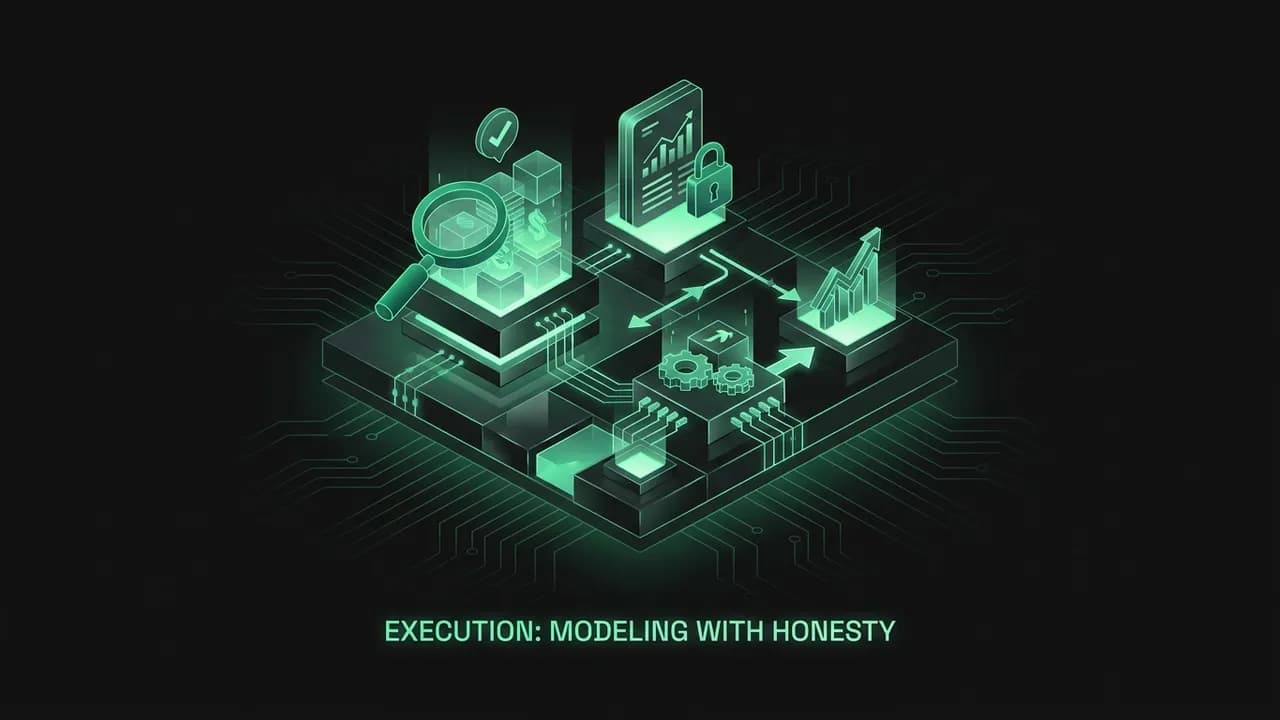
Execution: Modeling with Honesty
Step 1: The 'Ad Spend' Throttle
Don't just assume more money = more sales.
Step 2: The 'Hiring Lag' Buffer
Founders always model new hires starting and producing on Day 1.
Step 3: The 'Scenario' Switch
Don't have 10 different spreadsheets for different ideas.
Step 4: Cash Flow vs. P&L
Treat your bank account and your profit statement as two different things.
Why Diminishing Returns Belong In Growth Models
Scaling channels rarely preserves the same efficiency curve. New budget often reaches colder audiences, raises auction prices, or introduces weaker lead quality. A model that assumes flat CAC under scaling almost always overstates growth efficiency.
Hiring Delay Is One Of The Most Common Forecast Errors
Companies routinely underestimate how long it takes to source, hire, onboard, and ramp talent. This leads to both timing mistakes and budget mistakes. Modeling realistic hiring lag makes cash planning far more reliable.
Scenario Switching Improves Decision Speed
When pessimistic, base, and aggressive assumptions are built into one model, founders can respond to new information faster. Instead of rebuilding the spreadsheet from scratch, they can assess how a changed assumption affects runway, hiring, and fundraising posture immediately.
Cash Flow Must Stay Separate From Accounting Profit
Profitable-looking businesses can still run out of cash because working capital, tax timing, deposits, inventory, and collections lag distort the bank balance. That is why founder decision-making should always include both P&L logic and cash logic.
A Practical Modeling Habit
Strong teams track:
Honesty Makes The Model More Valuable, Not Less
A forecast that shows problems early is doing its job. The spreadsheet is not there to comfort leadership. It exists to surface constraints while there is still time to change course.
Case Study: The Model That Saved a Seed Round
The Success: The Driver-Based Pitch
A SaaS startup was pitching for a $1M Seed round. Instead of showing a static graph of growth, they shared their 'Dynamic Model.'
The Strategy: They showed exactly how many 'Cold Leads' they needed per month to hit their goal, and what would happen to their runway if their Conversion Rate dropped from 3% to 1.5%.
The Result: The investors were impressed by the 'Financial Maturity.' One investor noted: 'I'm not betting on your revenue number, I'm betting on your understanding of the levers that create that revenue.' They closed the round in 3 weeks because they proved they knew how to manage the money once it hit the bank.
Why This Worked
The company demonstrated that its model was not a storytelling prop. It was a management tool. Investors trusted the team more because it understood the causal mechanics behind growth and had already thought through downside cases.
The Pitfalls: Forecasting Errors
Market Share Fiction: Starting with a giant market and an arbitrary slice of it instead of modeling acquisition mechanics.
Straight-Line Assumptions: Pretending growth, hiring, and sales conversion move in smooth, predictable lines.
Ignoring Timing Lags: Forgetting recruiting delays, contract cycles, implementation time, and collections.
One-Scenario Thinking: Building only the optimistic case. Fix: always maintain pessimistic and base cases beside the upside case.
No Recalibration Ritual: Leaving the model unchanged after repeated misses. Fix: update assumptions monthly using actuals.
What Healthy Forecasting Looks Like
Healthy forecasting is operational, adaptive, and humble. The company knows its key drivers, updates the model regularly, separates cash from accounting profit, stress-tests key assumptions, and uses the forecast to guide decisions rather than justify hope.
Questions Founders Should Ask
The Final Principle
A financial model is useful when it makes your next decision smarter. If it only makes the future look prettier, it is not a forecast. It is fiction with formatting.
Key Takeaways
Build bottom-up from real drivers (calls → meetings → sales), never top-down from a market-share fantasy.
Run sensitivity analysis to find your 'kill variable' — the input that breaks the company if it moves 20%.
Model step functions and plateaus, not smooth 10%-a-month growth, because startups grow in spikes.
Track runway as cash / monthly net burn; under 6 months means you're in a 'fundraise or fire' cycle.
Only model drivers you can actually measure and assign an owner to — unobservable inputs make the forecast fiction.
Frequently Asked Questions
What is a startup financial model?
How do you build a financial model that isn't a lie?
What is sensitivity analysis and the 'kill variable'?
How do you calculate runway?
What are good and bad financial model examples?
What are common financial modeling mistakes?
Your Turn: The Action Step
Honest Forecast Worksheet
Walk out with a driver-based 12-month forecast and a 'default alive' runway date you'd actually defend to an investor.
Anchor to actuals
Input real revenue and expenses from the last 3 months — your 'base reality'.
| Month | Revenue ₹ | Expenses ₹ |
|---|---|---|
Map your 3 real drivers
Name the 3 things that actually create revenue, with the conversion math for each.
| Driver | Volume/mo | Conv % | New revenue ₹ |
|---|---|---|---|
Project net new MRR
Add driver revenue, subtract churn, to get realistic monthly net new MRR.
Compute the default-alive date
Cash in bank divided by monthly burn — when do you run out if you never raise again?
Set the re-calibration rule
Write the monthly rule: if you miss a driver by X%, adjust the whole forecast immediately.
Before you close this
0/4 doneYour answers are saved in this browser only. Use “Download as PDF” to keep a copy.
Why Buying in Bulk Can Kill Your Business
Ready to apply this?
Stop guessing. Use the Litmus platform to validate your specific segment with real data.
Simulate Your Future