The Path to Profitability: When to Flip the Switch
Ditch the 'Endless Burn' spiral. Learn how to engineer your business for sustainability using the 3-Stage Profit Bridge and the Default Alive principle.

The Problem: The 'Endless Burn' Spiral
The 'Growth at All Costs' Trap
“We've been scaling for 18 months. Our revenue is growing, but our expenses are growing even faster. We're currently losing $40,000 a month, and we have $400,000 left (10 months of runway). We keep telling ourselves that 'Profitability is a choice' that we'll make once we hit major scale. But we realize we don't actually know how to flip the switch. Our team is used to spending freely, and we're terrified that if we stop burning cash, our growth will vanish.”
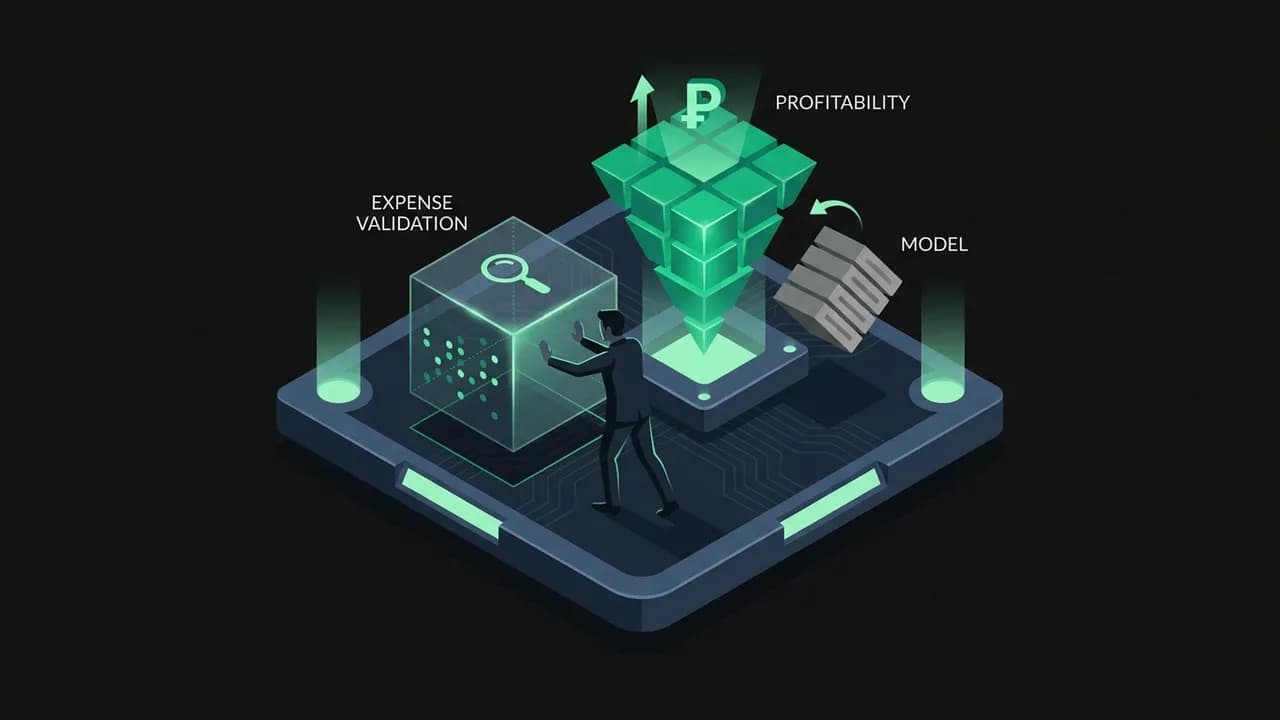
Profitability isn't a 'Switch'—it is a 'Build.' You don't just wake up one day and decide to be profitable; you have to engineer your business to be capable of it.
To scale, you must move from 'Growth Maximization' to 'Profitability Planning'—where you track the 'Default Alive' metric and have a clear, documented path to breakeven that doesn't rely on the next VC check.
Why Endless Burn Becomes Normalized
Startups often become culturally attached to burn because spending gets associated with ambition. Hiring fast, running campaigns, opening tools, and launching initiatives all feel like movement. Over time, the organization forgets to ask whether spending is compounding value or simply compounding habit.
Revenue Growth Can Hide Structural Weakness
A company can grow and still be moving farther from sustainability. If expenses rise faster than revenue, payback remains slow, gross margin is thin, or headcount expands ahead of true need, growth can mask a worsening financial position.
Profitability Requires Design, Not Hope
Many founders talk about profitability as though it will appear automatically after some future milestone. In reality, profitability emerges from deliberate choices about pricing, cost structure, product mix, hiring discipline, and capital allocation.
Burn Rate Is A Strategic Constraint
Burn is not just an accounting number. It determines how much experimentation the company can afford, how much fundraising pressure exists, and how aggressively leadership must respond to mistakes or market slowdowns.
Teams Need A Map, Not A Slogan
Telling the organization to 'be more efficient' is rarely enough. Teams need a clear plan for how the company moves from loss-making growth to self-sustaining growth, what tradeoffs will be made, and what measures of progress matter most.
Profitability Planning Builds Negotiating Power
A company that knows how to become default alive can negotiate with investors, acquirers, employees, and vendors from a stronger position. When survival is less dependent on outside rescue, decision quality improves across the board.
Key Concepts: Flipping the Model
Survival in the startup world is defined by a single binary state: Are you dying or are you living?
1. Default Alive vs. Default Dead
2. The Efficiency Gap
As startups grow, they often add layers of management and complex tools that don't directly contribute to revenue. This 'Organizational Debt' makes the path to profit much longer and steeper.
3. Variable vs. Fixed Cost Flexing
Profitable startups have the ability to immediately cut variable costs (like ads or travel) to achieve breakeven at a smaller scale. If 90% of your costs are 'Fixed' (Salaries/Rent), you have very little room to maneuver.
4. Operating Leverage
This is the 'Engine' of profitability. It occurs when your revenue grows at 2x or 3x the rate of your expenses. Without operating leverage, scale just means you lose money faster.
5. The 'Rule of 40'
A healthy SaaS company's (Growth Rate + Profit Margin) should be at least 40%. If you are growing at 50% but losing 40%, you are at 10%—dangerously inefficient.
Why Default Alive Is Such A Powerful Concept
Default alive forces the team to think beyond the next fundraise. It asks whether the business can eventually sustain itself from internally generated cash. That question changes hiring, budgeting, pricing, and strategic urgency.
Efficiency Gaps Accumulate Quietly
Waste rarely appears as one dramatic expense. It usually appears as accumulated friction: overlapping tools, redundant processes, soft accountability, underutilized managers, low-return projects, and policies that grew with optimism but no longer fit reality.
Cost Flexibility Determines Survival Options
A business with flexible costs can react more quickly when growth slows. A business dominated by fixed obligations has fewer choices and often needs deeper, more painful interventions to regain control.
Operating Leverage Is What Makes Scale Valuable
Scale is financially attractive only when additional revenue carries disproportionately higher contribution than additional expense. Without operating leverage, bigger revenue numbers can still coexist with a weak or nonexistent path to breakeven.
Benchmarks Should Inform, Not Dictate
The Rule of 40 and similar metrics are useful reference points, but founders should interpret them in context. Stage, business model, market structure, and capital environment all matter. The key is to understand whether the company’s current tradeoff between growth and profitability is intentional and sustainable.
Flipping The Model Starts With Visibility
Teams cannot improve what they do not see clearly. Good profitability planning requires accurate visibility into unit economics, burn composition, payback periods, contribution margin, headcount efficiency, and non-core overhead.
The Framework: The '3-Stage Profit Bridge'
Use this bridge to transition your company from burn to cash-flow positive.
Stage 1: The Unit-Profit Lock. Verify your unit economics (Module 9, Topic 1). Ensure that for every $1 you sell, you keep at least $0.70 after variable costs. If this is broken, stop growing; you are just scaling a leak.
Stage 2: The Efficiency Audit. Identify every expense that isn't a 'Core Driver' (Topic 133). Cut the 'Nice-to-Haves' until your monthly burn is reduced by 20% without touching headcount.
Stage 3: The Growth Slowdown. Reduce your marketing spend by 30%. Your growth curve will flatten, but your 'Path to Profit' will shorten significantly.
Stage 4: The Milestone Flip. Set a hard date (e.g., '6 months from today') where the company must become 'Cash Flow Neutral.' No exceptions. This creates the 'Creative Constraint' needed to find efficiencies.
Why This Bridge Works
The Profit Bridge creates sequence. Many founders try to jump straight to cutting spending without understanding whether the core unit economics are healthy. The bridge prevents cosmetic fixes by forcing the company to address fundamental economics first.
Unit-Profit Lock Protects Against False Breakeven
If the company reaches breakeven only by starving growth while still having weak unit economics, profitability will be fragile. The first stage ensures the model itself can support sustainable scaling rather than merely temporary austerity.
Efficiency Audits Create Fast Wins
Not every cost reduction requires layoffs or dramatic restructuring. Many savings come from vendor cleanup, tool consolidation, project prioritization, contractor review, workspace decisions, policy tightening, and better budgeting discipline.
Growth Slowdown Can Be Strategic, Not Defeatist
Reducing spend on low-efficiency growth channels may look like retreat, but it often shortens the distance to sustainability. In difficult capital markets, a slower but sturdier company can be strategically stronger than a faster but fragile one.
Milestones Force Accountability
A profitability date changes behavior because it converts aspiration into commitment. Teams start asking harder questions about priorities, payback, and execution tradeoffs when the timeline becomes concrete.
The Bridge Should Be Reviewed Regularly
Each stage should be assessed with updated actuals. If the team discovers that unit economics are worse than expected or savings are smaller than hoped, the path must be recalibrated quickly rather than defended emotionally.
Execution: Hardening the Business

Step 1: The 'Zero-Based' Hiring Freeze
Don't hire 'just in case' or because it's in the original budget.
Step 2: The 'Long-Term' Vendor Audit
Software and office space are cheaper when you commit.
Step 3: Yield-First Marketing
Stop 'Brand' spending and focus on immediate returns.
Step 4: The 'Radical Transparency' Memo
Get the entire team aligned on the new goal.
Why Zero-Based Thinking Improves Discipline
Hiring plans often inherit momentum from earlier optimism. Zero-based review forces leaders to justify each new fixed commitment in the current reality, not the previous one.
Vendor Audits Often Produce Quiet Margin Gains
Recurring tools and service contracts rarely receive the same scrutiny as payroll, yet they can add up quickly. Small reductions across multiple vendors can materially shorten the path to breakeven.
Yield-First Marketing Changes The Growth Culture
When marketing is judged on fast payback and contribution rather than vanity reach, the company becomes more financially grounded. This does not eliminate experimentation, but it prioritizes channels that help the company survive.
Transparency Reduces Fear And Rumor
Profitability transitions are stressful. If leadership hides the numbers, employees often imagine the worst. Clear communication about runway, goals, and tradeoffs can create more trust and more useful participation from the team.
A Hardening Checklist
Leaders should review:
Hardening Is About Optionality
The goal is not merely to spend less. It is to create a business that has more options: more time, more negotiating power, and more control over its future.
Case Study: The 120-Day Turnaround
The Success: Reaching 'Default Alive'
A B2B software company was burning $60k/mo with $400k in the bank. They realized they only had 7 months to live and the VC market had cooled.
The Strategy: They implemented Stage 1-3 of the Profit Bridge. They cut their office space, shifted from 'Growth Marketing' to 'Expansion Sales' (upselling existing customers), and paused all non-revenue hiring.
The Result: Within 4 months, they reduced their burn to $5k/mo. While their revenue growth slowed from 15% to 5% month-over-month, they became 'Default Alive.' They successfully raised a new round 6 months later, not because they needed the money to survive, but because they had proven they were a sustainable business. They negotiated from a position of absolute power.
Why This Worked
The company accepted that speed without financial control was not strength. By improving efficiency, focusing on expansion revenue, and cutting rigid costs, it reduced the need for rescue capital and increased investor confidence at the same time.
The Pitfalls: Profitability Transition Errors
Cutting Blindly: Slashing costs without knowing which ones protect revenue or product quality.
Ignoring Unit Economics: Trying to reach breakeven while still selling a weak-margin product.
Protecting Vanity Growth: Preserving high-burn marketing because the topline graph looks exciting.
All-Fixed Cost Structure: Building an expense base that cannot be flexed when growth slows. Fix: increase variable flexibility where possible.
No Team Alignment: Asking for efficiency without explaining the stakes or the plan. Fix: communicate targets and reasoning clearly.
What Healthy Profitability Planning Looks Like
Healthy profitability planning is explicit, measurable, and stage-aware. The company knows its runway, understands its unit economics, tracks the gap between revenue and cost structure honestly, and makes tradeoffs deliberately rather than reactively.
Questions Founders Should Ask
The Final Principle
Profitability is not the opposite of ambition. It is disciplined ambition. A startup that knows how to become default alive is not giving up on growth. It is earning the right to keep growing on better terms.
Key Takeaways
Know whether you're 'default alive' (current cash + growth reaches profitability) or 'default dead' (you hit $0 first) — it changes every decision.
Build operating leverage: revenue must grow faster than expenses, or scale just loses money faster.
Keep enough variable cost (ads, travel) flexible to flex down to breakeven; 90% fixed costs leave no room to maneuver.
Use the Rule of 40 for SaaS — growth rate plus profit margin should total at least 40%.
Cut the 'organizational debt' of management layers and tools that don't move revenue and lengthen the path to profit.
Frequently Asked Questions
What is the path to profitability?
What does 'default alive' vs 'default dead' mean?
When should a startup become profitable?
What are examples of startups reaching profitability?
What is the Rule of 40?
What are common mistakes on the path to profitability?
Your Turn: The Action Step
Profit Bridge Worksheet
Walk out with a staged plan that bridges your business from burn to cash-flow positive, with the exact month you flip the switch.
Lock unit profit
Confirm you keep at least ₹0.70 per ₹1 of revenue after variable costs. If not, fix this first.
Cut non-core burn
List 'nice-to-have' expenses you can cut WITHOUT touching core headcount or product, with ₹ saved.
| Expense | Core or Nice-to-have | ₹ saved/mo |
|---|---|---|
Deliberately slow growth
Decide how much to cut growth spend (e.g. 30%) and what that does to burn and growth rate.
Compare burn vs contribution
Set new monthly burn against monthly contribution to find the gap to close.
Set the flip milestone
Name the month and the trigger metric at which you flip to profitability.
Before you close this
0/4 doneYour answers are saved in this browser only. Use “Download as PDF” to keep a copy.
Why 90% Startups Run Out of Money
Ready to apply this?
Stop guessing. Use the Litmus platform to validate your specific segment with real data.
Build for Eternity