Consulting to Software: The Service-First Bridge
Stop building software in a vacuum. This 3,000-word guide masters the 'Service-to-Product' Staircase to help you use consulting to fund development, validate features, and build a SaaS that people actually need.

Why Service Businesses Often Become the Best Starting Point for Software
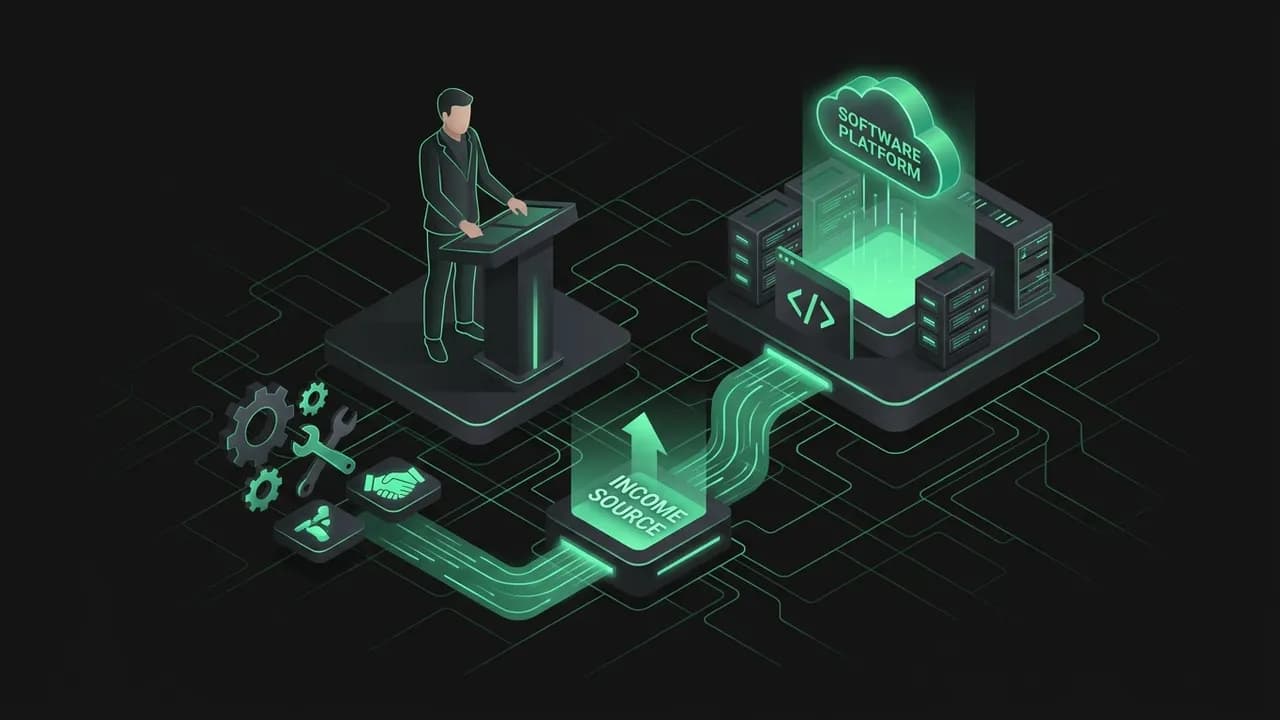
Many founders dream of building software first because software appears scalable, fundable, and recurring. Services, by contrast, are often treated as less glamorous: harder to scale, more labor-intensive, and too dependent on people. But in practice, many of the strongest software businesses begin as service businesses.
That is because services force contact with real customer pain. Consulting, agency work, implementation, advisory, and done-for-you delivery expose the founder to repeated workflows, recurring objections, messy edge cases, and the practical details of what customers will actually pay to solve. Software built after that learning can be much stronger than software imagined in isolation.
This is the logic of the service-first bridge. Instead of treating consulting as a distraction from software, the founder uses services to discover demand, refine the use case, understand the economics, and gradually productize what keeps repeating.
In 2025-2026, this path is especially relevant because markets are crowded, software acquisition is expensive, and buyers increasingly prefer solutions that are clearly tied to outcomes. A service-first path can reduce guesswork, generate early cash flow, and reveal what part of the work is truly productizable.
The real question is not "should we stay a service business forever?" The better question is: which parts of the service workflow are repeated, valuable, and standardizable enough to become software, and which parts should remain human because they create premium value?
Core Framework: How the Service-First Bridge Works
The path from consulting to software usually has five stages.
1. Solve the Problem Manually
Work directly with customers and understand the workflow in detail.
2. Identify Repetition
Notice which tasks, decisions, reports, or processes repeat across clients.
3. Standardize the Workflow
Turn scattered delivery into templates, SOPs, playbooks, or internal tools.
4. Productize the Repeatable Layer
Extract the reusable part into a tool, dashboard, system, or workflow product.
5. Separate Human Value From Software Value
Keep premium judgment, strategy, or high-trust work human while software handles the repeatable layer.
This framework matters because software should emerge from repeated customer evidence, not just founder intuition. The more consistent the repeated workflow, the more likely there is a real software opportunity underneath the service business.
When the Service-First Bridge Works Best
The consulting-to-software path works best when:
This path is especially strong in categories like:
It is less effective when every client problem is truly bespoke, when the founder never reaches operational pattern recognition, or when the value comes entirely from expert judgment that does not translate well into product form.
Execution: How to Move From Custom Work to Productized Revenue
Step 1: Capture Repeated Tasks
Document what happens in delivery over and over again.
Step 2: Build Internal Tools Before External Products
A simple internal tool often proves product demand better than a large public launch.
Step 3: Standardize Inputs and Outputs
The more structured the workflow becomes, the easier it is to turn into software.
Step 4: Test Product Pull With Existing Clients
Offer software as a layer that improves speed, visibility, or collaboration.
Step 5: Decide the Long-Term Mix
Some businesses stay hybrid: software + services. Others gradually shift more value into product.
The goal is not to abandon services prematurely. The goal is to use services as a laboratory for discovering which parts deserve to scale through software.
Real-World Examples: How Services Become Software
Example 1: Agency tools becoming SaaS
Many marketing, SEO, and analytics products began as internal tools used by agencies or consultants.
Example 2: Recruiting and HR workflows
Service-heavy hiring firms often discover repeatable coordination, evaluation, or pipeline management layers that can be productized.
Example 3: Fintech and back-office software
Accounting, RevOps, and finance services often uncover recurring reporting and reconciliation tasks ripe for automation.
Example 4: Education and coaching systems
Coaches and consultants often turn frameworks, dashboards, and progress systems into software or memberships.
Example 5: AI workflow tooling
Some AI businesses begin as done-for-you process improvement work, then extract repeated prompts, review steps, or orchestration layers into software.
Common Pitfalls & How to Avoid Them
Pitfall 1: Trying to build software before enough repetition exists
This creates product guesswork.
Pitfall 2: Productizing custom chaos
If delivery is still inconsistent, the product will inherit that mess.
Pitfall 3: Abandoning service revenue too early
Software often takes longer to validate than founders expect.
Pitfall 4: Confusing expert judgment with automatable process
Not all valuable work should become software.
Pitfall 5: Building for current clients only
A product needs a market beyond one or two custom accounts.
Pitfall 6: Underestimating go-to-market shift
Selling software is different from selling services.
What to Measure in the Service-to-Software Transition
Core Metrics
Diagnostic Questions
The strongest service-to-software transition is not the one that escapes services fastest. It is the one that productizes the right layer at the right time.
Actionable Conclusion: Let Services Teach You What Software Should Be
Services can be the best path to software when founders use them as a discovery engine instead of a permanent detour. The real leverage comes from understanding what repeats, what scales, and what should stay human.
Your Next 5 Steps
document repeated workflows across current clients
isolate the tasks that are standardizable and tool-friendly
build internal tooling before externalizing the product fully
test product pull with existing service accounts
decide deliberately which value remains human and which becomes software
SEO / Optimization Notes
This guide should naturally target keywords like consulting to software, service to SaaS, productizing services, software from consulting, and service first startup. The meta description should emphasize how consulting can become a bridge to software revenue. Internally, this guide should connect to subscription models, licensing, upselling, and ARR/MRR guides in Module 5.
The best software ideas are often hiding inside service businesses that have seen the same painful workflow one hundred times in a row.
Economics: Why Services Create the Learning and Cash Flow Software Usually Lacks Early On
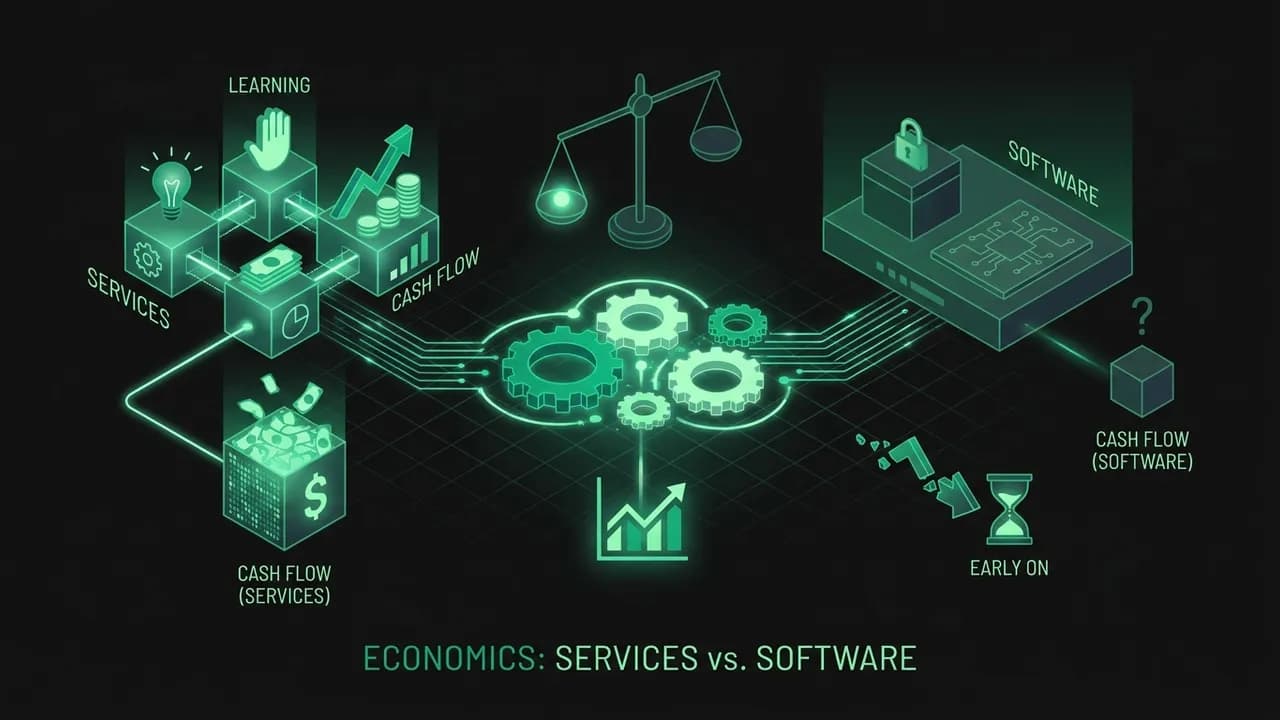
One of the strongest arguments for the service-first bridge is economic. Services often create early revenue faster than software because customers will pay for human help before they will trust a new tool. That revenue can fund product discovery, hiring, and experimentation without relying entirely on outside capital.
But the deeper advantage is not just cash. It is learning density. In services, every client conversation, delivery cycle, and problem diagnosis produces information about what actually matters. Software founders often spend months guessing which feature matters most. Service-first founders see the answer in daily work.
That said, service economics and software economics are different. Services monetize time, expertise, and outcomes directly. Software monetizes repeatability, onboarding, and retained usage. The bridge works only when founders use service revenue to identify scalable product layers rather than simply expanding service headcount forever.
The healthiest path usually combines:
Without that discipline, a founder can become trapped in a successful service business that never truly becomes a product company.
Customer Psychology: Why Buyers Often Trust Service First and Product Second
Customers usually buy services first when the problem feels high-stakes, unclear, or operationally messy. Human help reduces uncertainty. Buyers feel safer paying for an expert who can adapt than for software they are not yet sure will fit.
This is exactly why service-first can be such a strong bridge to software. Once the customer sees repeated value through the service, they become more open to productizing part of the relationship. They have already experienced the outcome and now want more speed, visibility, or independence.
This shift in psychology matters. The product is no longer asking the customer to imagine value from scratch. It is helping them scale or stabilize value they already understand.
That is often the best moment to introduce software:
Advanced Examples: What Productization Looks Like in the Real World
Example 6: RevOps and internal dashboard tools
Consultants often build internal dashboards, reporting layers, or workflow automations that eventually become product offerings.
Example 7: Compliance and audit workflows
Manual advisory work often reveals repeated documentation, approval, and evidence-collection patterns that can be productized.
Example 8: Recruiting and evaluation workflows
Search firms and recruiting operators often discover repeatable pipeline and assessment layers worth building as tools.
Example 9: AI-assisted service delivery
Done-for-you AI workflow services often reveal reusable prompt libraries, review pipelines, and orchestration interfaces.
Operating Model: How to Productize Without Breaking the Service Engine
The transition works best when productization is staged rather than abrupt.
Useful Sequence
Review Questions
This operating model matters because founders often make one of two mistakes: they wait too long to productize, or they productize too early and lose the very customer proximity that gave them an advantage in the first place.
Tooling and Packaging: Internal Tools Become Products Only When They Become Understandable
Many service-first founders build internal tools long before they build a customer-facing product. That is usually a good sign. Internal tools prove repeated need. But an internal tool is not automatically a product.
To become productizable, the tool usually needs:
This packaging step is critical. A tool that works well inside the company may still be too messy, too brittle, or too context-dependent for customers. Productization happens when the internal leverage layer becomes usable and valuable beyond the founder's own hands.
Hybrid Models: Many Great Businesses Stay Software Plus Services
A common mistake is assuming success means abandoning services completely. In reality, many strong companies remain hybrid on purpose.
Software plus services can be powerful when:
This hybrid design can improve retention and monetization because it lets different customer segments buy at different levels of support. It can also increase defensibility, since competitors may copy the software more easily than the combined system of software, methodology, and delivery expertise.
The right end state is not always pure SaaS. The right end state is whatever mix creates durable value and healthy economics.
Final Playbook: How to Know What Should Become Software
Before productizing a service workflow, answer these questions:
what part of delivery repeats across most accounts?
what part creates the biggest bottleneck or cost?
what part can be standardized without killing results?
would customers pay for access to the tool or only for the outcome it supports?
should the long-term business be hybrid or increasingly software-led?
These questions matter because not every repeated task deserves productization. The best software candidates are repeated, painful, high-frequency, and legible enough to become part of a customer's operating routine.
Final Decision Principle: Let Repetition Earn the Right to Become Product
The cleanest principle in the service-first bridge is this: repetition earns the right to become product. When the same workflow appears across enough customers, with enough consistency, and enough willingness to pay, the business has strong evidence that software may deserve to exist.
That principle keeps founders grounded. It prevents both premature software fantasy and long-term service stagnation.
Key Takeaways
Use consulting revenue to fund development and validate exactly what customers will pay for, without dilution.
Productize the work you repeat across clients; climb from bespoke projects to templated services to self-serve software.
Turn early service clients into design partners and reference customers for the product.
Guard against over-customization and endless services demand by setting explicit milestones to move up the staircase.
Track product revenue share as a target so the services-to-SaaS transition is measured, not just hoped for.
Frequently Asked Questions
What is the consulting-to-software (services-to-SaaS) model?
How do you transition from services to a SaaS product?
What are examples of services-to-software companies?
Why use consulting to fund a product?
What are common services-to-SaaS mistakes?
How do you avoid getting stuck in services?
Your Turn: The Action Step
Services-to-Product Bridge Plan
Turn a repeatable consulting engagement into a productisable software offering — by finding the repeated work, packaging it, and planning the revenue-mix shift over time.
Audit recent engagements for repetition
Across your last 5 projects, list the work you did EVERY time. That's your product seed.
Quantify the service baseline
Average fee, duration, and gross margin of a typical engagement.
Design the productised offering
What does the repeated work become as a packaged product/SaaS, and at what price?
Plan the revenue-mix shift
Set the service:product split for each of the next 4 quarters.
| Quarter | Service % | Product % |
|---|---|---|
Design the bridge offer
A hybrid (setup fee + subscription) that eases existing clients onto the product.
Before you close this
0/5 doneYour answers are saved in this browser only. Use “Download as PDF” to keep a copy.
Make More Money From Same Customers: Upselling & Cross-Selling
Ready to apply this?
Stop guessing. Use the Litmus platform to validate your specific segment with real data.
Build Your Bridge