Dynamic Pricing: How Airlines and Uber Maximize Revenue
Static pricing is a relic of the industrial age. This 3,000-word guide masters the 'Yield Management' Protocol to help you implement surge pricing, time-based discounts, and AI-driven segmentation to maximize every dollar.

Why Dynamic Pricing Is Powerful, Profitable, and Easy to Misuse

Dynamic pricing is one of the most misunderstood revenue strategies in business. To some founders, it looks like a sophisticated optimization engine that automatically increases revenue by charging different customers different prices at different times. To many customers, it can look unfair, manipulative, or confusing—especially when price changes feel opaque.
That tension is what makes dynamic pricing both powerful and dangerous. At its best, dynamic pricing helps match price to real-time demand, capacity constraints, urgency, inventory perishability, or customer willingness to pay. At its worst, it damages trust, creates backlash, and teaches customers to game the system.
In 2025-2026, dynamic pricing is far more relevant than airlines and ride-sharing alone. It now shapes SaaS packaging, ecommerce discounts, ticketing, hospitality, logistics, API usage, delivery economics, and many digital marketplaces. Better data infrastructure makes dynamic pricing more accessible. But easier access does not make it strategically simple.
The real question is not "can we change prices dynamically?" The better question is: when does dynamic pricing improve revenue and resource allocation in a way customers can tolerate or even understand, and when does it cross the line into value destruction or trust erosion?
Core Framework: What Dynamic Pricing Actually Optimizes
Dynamic pricing is usually trying to optimize one or more of the following variables.
1. Demand Fluctuation
Raise or lower price based on current demand levels.
2. Capacity Constraints
When supply is limited, pricing helps allocate scarce inventory or time.
3. Time Sensitivity
Some goods become less valuable over time or need to be sold before expiry.
4. Utilization Efficiency
Pricing can smooth demand across peak and off-peak windows.
5. Customer Segment or Use Case Variation
Different customers create different levels of value or urgency.
Airlines, ride-sharing, hotels, cloud infrastructure, and marketplaces all use dynamic pricing because static pricing often leaves money on the table or misallocates scarce resources.
But optimization only works when the model is linked to real business constraints. If prices change arbitrarily or without a credible reason, customers perceive the system as exploitative rather than rational.
When Dynamic Pricing Works Best
Dynamic pricing tends to work best in situations with:
Classic Cases
Why It Works in These Categories
Customers may not love price variation, but they can often understand the reason behind it: availability changes, timing matters, or demand exceeds supply.
Dynamic pricing becomes much harder in categories where cost structure is invisible, the product is identical at all times, or customers expect stable pricing as part of the brand promise.
Execution: How to Design Dynamic Pricing Without Breaking Trust
Step 1: Define the Variable That Justifies Price Change
Examples:
Step 2: Decide How Transparent to Be
Transparency does not mean publishing every formula, but customers usually need a believable explanation.
Step 3: Set Guardrails
Dynamic pricing should have ceilings, floors, and fairness boundaries.
Step 4: Align With Customer Value
If higher price does not correspond to higher urgency, convenience, or scarcity, the system feels extractive.
Step 5: Monitor Behavioral Reactions
Customers may delay purchases, switch channels, abandon transactions, or complain publicly if pricing feels unreasonable.
The strongest dynamic pricing systems are disciplined. They optimize revenue while protecting trust and market perception.
Real-World Examples: How Dynamic Pricing Maximizes Revenue
Example 1: Airlines
Airlines change prices based on route demand, booking timing, seat availability, and travel windows.
Example 2: Uber / ride-sharing
Surge pricing is used to balance rider demand with driver supply during peak times.
Example 3: Hotels
Hotels adjust price by seasonality, occupancy, events, and booking timing.
Example 4: Cloud and API platforms
Usage-based or priority-based pricing can act like dynamic pricing by aligning cost with actual consumption or performance need.
Example 5: Event and ticket marketplaces
Prices move based on scarcity, event timing, and buyer urgency.
Common Pitfalls & How to Avoid Them
Pitfall 1: Dynamic pricing without a real constraint
Customers resent price movement that feels arbitrary.
Pitfall 2: Over-optimizing short-term revenue
Higher revenue today can create lower trust tomorrow.
Pitfall 3: No fairness guardrails
Extreme price swings trigger backlash.
Pitfall 4: Zero transparency
Opaque pricing feels manipulative.
Pitfall 5: Ignoring customer gaming behavior
Users learn to wait, compare, or circumvent if the system is predictable in the wrong way.
Pitfall 6: Applying airline logic to the wrong product
Not every category supports high price volatility.
What to Measure in Dynamic Pricing
Core Metrics
Diagnostic Questions
The best dynamic pricing systems improve both revenue efficiency and resource allocation without creating permanent trust damage.
Actionable Conclusion: Optimize Price Around Real Constraints, Not Greed
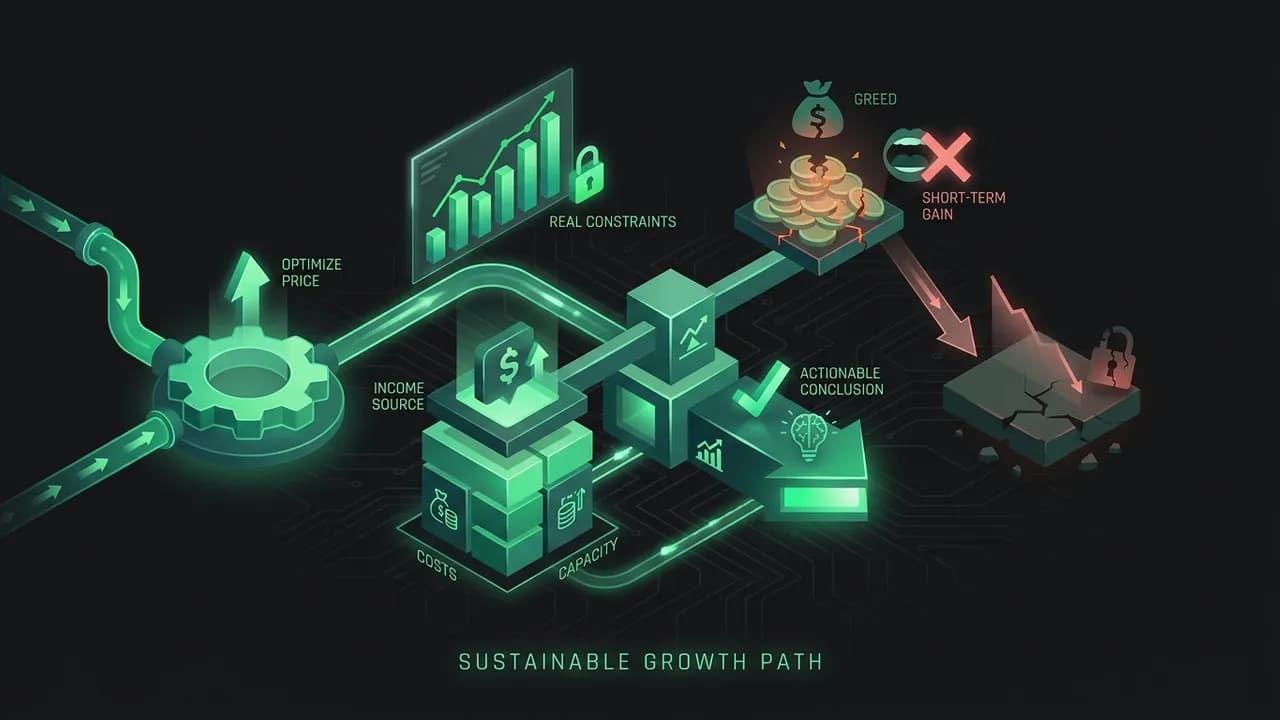
Dynamic pricing can be a brilliant revenue lever when it reflects real demand, capacity, urgency, or usage conditions. It becomes harmful when price movement feels arbitrary or opportunistic.
Your Next 5 Steps
identify the real variable that should justify price movement
test whether customers can understand the pricing logic
add ceilings, floors, and fairness guardrails
measure trust and behavior alongside revenue lift
avoid dynamic pricing where stable pricing is part of the brand promise
SEO / Optimization Notes
This guide should naturally target keywords like dynamic pricing, surge pricing, revenue optimization, pricing strategy, and demand based pricing. The meta description should emphasize when dynamic pricing improves revenue and when it damages trust. Internally, this guide should connect to discount psychology, tiered pricing, subscription fatigue, and ARR/MRR guides in Module 5.
The smartest pricing system is not the one that extracts the most in a single moment. It is the one that aligns price with reality without teaching customers that the brand is opportunistic.
Revenue Economics: Dynamic Pricing Works Best When Capacity and Timing Really Matter
The reason dynamic pricing can be so powerful is that it helps businesses capture more value from scarce, time-sensitive, or highly variable demand. Airlines cannot sell yesterday's empty seat tomorrow. Ride-sharing platforms cannot move yesterday's idle driver supply into tonight's rainstorm surge. Hotels lose revenue on unsold rooms every night.
In these settings, price becomes a balancing mechanism. It can:
The economic logic is strongest when unused capacity is perishable and when supply-demand mismatch is expensive. In those cases, static pricing often leaves money on the table or misallocates scarce resources.
But if the product has no real capacity constraint, no time sensitivity, and no meaningful usage variability, then dynamic pricing often looks more opportunistic than intelligent.
Customer Psychology: Why Fairness Perception Matters as Much as Revenue Lift
Customers rarely judge dynamic pricing as economists. They judge it as people. That means fairness perception matters enormously.
Users are more likely to accept price variation when:
Users are less likely to accept it when:
This is why dynamic pricing cannot be evaluated only through revenue dashboards. A pricing system that works economically but feels unfair can create social backlash, distrust, and long-term brand damage that is much harder to repair.
Advanced Examples: Beyond Airlines and Ride-Sharing
Example 6: Ecommerce flash-demand moments
Some ecommerce businesses use time-sensitive or inventory-sensitive pricing during high-demand launches.
Example 7: Delivery windows and logistics
Faster or more constrained delivery slots may cost more when operational load is higher.
Example 8: API and cloud infrastructure
Usage spikes, premium performance tiers, and reserved capacity models can function as dynamic revenue systems.
Example 9: Hospitality and events
Rates often adjust around city events, holiday periods, or demand peaks.
Operating Model: How to Run Dynamic Pricing With Discipline
Dynamic pricing should never be a black box that only the revenue team understands. It needs an operating model with clear accountability.
Questions to Review Regularly
Cross-Functional Input
This operating model matters because dynamic pricing is not only a math problem. It is also a product, trust, and brand problem.
Guardrails: The Difference Between Revenue Optimization and Trust Erosion
The healthiest dynamic pricing systems use clear guardrails. These boundaries protect customers from extreme swings and protect the company from short-term decisions that create long-term damage.
Good guardrails often include:
Guardrails matter because dynamic pricing systems inevitably encounter edge cases. If the company has no explicit fairness boundaries, the model will eventually optimize itself into backlash. Revenue systems need ethics and design constraints, not just algorithms.
Hybrid Models: Not Every Business Needs Fully Dynamic Pricing
Many startups benefit from partial dynamic pricing rather than total price fluidity. Hybrid models can preserve simplicity while still capturing some revenue optimization.
Examples include:
This approach works because it gives the business some pricing flexibility while keeping the user experience more understandable. In many categories, customers tolerate limited variability far more than fully unpredictable pricing.
That is often the smarter path for early-stage companies: introduce pricing variability only where the logic is clearest and most defensible.
Final Playbook: How to Decide if Dynamic Pricing Is Worth It
Before adopting dynamic pricing, answer these questions:
what real business constraint are we trying to solve?
will customers understand why the price changes?
where do we need fairness caps or exception handling?
would a simpler hybrid model create most of the upside with less confusion?
are we optimizing for revenue alone, or also for trust and repeat behavior?
These questions matter because dynamic pricing is easy to admire from the outside and easy to overuse on the inside. The strongest systems are grounded in operational reality, not pricing theater.
Final Decision Principle: Price Variability Must Reflect Real Variability
The simplest rule for dynamic pricing is this: price variability should reflect real variability. If demand, supply, timing, urgency, or cost genuinely change, dynamic pricing can be rational and even efficient. If the product is fundamentally stable and the variation feels artificial, the pricing system will eventually look manipulative.
That principle helps founders distinguish between smart optimization and short-sighted extraction.
Key Takeaways
Dynamic pricing pays off most where capacity is perishable and demand swings, like flights, hotels, and ride-sharing.
Tie every price change to a real constraint (empty seats, available drivers); variability without a reason reads as gouging.
Early-stage teams should start with transparent peak/off-peak tiers before attempting real-time AI pricing.
Cap surge with guardrails and explain why prices move; fairness perception protects long-term revenue.
Measure revenue per available unit and utilization, not just average price, and watch complaint volume for backlash.
Frequently Asked Questions
What is a dynamic pricing strategy?
How does surge pricing work for companies like Uber and airlines?
What are real examples of dynamic pricing?
How can an early-stage startup implement dynamic pricing?
What are common dynamic pricing mistakes?
What should I measure when running dynamic pricing?
Your Turn: The Action Step
Dynamic Pricing Rules Designer
Build a concrete, defensible set of dynamic-pricing rules — what triggers a price change, how much, and where the floor and ceiling sit — that you can hand to an engineer.
Set the base price and guardrails
Write your anchor price, the absolute floor (your cost + min margin), and the ceiling.
List the demand/supply signals you can read
What data do you actually have? Time of day, weather, inventory left, queue length, segment.
Write the pricing rules
One row per rule: the trigger, the multiplier, and the resulting price.
| Trigger | Multiplier | Resulting price |
|---|---|---|
Add fairness guardrails
What will you NOT do? (Surge on emergencies, stack multipliers, exploit new users.)
Define the measurement
Which metric proves dynamic pricing is helping — revenue/order, fill rate, or churn?
Before you close this
0/5 doneYour answers are saved in this browser only. Use “Download as PDF” to keep a copy.
The Business Strategy Behind Selling at Loss
Ready to apply this?
Stop guessing. Use the Litmus platform to validate your specific segment with real data.
Optimize Your Yield