Enterprise Sales: Navigating Procurement and Long Cycles
Enterprise deals don't die on the product; they die in the procurement office. This 3,000-word guide masters the 'Contract Champion' Framework to help you navigate 6-month sales cycles and close six-figure B2B contracts.

Why Enterprise Revenue Is Attractive but Operationally Expensive
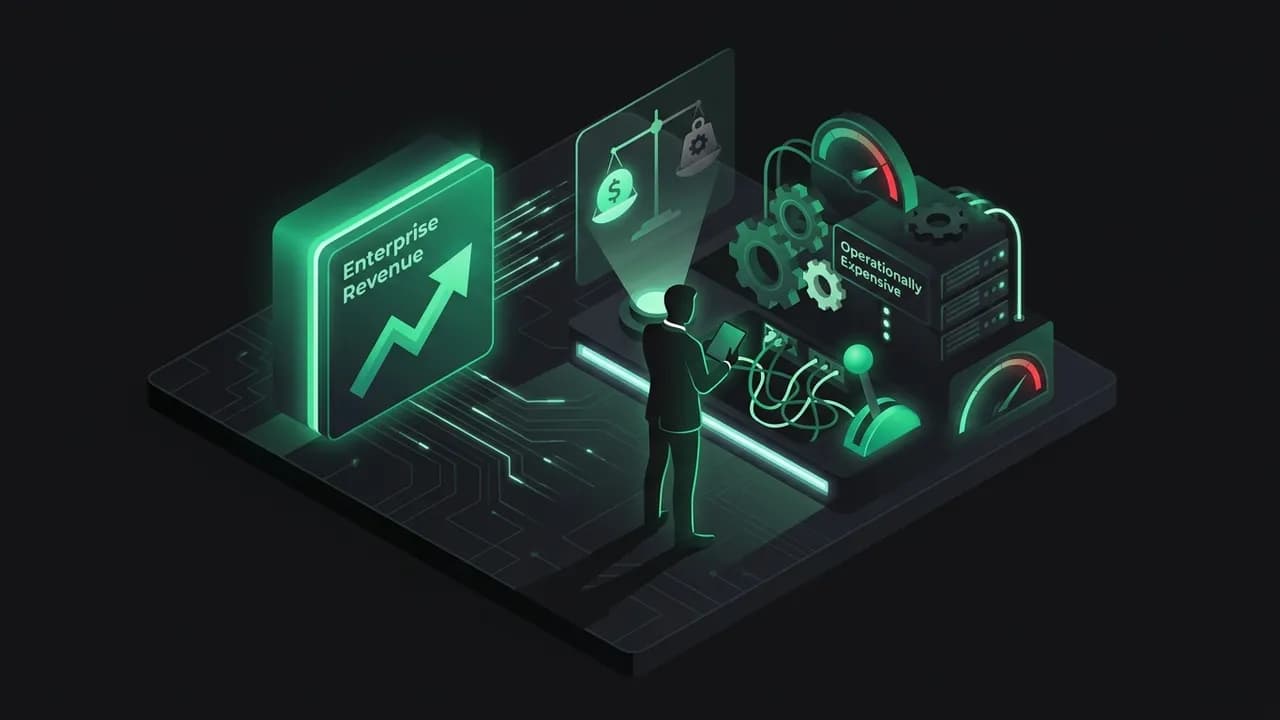
Enterprise sales are attractive because a single deal can generate meaningful revenue, create credibility in the market, and open the door to long-term expansion. Large customers can produce bigger contracts, multi-year agreements, premium support revenue, and stronger account-level retention than many SMB or self-serve customers.
But enterprise revenue is rarely simple. It comes with long cycles, multiple stakeholders, procurement reviews, legal redlines, security questionnaires, pilots, budget timing, and internal champion risk. Founders often underestimate how much of enterprise selling is not persuasion but navigation: navigating internal politics, buying committees, compliance requirements, and the slow machinery of large organizations.
In 2025-2026, enterprise selling remains highly relevant across SaaS, data products, AI tools, infrastructure, fintech, cybersecurity, and workflow software. At the same time, buyers are more cautious, governance is tighter, and procurement scrutiny is stronger—especially for products involving data, AI outputs, or operational risk.
That is why the real question is not "can we sell to enterprises?" The better question is: does the product solve a painful enough problem, for a large enough buyer, that the company can justify the long sales cycle and operational burden required to close and support enterprise accounts?
Enterprise revenue can be highly valuable. But it only works when the business is prepared for the complexity that comes with it.
Core Framework: What Makes Enterprise Sales Different
Enterprise sales differ from SMB or self-serve models in several important ways.
1. More Stakeholders
There is rarely one buyer. There may be a champion, economic buyer, procurement, security, legal, finance, and end users.
2. Longer Validation Cycles
Large customers often need pilots, references, internal alignment, and proof of ROI.
3. Higher Trust Burden
Security, compliance, uptime, data handling, and vendor reliability matter much more.
4. More Friction in Closing
MSAs, DPAs, procurement systems, and redlines can slow deals significantly.
5. Larger Expansion Potential
Once land-and-expand begins, enterprise accounts can grow through seats, departments, regions, or higher-value tiers.
Enterprise selling is not just a bigger version of normal sales. It is a different operating model. The product, sales process, onboarding, support, and company readiness all need to support more complex buying and delivery behavior.
When Enterprise Sales Is the Right Revenue Strategy
Enterprise sales works best when:
It is especially strong for:
It is weaker when the product is nice-to-have, hard to quantify, not deeply embedded, or too lightweight to survive the scrutiny of multi-step evaluation.
Execution: How to Navigate Procurement and Long Sales Cycles
Step 1: Identify the Real Economic Pain
Enterprise buyers act slowly unless the problem is expensive, risky, or strategically visible.
Step 2: Find a Champion
A champion is the internal advocate who pushes the deal forward when you are not in the room.
Step 3: Prepare for Multi-Stakeholder Selling
Map:
Step 4: Reduce Procurement Friction Early
Security documents, compliance answers, pricing clarity, and standard agreement readiness can remove weeks of delay.
Step 5: Plan for Post-Sale Delivery
Enterprise selling does not end at signature. Onboarding, enablement, adoption, and renewal preparation begin immediately.
The companies that close enterprise deals most consistently are often not the most charismatic. They are the most operationally prepared.
Real-World Examples: What Enterprise Selling Actually Looks Like
Example 1: Security and compliance software
These products often close because the cost of risk is high enough to justify long evaluation cycles.
Example 2: Core analytics and data infrastructure
Enterprise buyers tolerate longer cycles when the tool becomes essential to decision-making or reporting.
Example 3: HR and recruiting platforms
Large organizations often require stakeholder alignment across people ops, finance, and IT.
Example 4: AI workflow software
AI products increasingly face governance, security, and reliability scrutiny before enterprise rollout.
Example 5: Land-and-expand SaaS
Some products start with one team or department, then grow account value through visible internal adoption.
Common Pitfalls & How to Avoid Them
Pitfall 1: Chasing enterprise logos too early
Large deals look attractive, but readiness may be low.
Pitfall 2: No champion inside the account
Deals stall without internal momentum.
Pitfall 3: Underestimating procurement and legal delays
These can add months unexpectedly.
Pitfall 4: Selling value vaguely
Enterprise buyers need clearer ROI or risk-reduction logic.
Pitfall 5: Treating close as the finish line
Poor onboarding kills renewal and expansion.
Pitfall 6: Taking every enterprise request literally
Custom requests can derail the product roadmap.
What to Measure in Enterprise Revenue Systems
Core Metrics
Diagnostic Questions
The best enterprise revenue engine is not the one with the biggest pipeline headlines. It is the one that closes the right accounts and retains them profitably.
Actionable Conclusion: Enterprise Sales Rewards Readiness More Than Hype

Enterprise revenue can be transformative, but only when the company is ready for the complexity that large customers bring. Big logos are not strategy. Solving a painful enough problem with enough operational readiness is strategy.
Your Next 5 Steps
validate that the product solves a painful enterprise-grade problem
map the stakeholders involved in a typical enterprise deal
prepare procurement, security, and legal materials before scaling outreach
equip internal champions with ROI and implementation narratives
build post-sale onboarding and expansion into the revenue model from day one
SEO / Optimization Notes
This guide should naturally target keywords like enterprise sales, procurement process, long sales cycle, enterprise SaaS sales, and B2B enterprise revenue. The meta description should emphasize how to navigate procurement and complex buying cycles. Internally, this guide should connect to consulting to software, one-time vs recurring revenue, usage pricing, and ARR/MRR guides in Module 5.
Enterprise deals rarely go to the founder with the best pitch alone. They go to the company that can survive the full complexity of being chosen.
Economics: Large Contracts Only Help If They Outweigh the Cost of Complex Selling
Enterprise deals can look incredible at the top line. A few large contracts may equal the revenue of dozens or hundreds of smaller customers. But enterprise economics are not just about contract size. They are about the full cost of winning and supporting those accounts.
Enterprise selling usually requires:
That means a large ACV is not automatically a great business. The deal has to be large enough, retained enough, and expandable enough to justify the human effort and cycle time required to close it.
The healthiest enterprise motions often look expensive early but become highly efficient when:
This is why enterprise revenue should be judged by lifetime account economics, not only by the thrill of a big first contract.
Buyer Psychology: Enterprise Customers Are Buying Career Safety as Much as Software
Enterprise buyers do not only ask, "Is this product good?" They also ask, often implicitly, "Is this choice safe for me inside my organization?"
This changes the whole sales process. Buyers want:
That is why enterprise selling is so different from self-serve conversion. The sale often depends on whether internal champions can defend the decision politically, financially, and operationally. A product can be strong and still fail if the buying case is too hard to justify internally.
Founders who understand this sell differently. They equip buyers with proof, ROI framing, security clarity, and rollout logic that make the internal decision feel safer.
Advanced Examples: What Enterprise Readiness Really Looks Like
Example 6: Security-heavy products
These often win because the cost of doing nothing is high, but they still need strong documentation and trust signals.
Example 7: Department-first land and expand
Some products close one team first, then use adoption proof to expand across the org.
Example 8: ROI-led workflow software
Products that save time, reduce error, or cut cost can sell more effectively when the business case is quantified.
Example 9: AI tools in regulated environments
These may face unusual scrutiny around security, hallucination risk, and data handling.
Operating Model: Build an Enterprise Motion, Not Just Enterprise Hopes
Enterprise success usually requires a coordinated operating model.
Core Components
Questions to Review Regularly
This operating model matters because enterprise sales are easy to romanticize from the outside. In reality, a company needs repeatable machinery to turn large-account interest into durable revenue.
Procurement Strategy: Reduce Delay Before It Starts
Procurement often looks like an administrative detail from the outside, but in enterprise deals it can become a major timing risk. Many deals that appear "verbally won" still take weeks or months to close because the company was not prepared for paperwork, security review, or internal purchasing systems.
A stronger procurement strategy usually includes:
This preparation matters because procurement is rarely persuaded by excitement alone. It is cleared by readiness. The faster a company can remove avoidable procurement friction, the more likely it is to convert pipeline into actual revenue.
Hybrid Motions: Enterprise Revenue Often Starts With Smaller Entry Points
Not every enterprise motion needs to begin with a massive top-down sale. Many companies succeed by combining product-led, team-led, or departmental entry points with a later enterprise expansion motion.
Examples include:
This hybrid approach works because it gives the buyer evidence before asking for organizational commitment. It also gives the vendor internal proof of usage and value, which makes the larger enterprise case easier to defend.
Final Playbook: How to Build an Enterprise Motion That Can Actually Close
Before pushing harder into enterprise sales, answer these questions:
is the problem painful enough to justify a long buying process?
who are the key stakeholders and what does each one need to believe?
how ready are we for procurement, security, and legal review?
what proof helps a champion defend us internally?
can we support onboarding and expansion after the contract is signed?
These questions matter because enterprise success is rarely about one great pitch. It is about building a complete system that can survive scrutiny from first conversation through renewal.
Final Decision Principle: Enterprise Deals Go to the Most Defensible Vendor, Not Just the Loudest One
The cleanest principle in enterprise sales is this: large buyers choose the vendor they can defend internally. Product quality matters, but defensibility matters too—proof, readiness, security, implementation confidence, and champion enablement.
That is why enterprise revenue rewards operational maturity as much as product ambition.
Key Takeaways
Enterprise deals are won by building a champion and multi-stakeholder consensus, not by selling to one contact.
Map the full buying committee early and surface security, legal, and procurement requirements before they stall the deal.
Use a mutual action plan with dated milestones to keep multi-month cycles moving.
Quantify ROI for the economic buyer and hold value instead of discounting early.
Track your own average cycle length and stage win rates; aim for fewer, larger, predictable deals.
Frequently Asked Questions
What is the enterprise sales process?
How do you navigate enterprise procurement and long sales cycles?
What is a good enterprise sales cycle length and deal size?
What are examples of enterprise sales motions?
What are common enterprise sales mistakes?
How do you shorten an enterprise sales cycle?
Your Turn: The Action Step
Enterprise Deal Map & Procurement Tracker
Map every stakeholder, gate, and document in a single enterprise deal so a 6-month procurement cycle doesn't stall on a surprise you could have seen coming.
Map the buying committee
Name the real humans in each role: economic buyer, champion, end users, blockers.
| Role | Name / title | What they want | Win or block? |
|---|---|---|---|
Lay out the procurement stages
List each gate in order with the document it requires and who owns it.
| Stage | Document needed | Owner | Target date |
|---|---|---|---|
Pre-empt the security/legal review
What will Security and Legal almost certainly ask? List it now and get it ready.
Identify the single biggest deal risk
What one thing most likely kills or delays this deal, and your mitigation?
Set the close plan with a compelling event
Work backwards from a real deadline (budget freeze, renewal, audit). Write the dated steps.
Before you close this
0/5 doneYour answers are saved in this browser only. Use “Download as PDF” to keep a copy.
The Big Problem With Monthly Subscriptions
Ready to apply this?
Stop guessing. Use the Litmus platform to validate your specific segment with real data.
Close Big Deals