Subscription Fatigue: Is SaaS the Only Way?
The 'Golden Age' of SaaS is over; users are exhausted by monthly bills. This 3,000-word guide explores the 'Recurrence Spectrum' and how to win with Lifetime Deals, Usage-Based pricing, and the Hybrid model.

Why Subscription Fatigue Forces Startups to Rethink Revenue Design

Subscriptions became the default monetization model for a generation of startups because recurring revenue is attractive. Investors like predictability. Operators like compounding MRR. Finance teams like cleaner forecasting. And founders like the story of stable, expanding revenue over time.
But customers do not experience subscriptions as spreadsheets. They experience them as another recurring charge, another renewal decision, another service that must justify its place in the monthly budget. That is where subscription fatigue enters the picture.
In 2025-2026, subscription fatigue is not just a consumer media problem. It affects software, productivity tools, education products, creator platforms, wellness apps, AI tools, and many forms of digital access. Buyers are increasingly willing to cancel, consolidate, downgrade, or rotate between tools unless the ongoing value is clear and continuous.
This creates a serious strategic question for startups: is SaaS-style recurring revenue still the best model for every product, or are there cases where one-time sales, usage-based pricing, service hybrids, outcomes-based pricing, or membership-style access make more sense?
The answer is not that subscriptions are dead. The answer is that lazy subscriptions are. A recurring charge only works when the product delivers recurring value that customers can feel, explain, and defend when they review spending.
Core Framework: When Subscription Models Work and When They Break
Subscription models work best when four conditions are true.
1. Recurring Value Exists
The customer receives ongoing utility, access, convenience, or outcomes on a repeat basis.
2. Usage or Need Repeats Naturally
The product is not a one-time fix. It supports a repeated workflow, continuing service, fresh content, ongoing collaboration, or evolving insight.
3. Switching Cost or Habit Strengthens Over Time
The more the customer uses the product, the harder it becomes to replace because of habit, workflow integration, team adoption, or stored value.
4. Price Feels Justified Repeatedly
The user can re-justify the recurring spend every month, quarter, or year.
Subscriptions break when one or more of these conditions fail. If the product solves a one-time job, if value arrives only during onboarding, or if customers can pause without pain, recurring pricing becomes fragile.
That is why the real issue is not whether SaaS is good. It is whether recurring pricing fits the underlying value pattern of the product.
Alternative Revenue Models When Recurring SaaS Is a Bad Fit
One-Time Sales
Best when the customer solves a discrete problem once or only occasionally.
Examples: templates, courses, audits, toolkits, digital assets.
Usage-Based Pricing
Best when customer value scales with consumption.
Examples: API calls, storage, compute, messaging, payments.
Hybrid Subscription + Usage
Best when there is a platform fee plus variable consumption.
Examples: infrastructure software, communications tools, fintech products.
Service + Software Hybrid
Best when customers need help implementing or operating the solution.
Examples: managed services, consulting-backed SaaS, done-with-you platforms.
Membership / Access Models
Best when ongoing value comes from community, content, privileges, or curation.
Examples: creator memberships, professional communities, research access.
Outcome or Performance-Based Pricing
Best when the company can credibly tie price to delivered results.
Examples: recruiting, lead generation, revenue-share, savings share.
The right model depends on whether the product creates recurring value, episodic value, usage-linked value, or outcome-linked value.
Decision Model: How to Choose Whether Subscription Is the Right Fit
Ask these questions in order:
Does the user get value repeatedly without needing to be re-sold each time?
Would the customer feel pain if access disappeared next month?
Does usage naturally continue, or is it bursty and project-based?
Would another model align price more directly to value delivered?
Are we using subscription because it fits, or because investors expect it?
If the product has recurring workflows, durable habit, and clear monthly value, subscription is usually strong.
If the product is sporadic, project-based, or solved in bursts, a recurring fee may create resentment faster than loyalty.
A model mismatch can produce the illusion of healthy revenue early while quietly increasing churn, discount dependency, and customer skepticism.
Execution: Building a Revenue Model That Matches Customer Reality
Step 1: Map the Value Cycle
How often does the customer actually need the product?
Step 2: Identify the Monetizable Unit
What should the customer pay for?
Step 3: Model Customer Psychology
Customers tolerate recurring billing when the product feels like ongoing infrastructure or ongoing advantage. They resist it when the charge feels detached from recent value.
Step 4: Test Pricing Narrative
The pricing model has to be easy to explain. If customers immediately ask, "Why is this a subscription?" that is a warning sign.
Step 5: Measure Retention Quality
Look beyond first conversion. A weak recurring model often reveals itself in early churn, downgrades, and discount pressure.
Real-World Examples: Subscription Success and Subscription Failure Modes
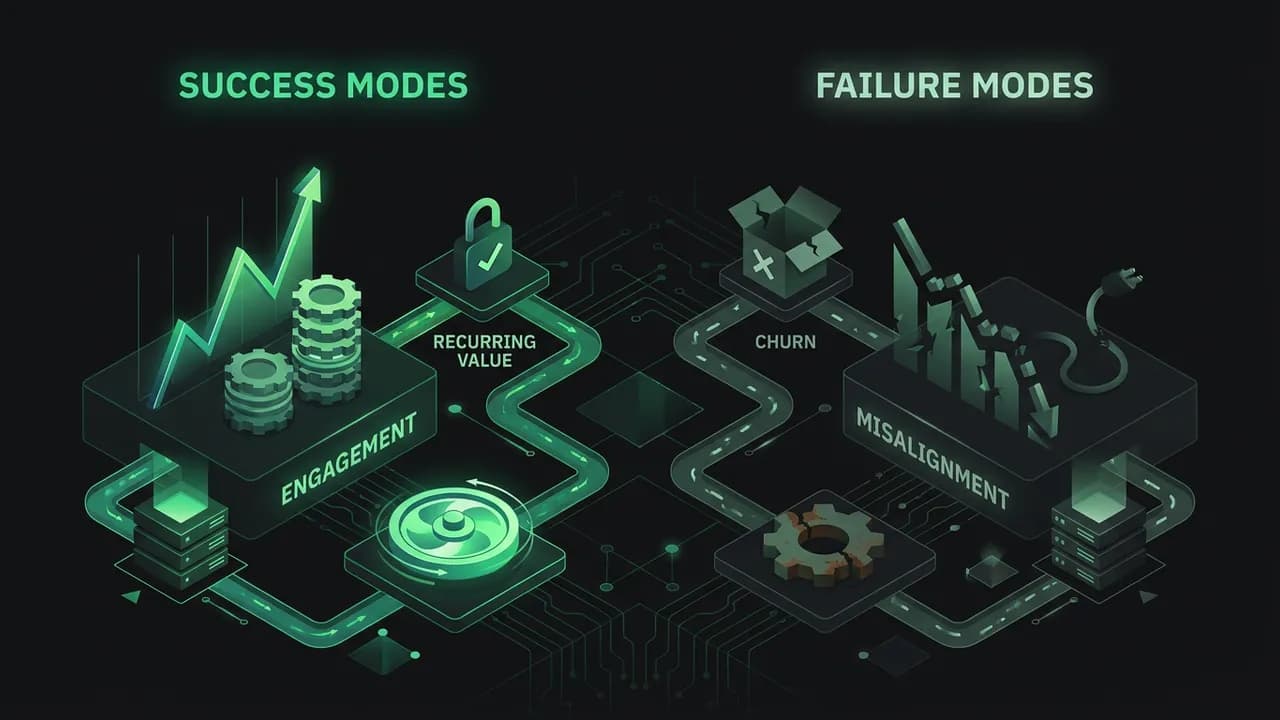
Example 1: Adobe Creative Cloud
Subscription works because the product supports continuing workflows, updates, collaboration, and professional dependency.
Example 2: Netflix and content subscriptions
Media subscriptions succeed when new value keeps arriving and habit remains strong. They weaken when customers feel they can rotate in and out without penalty.
Example 3: API and infrastructure tools
Usage-based or hybrid models often fit better than flat SaaS because value scales with actual consumption.
Example 4: Education products
Some learning products perform better as one-time programs or cohort-based offers than ongoing subscriptions because the core transformation is finite.
Example 5: Communities and memberships
Membership can work when the value is fresh curation, access, accountability, or belonging—not merely static content behind a paywall.
Common Pitfalls & How to Avoid Them
Pitfall 1: Choosing subscription because it looks investable
Recurring revenue is attractive only if customers genuinely want to keep paying.
Pitfall 2: Ignoring usage pattern
Project-based products often struggle under flat recurring fees.
Pitfall 3: Treating churn as normal instead of diagnostic
High churn may indicate model mismatch, not weak marketing.
Pitfall 4: Hiding weak value behind annual discounts
Aggressive annual pricing can mask model weakness temporarily.
Pitfall 5: No pricing narrative
If customers cannot explain why the product is recurring, skepticism rises.
Pitfall 6: Assuming all recurring models should look like SaaS
Many products need different recurring logic.
What to Measure When Evaluating Subscription Fit
Core Metrics
Diagnostic Questions
The strongest revenue model is the one customers continue choosing without feeling trapped.
Actionable Conclusion: Recurring Revenue Only Works When Value Recurs
Subscription fatigue does not mean recurring revenue is broken. It means recurring revenue has to be earned continuously.
Your Next 5 Steps
map whether customer value is truly recurring, episodic, or usage-based
compare subscription against one alternative pricing model honestly
review churn reasons for signs of model mismatch
test whether the pricing narrative feels obvious to customers
choose the model that best matches value delivery—not the trendiest model
SEO / Optimization Notes
This guide should naturally target keywords like subscription fatigue, SaaS pricing, recurring revenue, subscription model, and alternative pricing models. The meta description should emphasize when subscription pricing works and when other revenue models may fit better. Internally, this guide should connect to freemium vs trial, ARR/MRR, usage-based pricing, and dynamic pricing guides in Module 5.
The best monetization model is not the one founders admire on Twitter. It is the one customers keep paying for because the value keeps showing up.
Revenue Quality: Why Predictable Revenue Is Not Always Healthy Revenue
Recurring revenue looks clean in a spreadsheet, but the quality of that revenue matters more than the existence of the subscription itself. If recurring revenue depends on heavy discounting, weak retention, constant reacquisition, or users who do not fully understand why they are still paying, the model is less durable than it appears.
This is why founders should separate recurring revenue from healthy recurring revenue. Healthy recurring revenue usually includes:
A subscription business with weak revenue quality often spends its energy patching leaks. A business with stronger model fit compounds more naturally because the recurring charge matches a recurring reason to stay.
Customer Psychology: Why Recurring Charges Get Reviewed More Harshly Than One-Time Purchases
A one-time purchase is judged once. A subscription is judged repeatedly. That repeated judgment changes buyer psychology.
Customers ask themselves:
That is why subscription fatigue can appear suddenly. The issue is not always product failure. Sometimes it is simply that the product lost salience in the customer's mind. The charge stayed visible while the value faded into the background.
Strong subscription businesses solve this by making value visible continuously. They do not rely only on the product existing. They remind the customer, through outcomes, usage, insight, or convenience, why the ongoing fee makes sense.
Advanced Examples: What Different Recurring Models Can Teach Startups
Example 6: B2B seat-based SaaS
Seat-based pricing works well when the tool becomes embedded in team workflow and additional users create real value.
Example 7: AI tools with usage spikes
Many AI tools struggle with flat subscriptions because customer usage is irregular. Hybrid or usage-based pricing often fits better.
Example 8: Fitness and wellness apps
These products often depend heavily on motivation cycles. Retention weakens when the habit layer is not strong enough.
Example 9: Research or intelligence memberships
These can work when new insight, curation, or access continuously arrives. They weaken when the product feels static.
Operating Model: How to Review Whether Subscription Is Still the Right Model
A startup should not assume its first pricing model is permanent. As the product, customer base, and usage patterns evolve, the revenue model may need to evolve too.
A monthly or quarterly pricing review should ask:
Teams should also compare alternatives in live experiments. For example:
This operating model keeps monetization tied to customer reality instead of treating pricing as a fixed identity.
Hybrid Models: The Middle Ground Between SaaS and One-Time Pricing
Many startups do not need to choose between pure SaaS and pure one-time sales. Hybrid models often outperform both extremes because they separate different types of value.
Examples include:
Hybrid models work when they make the pricing logic easier to justify. The customer can see what they are paying for repeatedly and what they are paying for only once. That clarity reduces fatigue because the recurring charge feels earned by recurring value, while the one-time charge reflects setup, transformation, or project-specific work.
Final Playbook: How to Decide if Your Product Deserves a Subscription
Before you commit to subscription pricing, answer these questions clearly:
what value repeats often enough to justify recurring billing?
what user behavior proves that ongoing value is real?
what alternative model would better match bursty, project-based, or outcome-linked demand?
are we relying on annual plans or discounts to hide weak monthly value?
if the subscription vanished tomorrow, would customers fight to keep it?
These questions force honesty. Subscription is powerful when the product becomes part of the customer's operating system. It is fragile when it is just a convenient business model for the company.
Final Decision Principle: Recurring Billing Must Mirror Recurring Value
The simplest principle in subscription design is also the most important: recurring billing should mirror recurring value. If the customer's need, usage, and outcome repeat naturally, subscription can be a great fit. If not, another pricing model will often create less friction and healthier trust.
That is why the best monetization model is not the one with the prettiest MRR chart. It is the one customers repeatedly choose without feeling trapped into paying for yesterday's value.
Key Takeaways
Subscription only works when value genuinely recurs every billing period, not just because recurring revenue looks good on a deck.
Know your alternatives: usage-based, seat-based, lifetime deals, and outcome-based pricing each fit different value patterns.
Offer annual or usage options to relieve subscription fatigue for price-sensitive segments.
Recurring charges are scrutinized harder than one-time purchases, so make the value visible every single cycle.
Track active usage per paying account monthly; falling usage is an early churn warning the model is misfit.
Frequently Asked Questions
What is a subscription business model?
What are the main SaaS pricing models besides subscription?
Is SaaS subscription the only way to monetize software?
What are examples of subscription alternatives that work?
What are common subscription model mistakes?
How do I know if my product deserves a subscription?
Your Turn: The Action Step
Revenue Model Stress-Test (Beyond Subscriptions)
Pressure-test whether a subscription is actually right for your product, or whether a one-time, lifetime, or usage model would convert better and churn less.
Diagnose the fatigue signal
What proves customers resent the subscription? Cancellations, low usage, complaints — quote a real number.
Map usage frequency to billing frequency
How often do they actually use it vs how often you bill? A mismatch is the core problem.
List 3-4 candidate models
For each, note the price, the upside, and the risk.
| Model | Price | Upside | Risk |
|---|---|---|---|
Score each for psychological fit
Rate 1-5: does the billing feel fair given how they use it?
| Model | Feels fair? (1-5) | Likely churn (1-5) |
|---|---|---|
Pick and write the offer
Write the exact offer as a customer would read it on the pricing page.
Before you close this
0/5 doneYour answers are saved in this browser only. Use “Download as PDF” to keep a copy.
Why 1 Million Views Still Don’t Make Money
Ready to apply this?
Stop guessing. Use the Litmus platform to validate your specific segment with real data.
Analyze Your Revenue