Tiered Pricing Psychology: The 'Decoy' Effect
Pricing isn't about math; it's about choice architecture. This 3,000-word guide masters the 'Decoy Effect' and Asymmetric Dominance to help you nudge users toward your most profitable tiers without them ever feeling pressured.

Why Tiered Pricing Is About Decision Design, Not Just More Options

Tiered pricing is one of the most common monetization systems in startups because it seems to solve multiple problems at once. It allows a business to serve different customer segments, capture different willingness-to-pay levels, and create a pathway from entry-level adoption to premium revenue.
But most teams think about tiers too mechanically. They add a Basic, Pro, and Enterprise plan and assume the market will sort itself out. In reality, pricing tiers are not just a menu. They are a decision environment. The way choices are framed, compared, and anchored changes what customers perceive as reasonable, valuable, and "worth it."
That is where the decoy effect becomes relevant. A decoy tier is a strategically designed option that makes another tier look more attractive by comparison. This does not mean manipulation by default. It means pricing psychology is comparative. Customers rarely evaluate plans in isolation. They evaluate one against another.
In 2025-2026, tiered pricing is everywhere: SaaS, creator products, memberships, AI tools, education businesses, fintech apps, consumer subscriptions, and service bundles. But many teams still get it wrong by building tiers around internal packaging logic instead of customer decision logic.
The real question is not "how many plans should we have?" The better question is: how do we structure choices so that the right customer can quickly understand the value gap between plans and feel confident selecting the right one—while the business captures fair value across segments?
Core Framework: What Tiered Pricing Actually Does
Tiered pricing usually serves four strategic purposes.
1. Segmenting Different Customers
Different users have different budgets, needs, and willingness to pay.
2. Anchoring Value Perception
Higher-priced tiers can make mid-tier plans feel more reasonable and valuable.
3. Creating an Upgrade Path
As customers grow or usage deepens, the pricing model provides expansion room.
4. Simplifying Choice Through Structured Comparison
Well-designed tiers help customers self-select faster.
The Decoy Effect
The decoy effect happens when one option exists partly to change how another option is perceived. A tier may be intentionally less attractive so that the target tier looks like the obvious best value.
For example:
In this case, Basic and Enterprise may both influence more buyers toward Pro. That does not make the design dishonest if all options still have legitimate segment fit. It becomes problematic only when tiers are confusing, padded, or obviously artificial.
When Tiered Pricing and the Decoy Effect Work Best
Tiered pricing tends to work best when:
The decoy effect works best when customers can quickly compare plans and see a logical tradeoff. It works poorly when the tiers are so complex that comparison becomes mentally exhausting.
That is why strong tiered pricing usually feels clarifying. Weak tiered pricing feels like a maze designed to force overpayment. The difference is not whether comparison psychology exists. The difference is whether the structure helps or confuses the buyer.
Execution: How to Build Tiers That Convert Without Feeling Manipulative
Step 1: Define the Core Segments
Who is each plan really for?
Step 2: Package Around Outcomes
Customers should understand what each tier unlocks in terms of real use, not feature clutter.
Step 3: Choose the Target Tier
Most businesses have one tier they want to steer the majority of qualified users toward.
Step 4: Build Contrast Carefully
Use pricing, feature differences, and volume logic so the target plan looks clearly better for its intended segment.
Step 5: Review Friction and Regret
A tier system should not only increase conversion. It should reduce decision confusion and post-purchase regret.
Good tier design makes the right choice feel easy. Bad tier design makes every choice feel suspicious.
Real-World Examples: How Tiers Influence Choice
Example 1: SaaS Basic / Pro / Enterprise plans
Many SaaS companies use a middle Pro tier as the commercial center of gravity, with Basic as a starter path and Enterprise as a custom high-value path.
Example 2: Subscription media tiers
Digital publishers may offer a low entry tier, a premium membership, and a high-touch professional tier.
Example 3: Creator education products
A course, course-plus-community, and course-plus-coaching stack often uses the middle option to anchor perceived value.
Example 4: Cloud and usage products
Some products combine feature tiers with usage bands to steer different customer profiles effectively.
Example 5: Fast food / cinema combos
Even offline businesses use decoy logic when medium or combo options are designed to feel like the obvious best deal.
Common Pitfalls & How to Avoid Them
Pitfall 1: Too many tiers
Excessive choice increases confusion.
Pitfall 2: Arbitrary feature gating
Customers resent limits that feel artificial.
Pitfall 3: No clear target tier
If every plan looks equally random, users stall.
Pitfall 4: Decoy with no legitimate segment fit
A fake-feeling option can reduce trust.
Pitfall 5: Ignoring post-purchase mismatch
A higher conversion tier can still create churn if customers buy the wrong plan.
Pitfall 6: Internal logic over customer logic
Teams often package based on technical convenience.
What to Measure in Tiered Pricing Performance
Core Metrics
Diagnostic Questions
The best pricing tier system is not the one with the cleverest decoy. It is the one that helps customers self-select accurately while increasing healthy revenue.
Actionable Conclusion: Structure Choices So the Right Plan Feels Obvious
Tiered pricing is most effective when it clarifies the decision instead of complicating it. The decoy effect is powerful because customers compare options, but the best businesses use that insight to reduce confusion—not to build fake choices.
Your Next 5 Steps
define the real segments your pricing needs to serve
choose the target tier you want qualified users to prefer
package plans around outcomes, not random feature piles
simplify comparison so the value gap is obvious
measure retention and downgrade behavior, not just initial conversion
SEO / Optimization Notes
This guide should naturally target keywords like tiered pricing, decoy effect, pricing psychology, pricing tiers, and plan comparison. The meta description should emphasize how pricing structure influences customer choice. Internally, this guide should connect to discount psychology, dynamic pricing, upselling, and ARR/MRR guides in Module 5.
The best tier system does not trick people into buying more. It helps the right customer recognize the right plan faster.
Pricing Economics: Tiers Help Capture Different Levels of Willingness to Pay
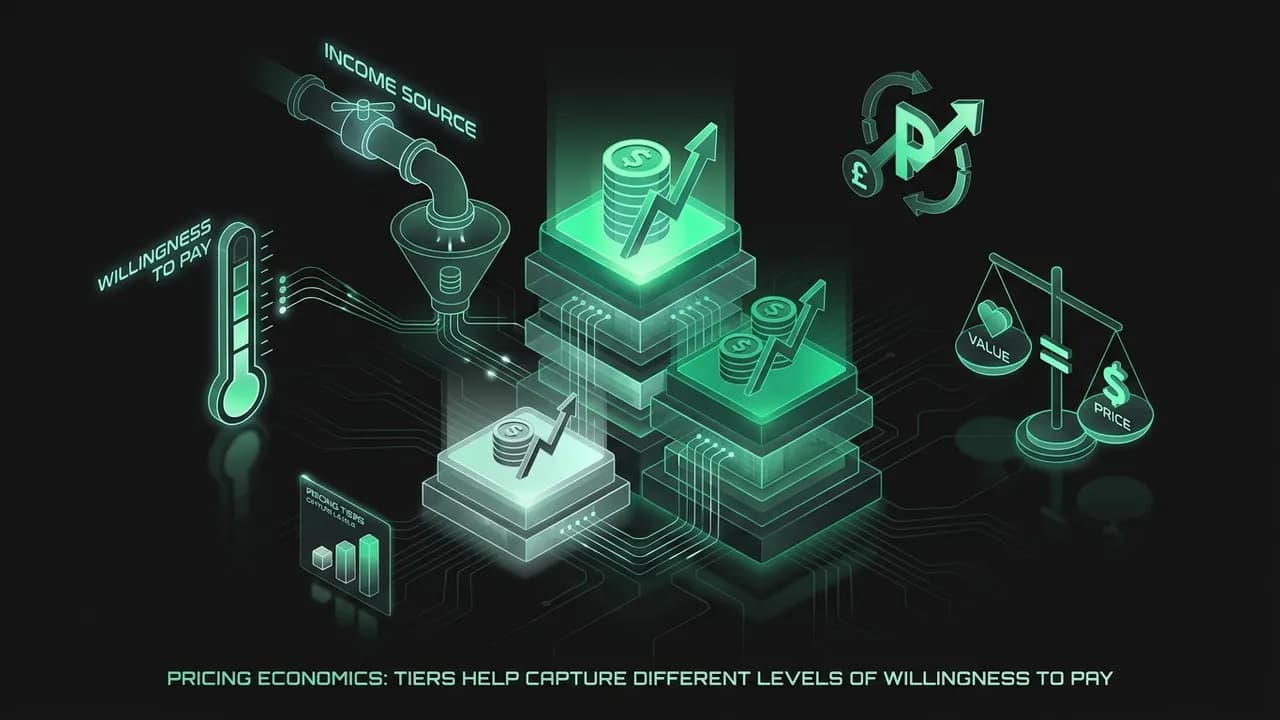
One of the main economic advantages of tiered pricing is that it helps a business capture more value across heterogeneous customers. Without tiers, a single price usually forces a bad compromise: price too low and premium willingness-to-pay gets left behind; price too high and entry-level customers never convert.
Tiers solve that by creating value steps. The starter tier lowers entry friction. The middle tier captures the largest commercial segment. The top tier captures higher-intensity, higher-complexity, or higher-status buyers.
This economic logic is why tiered pricing is so common. But it only works when the tiers correspond to real differences in value perception and use case. If the tiers are arbitrary or inflated, the business may still increase initial conversion but create retention problems later.
Healthy tier economics show up in:
The tier system should not merely raise ARPU. It should raise ARPU by helping the right customers land in the right value band.
Customer Psychology: People Compare, Anchor, and Simplify
Customers rarely know the absolute value of a plan in advance. Instead, they compare what is in front of them. That means pricing psychology is deeply relative.
Customers tend to:
This is why the decoy effect works. A plan does not need to be selected often to influence selection behavior. Its presence changes how another option is perceived.
But there is a fine line here. If customers feel that a tier exists only to manipulate them, trust falls. The best pricing psychology feels clarifying, not sneaky. It helps the customer make sense of tradeoffs rather than hiding them behind clutter.
Advanced Examples: Different Ways Tiers Shape Buying Behavior
Example 6: AI tool pricing
Many AI products use free, pro, and team tiers, with the middle plan designed to feel like the obvious serious-user choice.
Example 7: Education and coaching stacks
Self-serve, group, and premium-coaching tiers let buyers self-select by support need and ambition level.
Example 8: B2B seat and admin pricing
Plans often segment smaller operators from larger compliance-heavy teams.
Example 9: Consumer subscriptions
Ad-supported, standard, and premium plans often use the middle option to absorb most users while preserving a higher anchor.
Operating Model: How to Review a Tier System Over Time
Tiered pricing should not be treated as a one-time pricing page project. It needs ongoing review.
Questions to Review Monthly or Quarterly
Team Alignment
This operating discipline matters because what feels like the perfect tier design at launch can become outdated as product value changes.
Tier Design: Package Around Customer Progress, Not Internal Convenience
The best tier systems feel like natural stages of customer progress. Entry tiers help a user get started. Mid tiers help a serious user operate effectively. Premium tiers support scale, control, or specialized requirements.
This progression is important because customers do not buy features in the abstract. They buy a path that fits how they work today and what they may need tomorrow. When tiers follow that logic, upgrade paths feel intuitive.
Many weak tier systems are built around internal technical convenience instead. A feature gets placed into a plan because it was easy to package there, not because it reflects how the customer thinks about value. That often creates awkward comparisons and pricing-page confusion.
A strong rule is simple: each tier should tell a coherent story about who it is for and what job it helps them do better.
Clarity and Copy: Pricing Pages Are Decision Interfaces
A pricing page is not only a place to list plans. It is a decision interface. That means the words, labels, highlighted recommendations, and feature groupings all change how buyers interpret the options.
Useful clarity principles include:
This matters because the decoy effect is often amplified or weakened by copy and presentation. A well-structured page can make a legitimate value anchor obvious. A cluttered page can make even good tiers feel manipulative or arbitrary.
Hybrid Models: Tiers Can Combine Features, Usage, and Service Depth
Many pricing systems are stronger when tiers are not based on features alone. Hybrid designs can combine:
This approach works because real differences in value often come from more than one dimension. A growing team may need both higher usage and more admin control. A premium customer may need both advanced features and faster support.
Hybrid tiers are powerful, but they must still remain understandable. The more dimensions you add, the more discipline you need in explaining what each plan is for and why the jump in price is worth it.
Final Playbook: How to Fix a Weak Tier Structure
If your tiered pricing is underperforming, work through this checklist:
define the real customer segments and their primary outcomes
choose the commercial center of gravity tier
reduce feature clutter and make the comparison clearer
ensure every plan has a real use case, even if one is chosen less often
review downgrade, regret, and support confusion to find mismatch
These steps matter because weak tier performance is often a decision-design problem, not merely a price-point problem.
Final Decision Principle: Tiers Should Reduce Uncertainty, Not Increase It
The best tier system reduces uncertainty. It helps the buyer understand what they need, what they gain by paying more, and why one option is a better fit than another. When that happens, pricing psychology becomes a tool for clarity rather than manipulation.
That is the standard worth aiming for. The decoy effect is useful only when it helps customers make a decision that still feels right after they buy.
Key Takeaways
Tiered pricing captures different willingness-to-pay segments with one product; three tiers is the usual sweet spot.
The decoy effect uses a deliberately weaker option to make your target plan look like obvious best value.
Highlight the middle plan as most popular and anchor with a high tier so it feels reasonable.
Avoid too many tiers and unclear value gaps; choice paralysis kills conversion.
Test the structure with real buyers and watch which tier they actually pick, not the one you intended.
Frequently Asked Questions
What is a tiered pricing strategy?
What is the decoy effect in pricing?
How do you design a tiered pricing page using the decoy effect?
What are real examples of tiered and decoy pricing?
What are common tiered pricing mistakes?
How many pricing tiers should a startup have?
Your Turn: The Action Step
Three-Tier Pricing Page Designer
Design a 3-tier pricing page with a deliberate decoy and a clearly best-value 'anchor' tier that nudges most buyers to the plan you actually want them on.
Choose the tier you want most buyers on
Pick your target tier and its price. Everything else is engineered around it.
Lay out all three tiers
Name, price, and the 3-4 headline features per tier.
| Tier | Price | Headline features |
|---|---|---|
Design the gate and the decoy
What one feature pushes Basic buyers up to your target? What makes the top tier a 'decoy' that flatters the middle?
Write the nudge copy
The 'Most popular' / 'Best value' badge and the one-line reason on your target tier.
Predict and plan to verify the mix
What % do you expect on each tier, and how will you check after launch?
| Tier | Expected % | Actual % (after 30 days) |
|---|---|---|
Before you close this
0/5 doneYour answers are saved in this browser only. Use “Download as PDF” to keep a copy.
Make More Money From Same Customers: Upselling & Cross-Selling
Ready to apply this?
Stop guessing. Use the Litmus platform to validate your specific segment with real data.
Design Your Tiers