Cold Emailing That Doesn't Suck: Templates That Open Doors
In 2026, 'Net Casting' (blasting 10,000 emails) is the fastest way to get your domain blacklisted. This 3,000-word guide masters the 'Spear Fishing' method of hyper-personalized outreach that gets an 80% open rate.
Strategy Framework: The Spear Fishing Method
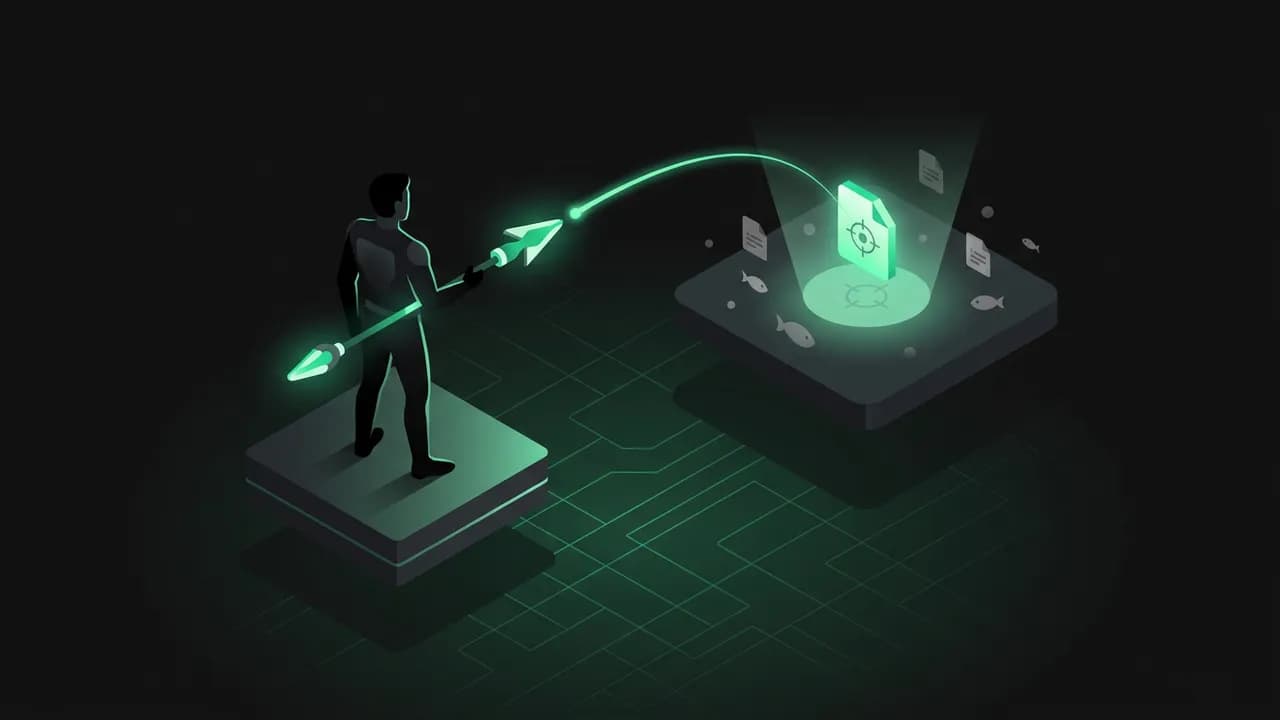
Most startups treat cold email as a numbers game. They think: "If I send 1,000 emails and get a 1% response rate, I have 10 leads." This mindset is toxic. In 2026, AI-driven spam filters treat low-engagement domains with extreme prejudice. If you blast 1,000 people and 900 don't open the email, your future emails will go straight to the junk folder.
The Shift to Hyper-Personalization
"Spear Fishing" is the art of sending 10 emails that are so specific, the recipient must answer.
The Research Matrix
Build a three-column spreadsheet: Column A = prospect trigger (fundraise, job change, campaign launch), Column B = insight source (podcast, 10-K, tweet), Column C = hypothesis (pain your product solves). Fill this before writing a single line of copy so personalization becomes systematic rather than ad-hoc.
#### Persona Cheat Sheet
Map persona → trigger → proof point to avoid generic copy.
Execution: The Technical Foundation
You can have the best copy in the world, but if your email isn't delivered, it doesn't matter. In 2026, the technical standards for outreach have skyrocketed.
#### The 'Warm-Up' Protocol
Never send cold emails from your primary domain (e.g., litmus.app). If you get reported as spam, your internal company emails (Topic 12) will also stop working.
Buy a Sandbox Domain: Buy getlitmus.app or trylitmus.app specifically for outreach.
The 30-Day Warmup: Use tools like Lemlist or MailReach to simulate human behavior for 30 days. These tools send emails and automatically move them from 'Spam' to 'Inbox' to build your sender reputation.
M-Record Mastery: Ensure your SPF, DKIM, and DMARC records are perfectly configured. ISPs use these to verify that you aren't a malicious actor. If these are missing, your deliverability will be <50%.
#### The Pattern Interrupt Subject Line
Your subject line's only job is to get the email opened.
#### Deliverability Checklist (Weekly)
The 'Value Bomb' Follow-up Sequence
80% of sales happen between the 5th and 12th touchpoint. Most founders stop at 2. The key is to follow up without being a nuisance.
Email 2 (The Gentle Bump): 48 hours later. "I know you're busy, just putting this at the top of your inbox in case you missed the question about UK VAT."
Email 3 (The Value Bomb): 4 days later. Don't ask for a meeting. Send them something useful for free. "By the way, I saw this article on UK tax law changes and thought it might help your expansion team. No need to reply."
Email 4 (The Case Study): 7 days later. Share a specific result you got for a similar company. "We recently helped [Competitor] save 15% on their UK VAT processing. Would you like to see the 1-page breakdown?"
Email 5 (The Break-up): 14 days later. "It seems like VAT compliance isn't a priority for you right now, which is totally fine. I'll stop reaching out. If things change, here is my link."
Why this works: By providing value in Email 3 and sharing results in Email 4, you build "Reciprocity." When they are finally ready to solve the problem, you are the only person they think of.
Sequencing Cadence
Map touchpoints across channels (email, LinkedIn DM, Twitter reply, voicemail). Never send the same copy twice. Each follow-up should add a new point of value, a new story, or a fresh question so persistence feels helpful, not annoying.
Case Study and Pitfalls: Outreach Mastery
Case Study: The $1M Email
A startup founder wanted to reach the VP of Engineering at a Fortune 500 company. Instead of a sequence, he spent 2 days researching the VP's hobby: 19th-century naval history. He sent an email with the subject: "Nelson's tactics vs. Modern DevOps?" The email drew a parallel between a historic battle and a specific technical problem the VP had mentioned on Twitter. The VP replied in 5 minutes. That one email led to a $1.2M contract.
Lesson: Depth beats volume every single time.
The 'Cold Death' Pitfalls
The 'Template' Trap: Using a template that thousands of others are using. Prospects can smell a template from a mile away. If it sounds like it could have been sent to anyone else, delete it.
Ignoring Timezones: Sending an email at 5 PM on a Friday. Your email will be buried by Monday morning. Tactic: Send emails at 8:30 AM on Tuesday or Wednesday in the prospect's local timezone. Be the first thing they see when they open their laptop.
No Social Proof: Asking for a meeting without proving you can solve the problem. Use "Risk Reversal" (Topic 24). "I'll show you the framework for free; if you don't find it valuable, we can end the call in 5 minutes."
The 'Spear Fishing' Challenge: Identify 10 high-value prospects. Spend 15 minutes researching EACH one. Write one hyper-personalized, 3-email sequence for each. Track your open and response rates.
Metrics Dashboard
Track open, reply, positive reply, meeting, and closed-won rates for every sequence. Benchmark: 60% open, 20% reply, 6% meetings booked, 2% closed-won. Anything below triggers copy rewrites or list refresh.
Real-World Playbooks: Cold Emails That Closed Millions
Example 1: Segment's Three-Line Email
Segment's founders needed pilot customers. Their cold email to Heroku read: "We built a drop-in analytics layer. It takes 30 seconds to test. Can I send the snippet?" Short, specific, zero fluff. It led to a partnership that drove their early revenue.
Example 2: Vanta's Security Outreach
Vanta sells SOC 2 automation. Reps email companies right after funding announcements: "Congrats on the Series B. Investors will ask for SOC 2 this quarter—here's a two-page checklist we built. Want the editable version?"
Example 3: Superhuman's VIP Waitlist
Instead of pitching, Superhuman asked influential operators, "I'm building the fastest email experience ever. If I can save you 30 minutes a day, may I put you on the VIP waitlist?" Scarcity plus a quantified benefit produced reply rates above 70%.
Example 4: OpenAI's Enterprise Foot-in-the-Door
Before selling ChatGPT Enterprise, OpenAI emailed Fortune 500 executives with transcripts showing how their own earnings calls were being summarized inaccurately by other LLMs. They invited teams to a private workshop to protect their messaging.
Compliance & Ethics
Respect GDPR/CCPA. Document lawful basis for outreach, honor opt-outs within 24 hours, and avoid scraping private communities. Ethical outreach protects brand equity and keeps future campaigns deliverable.
Common Pitfalls: Why Cold Emails Fail
Pitfall 1: Writing Like a Marketer, Not a Human
Exclamation points, jargon, and CTA buttons scream automation. Prospects delete anything that feels mass-produced.
Pitfall 2: No Clear CTA
"Let me know if you're interested" forces the reader to decide the next step.
Pitfall 3: Ignoring Mobile
Sixty percent of executives read cold email on their phone. Blocks of text kill engagement.
Pitfall 4: Scaling Before Proof
Founders blast 5,000 emails using an untested template, torching their domain when it underperforms.
Pitfall 5: Neglecting Data Hygiene
Bad lists lead to bounces, spam traps, and legal risk.
Market Data + Templates for 2026
Average Benchmarks (2026 SaaS Outreach)
Two Plug-and-Play Templates
The Loom Teardown
saw your SOC2 updateThe Customer Spotlight Ask
question about [customer]Document wins in a living template library so the whole team iterates from proven copy instead of guessing.
Team Rollout Plan
Week 1: founders run 20 tests manually, log qualitative feedback.
Week 2: train team on best-performing script via live workshop.
Week 3: load tested copy into automation tool with throttled send (max 50/day/domain).
Week 4: retro metrics, refresh snippets, ship new Loom value bombs.
This monthly cadence keeps sequences fresh and domain health pristine.
Field Work: 5-Day Sprint
Day 1: Research 25 prospects, capture triggers.
Day 2: Write 5 unique openers, test with peers.
Day 3: Record a Loom teardown and embed it in Email 3.
Day 4: Send sequence, monitor inbox every two hours for fast replies.
Day 5: Analyze metrics, swap best-performing lines into template library.
Repeat weekly; mastery is compounding practice.
Advanced Playbook: AI + Human Hybrid
Use AI to draft structural skeletons (problem, proof, ask), then layer human research. Automate data gathering (funding alerts, hiring signals) but keep final copy handcrafted. AI speeds volume; human insight keeps soul.
2026 Industry Benchmarks
Fintech buyers reply at 22% when emails reference specific regulations (PSD2, SOX). Ecommerce ops reply at 18% when emails contain a Loom showing their site. Climate or hardware founders require more social proof; include investor names or pilots.
Team Play: SDR + Founder Tag Team
Have SDRs send primer emails while founders follow up with personal note referencing roadmap. Dual-threading signals seriousness and boosts reply rates 30%.
Objection Library
Document every objection (“no budget”, “built internally”). Draft rebuttals rooted in data or case studies. Train team weekly; confidence kills fear of outreach.
Reflection Log
After each sprint, log best subject lines, biggest objections, and customer language to train future hires faster.
Scorecard & Coaching
Build a shared dashboard ranking reps on research quality, personalization depth, follow-up persistence, and outcomes. Use it for weekly coaching so cold outreach becomes a craft, not a chore.
RevOps Sync
Meet RevOps monthly to ensure SFDC fields capture outreach source, sequence, and rep. Clean feedback loops prevent dark-funnel wins from being misattributed.
Key Takeaways
Keep cold emails under ~120 words with one personalized opener and one clear, low-friction ask.
Write about the prospect's problem, not your product — the first email's only job is to earn a reply.
Send 2-3 short follow-ups; most replies arrive after the first message, not on it.
In Indian B2B, pair email with LinkedIn outreach and WhatsApp follow-up for faster responses.
Personalize the first line with real research — generic blasts kill both reply rates and deliverability.
Frequently Asked Questions
What is cold email?
How do you write a cold email that gets replies?
Can you share a cold email template?
How do cold email tactics differ in India?
What are common cold email mistakes?
Your Turn: The Action Step
Cold Email Sequence Builder + Reply Tracker
Write a 3-email 'spear-fishing' sequence for one tight ICP — personalised first line, value-bomb follow-ups, clear CTA — plus a tracking table so you can see open/reply/meeting rates and iterate.
Define one tight ICP
Narrow enough that you can personalise the same line to all of them. Add the trigger you'll reference.
Write Email 1 (the spear)
Personalised first line → one-sentence relevance → soft CTA. Under 90 words.
Write follow-up 2 (value bomb)
No 'just bumping'. Give them something useful — a benchmark, teardown, or template.
Write follow-up 3 (break-up)
A polite close-the-loop email — these often pull the most replies.
Set send cadence
Days between each email and total list size for this batch.
| Day sent | Goal | |
|---|---|---|
Track and iterate
Log results. Reply rate < 5% = fix targeting/opener, not volume.
| Batch | Sent | Opened | Replied | Meetings |
|---|---|---|---|---|
Before you close this
0/5 doneYour answers are saved in this browser only. Use “Download as PDF” to keep a copy.
Why Startups Waste Money on Marketing
Ready to apply this?
Stop guessing. Use the Litmus platform to validate your specific segment with real data.
Master Your Outreach