Podcast ROI: Is Starting a Show Worth the Effort?
Most corporate podcasts are a 'Vanity Project' that dies after 7 episodes. This 3,000-word guide breaks down the true math of podcasting and the 'Multiplication Engine' required to make the ROI positive from Day 1.
Strategy Framework: The Content Multiplication Engine
The biggest mistake in podcasting is treating the audio as the final product. If you spend 5 hours producing an episode and only get 100 listens, your hourly ROI is terrible. In 2026, the podcast is merely the Raw Material for a 50-asset distribution engine.
The 1:50 Strategy
One 45-minute recording should produce:
Why it works: You are decoupling the 'Creation' time from the 'Reach' volume. The podcast becomes your primary R&D (Research & Development) phase. You are essentially getting paid (in content) to interview experts and learn your market.
Guest Selection Flywheel
Prioritize guests who are customers, partners, or distribution allies. Each episode should create downstream leverage beyond listens: co-marketing, case studies, or referrals.
Strategy: The 'Deep Focus' ROI Metric
Podcasting is the only medium where users will give you 45 minutes of undivided attention. A person might scroll past 50 of your ads, but if they listen to your podcast for 3 weeks, they become a Brand Advocate.
The Trust Conversion Rate (TCR)
We measure the value of a podcast not by downloads, but by its ability to shorten the sales cycle.
Pipeline Attribution
Add "How did you hear about us?" as a required CRM field with "Podcast" as a selectable option. Supplement with unique landing pages and offer codes mentioned only on the show.
Audience Development Tactics
Execution: Avoiding the 'Pro-Studio' Trap
Founders often delay launching because they think they need a $5,000 studio. In 2026, Intimacy beats Audio Quality.
#### The 'Minimum Viable Quality' (MVQ) Setup
Audio: A $100 Shure MV7 or similar USB mic in a room with carpets. High-end audio is a 'Nice to have,' but clear audio is a 'Must have.'
Video: Use your iPhone or a 4K webcam. Video podcasting is non-negotiable in 2026 because of platforms like YouTube and TikTok.
Post-Production: Use AI tools like Descript or Riverside.fm. These tools allow you to edit audio by editing text and automatically generate 'Clips' for social media. What used to take 10 hours now takes 1.
#### The Guest-Led Distribution Protocol
You are borrowing the audience of your guest.
#### Producer SOP
Outline a weekly operating procedure: pre-interview research doc, question bank, recording agenda, editing checklist, clip selection criteria, upload workflow. Process beats inspiration.
Case Study and Pitfalls: Scaling the Show
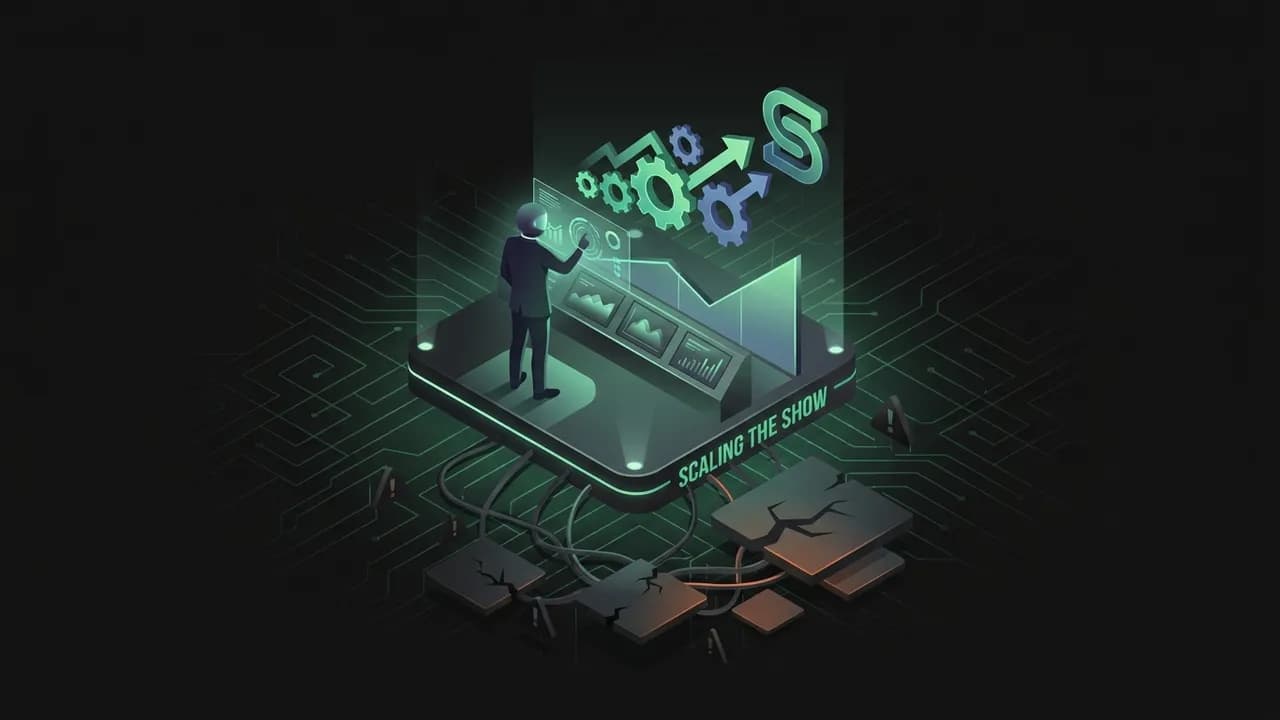
Case Study: How 'The Copywriter Club' Built a $1M Business
They didn't start with a course; they started with a podcast. They interviewed the world's best copywriters for free for a year. This did two things: 1) It gave them an education that no university could provide, and 2) It built a massive community of aspiring copywriters who trusted them. When they finally launched their paid membership, they had a 'Warm' audience waiting to buy. The podcast was their 'Loss Leader' (Topic 71) that fueled a million-dollar ecosystem.
The 'Mic-Drop' Pitfalls
The 'Interviewer Intro' Boredom: Spending 10 minutes talking about your guest's childhood. In 2026, users have no patience. Tactic: Start with the most controversial or valuable 30-second clip from the middle of the interview, then jump straight to the 'Meat.'
Consistency over Intensity: Posting 5 episodes in one week and then nothing for a month. The algorithm prizes the 'Stitch'—the regular habit of the listener. If you can't commit to one episode every 14 days for a year, don't start.
Ignoring SEO: Your podcast title shouldn't be "Episode 43 with John Smith." It should be "How John Smith scaled [Company] using [Specific Technique]." Use keywords in your show notes and titles to capture search traffic on Spotify and Google.
The 'Podcast Pilot' Challenge: Record a 15-minute 'Solo' episode defining your unique perspective on your industry. Use the 1:50 strategy to turn that one episode into 10 social posts. Measure the engagement.
Monetization Ladder
Stage 1 – Demand Gen: promote templates, waitlists, events.
Stage 2 – Community: paid cohorts or memberships for superfans.
Stage 3 – Productized Services: workshops, advisory retainers.
Stage 4 – Sponsorships (only after proving product ROI to avoid diluting the brand).
Real-World Examples: Shows that Print Revenue
Example 1: HubSpot's "Marketing Against the Grain"
Hosts Kipp Bodnar and Kieran Flanagan use the show to pressure-test go-to-market ideas before rolling them out. Every episode spawns blogs, LinkedIn posts, YouTube clips, and enablement assets.
Example 2: ProfitWell's "Protect the Hustle"
Patrick Campbell interviewed SaaS founders about pricing. Episodes doubled as sales collateral for their pricing consultancy and later the Paddle acquisition.
Example 3: Lattice's "All Hands"
The HR software company booked Chief People Officers as guests, then invited them to private roundtables. The podcast acted as a Trojan horse for enterprise deals.
Example 4: Morning Brew's "Founder's Journal"
Alex Lieberman records unscripted 15-minute reflections. The low-lift format produces daily touchpoints, fueling premium membership upsells.
SEO + Metadata
Write keyword-rich titles and descriptions, add chapter markers, and publish full transcripts. Optimize YouTube versions with tags and custom thumbnails so episodes become evergreen search assets.
Common Pitfalls: Why Corporate Podcasts Die
Pitfall 1: No Differentiation
Generic "leadership lesson" interviews attract nobody.
Pitfall 2: Measuring Downloads Only
Downloads do not pay salaries.
Pitfall 3: Inconsistent Cadence
Publishing sporadically trains algorithms and listeners to ignore you.
Pitfall 4: No CTA
Listeners finish episodes without a next step.
Pitfall 5: Overproducing
Spending $5k per episode on cinematic edits slows you down.
Production Calendar & Distribution Grid
| Week | Recording | Edit | Publish | Newsletter | LinkedIn | Shorts |
|------|-----------|------|---------|------------|----------|--------|
| Mon | Guest A | | | Outline | Clip 1 | Idea 1 |
| Tue | | Edit | | | | Clip 1 |
| Wed | Guest B | | Publish | Send Recap | Clip 2 | Clip 2 |
| Thu | | Edit | | | | Clip 3 |
| Fri | Solo ep | QA | | CTA push | Carousel | Clip 4 |
Map every episode to at least 10 derivative assets. Assign owners and deadlines so nothing stalls.
Guest Experience Blueprint
Send briefing doc with audience stats, topic angles, and sample questions.
Ship high-quality mic + return label for VIP guests.
Deliver post-show kit (quotes, clip previews, suggested copy).
Follow up 30 days later with performance stats to encourage ongoing sharing.
Listener Journey Map
Chart the path: discover episode → listen → subscribe → join newsletter → attend live session → purchase. Design CTAs for each step so listeners always know the next action.
Studio Toolkit (2026)
Hardware: Shure MV7, Rodecaster Duo, Elgato Key Light. Software: Riverside for recording, Descript for edits, Notion for show docs, OpusClip for shorts. Document gear + settings so any host can reproduce quality.
Guest Pipeline CRM
Track prospects in a CRM stage flow: Sourced → Pitched → Scheduled → Recorded → Promoted. Tag by persona so you maintain diversity (founders, customers, investors, operators).
Channel Stack
Every episode fuels: blog recaps for SEO, newsletter editorials, webinar invites, sales enablement clips, onboarding content. Document which teams consumed which assets so ops sees compounding value.
Growth Experiments
Test giveaways (books, consultations) for listeners who DM a keyword, run live Q&A after episodes, syndicate on niche podcast networks, and transcribe episodes into LinkedIn carousels for extra reach.
Ad Read Optimization
Even if you avoid external sponsors, master ad read structure. Hook -> personal story -> benefit -> CTA. Use this to sell your own product authentically inside episodes.
Internal Enablement
After each episode, summarize the three best insights and push them to sales, success, and product teams so the content fuels internal learning.
Guest Ladder Strategy
Start with friendly guests, then reference them when pitching dream guests. Each rung unlocked provides social proof for the next tier.
Measurement Cadence
Review analytics biweekly: downloads, completion %, CTA clicks, sourced pipeline. Adjust topics and CTAs based on data instead of gut feel.
Editorial Charter
Document your show's promise: audience, tone, forbidden topics, and differentiators. Share it with guests and internal teams so everyone understands why the show exists.
Live Extensions
Spin popular episodes into live AMAs, webinars, or conference talks. Use the same outline, invite listeners, and capture new leads while reinforcing the brand as a go-to educator.
Sponsor Readiness Checklist
If you ever add sponsors, require: documented audience stats, evergreen ad slots, contract templates, and listener survey data showing tolerance for sponsorship. Preparedness keeps monetization smooth.
Host Training Loop
Quarterly coaching on storytelling, energy, interviewing, and on-camera presence keeps the show sharp. Record practice episodes and review as a team.
Distribution Syndication
Publish to Spotify, Apple, YouTube, Recast, Substack, and LinkedIn newsletters simultaneously. Automate scheduling via Zapier so every episode hits all surfaces within 24 hours.
Listener Community
Create a private circle where listeners can discuss episodes, suggest guests, and access bonus Q&As. Community converts passive listeners into evangelists.
Ad Funnel Example
Top of funnel: TikTok clips drive to podcast. Mid funnel: podcast drives to newsletter. Bottom funnel: newsletter offers product trial. Track conversion rates at each handoff to learn which segments buy after listening.
Repurposing SOP
Every episode goes through: 1) transcript clean-up, 2) key quote extraction, 3) stats list, 4) 5 email snippets, 5) 8 social posts, 6) 3 video shorts, 7) knowledge base entry. Assign owners and deadlines so nothing slips.
Equipment Redundancy Plan
Keep spare mics, SD cards, and a backup recorder. Record local audio plus cloud to avoid losing top guests. Reliability protects your reputation.
AI Assistants
Use AI to summarize transcripts, flag quotable moments, generate SEO descriptions, and draft follow-up emails. Humans edit for nuance, but AI removes hours of grunt work.
Guest Pipeline Math
If you release weekly, you need 60+ guests/year. Keep a pipeline of 30 prospects, 10 booked, 5 recorded, 4 in edit. Without a numbers-driven view, consistency collapses.
Guest Pipeline Dashboard
Track invite acceptance rate, average response time, and topic coverage balance so you don’t over-index on one niche or burn relationships with slow follow-ups.
Evergreen Library
Organize episodes by problem solved. Sales reps can send “Security Budget Episode” or “Hiring Playbook Episode” as follow-up resources instead of writing long emails.
Emergency Backup Plan
Keep a bank of evergreen solo episodes ready for weeks when guests cancel. Consistency builds trust; missing a week kills momentum.
Merch & Physical Touchpoints
Send guests custom merch, thank-you notes, or books—then record their unboxings as extra content. Physical gestures deepen relationships and spark social shares.
Listener Feedback Loop
Embed a short survey link in show notes asking “What should we cover next?” and “Did this episode drive action?” Feed responses into backlog grooming so the audience literally programs the show.
Key Takeaways
Treat a podcast as a slow-burn authority and relationship channel, not a direct-conversion machine.
The biggest payoff is often the guest relationships — every interview is a warm, high-value connection.
Measure downloads, completion rate, and consistency over time, not just downloads-to-sales.
Repurpose every episode into clips, posts, and newsletter content to multiply the ROI.
Commit to a full season before quitting; podcasts compound and most die from inconsistency ('podfade').
Frequently Asked Questions
Should I start a podcast for my business?
What is the real ROI of a business podcast?
How do you measure podcast success?
What are business podcast examples?
What are common podcasting mistakes?
Your Turn: The Action Step
Podcast ROI & Content Multiplication Planner
Decide if a show is worth it by costing the real hours and modelling the ROI — then plan how each episode multiplies into 8+ pieces of content and a guest-led pipeline.
Name the ONE business goal
Pipeline, brand authority, SEO, or recruiting — pick one primary. 'Reach' is not a goal.
Cost the true effort
Hours per episode x your blended hourly cost + tools. Be honest about edit time.
| Line item | Hours/₹ |
|---|---|
Plan the multiplication engine
List every asset one episode becomes. Target 8+ pieces per recording.
| Asset type | How many | Channel |
|---|---|---|
Design the guest pipeline
If goal is pipeline: list the type of guest who is also an ideal buyer/partner.
Set the cadence & checkpoint
A realistic episodes/month you can sustain for 6 months, and a review date.
Before you close this
0/5 doneYour answers are saved in this browser only. Use “Download as PDF” to keep a copy.
Sales Funnel vs Direct Sales: What Actually Works?
Ready to apply this?
Stop guessing. Use the Litmus platform to validate your specific segment with real data.
Launch Your Show