SEO in 2026: Is It Still Worth It for Startups?
Thinking SEO is free, fast, or dead (due to AI) is the #1 reason startups fail to scale their organic reach in 2026. Here is the modern reality.
The 2026 Strategic SEO Landscape
The era of "Gaming the Algorithm" is dead. In 2026, search engines like Google and AI-driven platforms like Perplexity have effectively closed the loopholes that SEO specialists used for a decade. Transitioning from a "Mechanical SEO" mindset to a "Topical Authority" mindset is the single most important pivot for a startup founder. If you are still thinking about keyword density and backlink counts, you are playing a game that no longer exists.
The Rise of AI Overviews and LLM Crawlers
Google's AI Overviews (the feature that launched in beta as "Search Generative Experience" or SGE, then rolled out to all US users in May 2024 under its current name) has fundamentally changed the user journey. For simple queries ("What is a CRM?"), the search engine provides the answer directly, cannibalizing the traffic that used to go to blogs. A December 2025 Ahrefs study found that when an AI Overview appears, the click-through rate for the #1 organic result drops by 58% — nearly double the 34.5% drop measured in April 2025, and the gap is only widening. Startups that rely on "Definition-style" content are failing hardest. To survive, you must optimize for "The Answer" while providing "The Depth" that an LLM cannot yet synthesize—personal experience and proprietary data. The goal is no longer to get a click; it's to be the source that the AI cites.
The Psychology of Search Intent in 2026
We categorize modern search intent into four distinct buckets, each requiring a different content architecture:
The Investigation Intent: Users asking "Why" a problem exists. (High volume, low conversion). These users are in the education phase. Your content should be provocative and counter-intuitive. They are looking for a perspective, not just a fact.
The Comparison Intent: Users asking "Which" solution is best. (Medium volume, high conversion). These users are ready to buy but need a reason to trust you over the incumbent. This is where your USP must shine.
The Utility Intent: Users asking "How" to perform a task. (Low volume, recurring brand value). This builds product-led growth (PLG) by showing your tool in action. Solve a small part of their problem for free on the page.
The Transactional Intent: Users ready to sign up. These pages must be lightning-fast, frictionless, and optimized for immediate conversion.
The Long-Tail Dominance Framework
Instead of targeting broad, expensive keywords, we use the "Long-Tail Pyramid" to capture niche markets that legacy players ignore due to low individual volume. However, in aggregate, these niches represent 80% of total search traffic. For a startup, this is the only viable path to a moat.
#### Part A: Problem-Specific Keyword Sourcing
Most startups make the mistake of naming their category (e.g., "Project Management Software"). Instead, name the pain (e.g., "How to track billable hours for freelance interior designers").
The Strategy:
#### Part B: The "Modern Alternative" Comparison Play
Your customers are likely currently suffering with a legacy tool. They are searching for alternatives because of a specific missing feature or pricing change.
Step-by-Step Execution: Building the SEO Machine
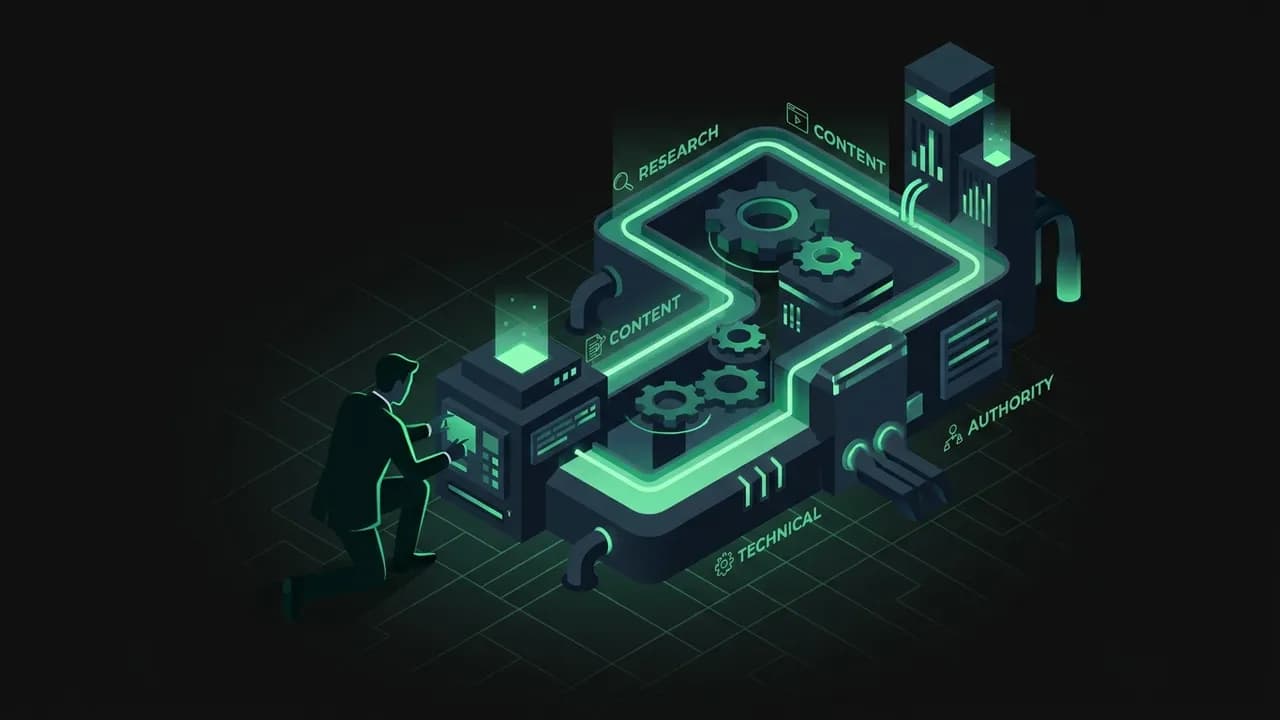
Phase 1: The Technical Foundation (Code & Structure)
SEO is no longer just a marketing task; it's a front-end engineering requirement. If your codebase is messy, your rankings will suffer regardless of content quality.
Structured Data (JSON-LD): You must explicitly tell the AI what your content is. Use the HowTo schema for guides, Product schema for feature pages, and FAQ schema to dominate the SERP real estate. This is the UI for search bots. Use Google's Tool to validate your markup.
Semantic HTML Hierarchy: Use main, article, header, and section tags. AI crawlers use these to understand the hierarchy of importance. A well-structured h1 to h4 hierarchy is better for SEO than any meta-tag. Ensure your H-tags are used for structure, not styling.
Core Web Vitals Mastery: If your page takes 3 seconds to load on a 4G connection, you will be penalized. Focus on LCP (Largest Contentful Paint) and CLS (Cumulative Layout Shift). In 2026, speed is a trust signal. Use Next.js Image components and aggressive caching.
Phase 2: The Programmatic Content Flywheel
Once you find a template that ranks, you must scale it. Programmatic SEO (pSEO) involves using a database to generate hundreds of high-quality pages automatically.
Phase 3: The E-E-A-T Signal Boost
Expertise, Experience, Authoritativeness, and Trustworthiness are non-negotiable. Don't just post generic text.
Phase 4: The AI Citation Strategy
In 2026, AI Overviews now appear on a majority of informational queries, and Ahrefs' December 2025 data shows the #1 organic result loses 58% of its clicks when one shows up on the page. Your new goal is to be the source that AI cites, not just the blue link people scroll past.
Proof and Pitfalls: Learning from the Trenches
Case Study: How "Canva" Won with Programmatic SEO
Canva didn't just rank for "Design Tool". They created thousands of landing pages for specific templates: "YouTube Thumbnail Maker", "Wedding Invitation Template", "Business Card Design". Each of these pages solved a specific, immediate problem. They captured the user at the "Utility" intent phase and pulled them into their ecosystem. They now rank for over 2 million keywords using this strategy.
Startup Lesson: Identify the "Specific Outputs" your product creates and build SEO pages around them. Treat your SEO assets as a product feature.
The "Invisible" Pitfalls that Kill Growth
The "Ghost Town" Effect: Posting 5 high-quality articles and then stopping for three months. Consistency is the primary signal of a "Living Brand". AI bots will crawl you less frequently if they see no updates. Set an editorial calendar and stick to it.
Content Without CTA: 10,000 visitors mean nothing if they don't have a reason to stay. Every blog post MUST have a lead magnet, a waitlist signup, or a "Book a Demo" button that feels like the natural next step. If you aren't capturing an email, you're wasting money.
Over-Optimizing for Bots: Writing text that sounds like a robot produced it. If a human skips through your content because it's repetitive and dry, the AI will notice the low "Dwell Time" and demote you. Write for the human, structure for the bot.
Ignoring Video SEO (but relying on it alone): YouTube remains the second-largest search engine after Google, processing billions of queries daily, so every major pillar page should still have a 2-minute video summary embedded — it increases dwell time and gives you two shots at the first page of Google. But don't stop there: a 2026 audit of buyer-intent queries found AI chatbots cited zero YouTube videos across the sample, even when 30-plus relevant creator videos existed on YouTube itself. If your only "depth" content lives in a video, it's invisible to the AI Overview and chatbot layer — always pair video with a written, structured transcript or summary on the page so both humans and AI crawlers can use it.
Real-World Examples: Companies That Won (and Lost) with SEO
Example 1: Canva — The Programmatic SEO Machine
Canva doesn't rank for "design tool." They rank for over 2 million long-tail keywords like "YouTube thumbnail maker," "wedding invitation template," and "business card design." Each of these is a dedicated landing page with a live editor that lets users start designing immediately. By the end of 2025, Canva had grown to more than 265 million monthly active users (up 20% during the year) and crossed $4 billion in annual recurring revenue. The more interesting 2026 data point: Canva was one of the top 10 most-referred domains from ChatGPT, with 26 million+ ChatGPT conversations mentioning the Canva app by October 2025 — proof that a programmatic SEO moat also becomes an AI-citation moat if your pages solve a specific, nameable job.
Example 2: Zapier — The Integration Directory Play
Zapier created landing pages for every possible integration combination: "Connect Slack to Google Sheets," "Connect Stripe to Mailchimp." This generated over 25,000 programmatic pages, each targeting a specific query with genuine utility. Organic search remains Zapier's single largest traffic channel today, ahead of direct and paid combined in most independent traffic estimates.
Example 3: Wise (TransferWise) — The Currency Converter Utility
Wise built free currency converter pages for every currency pair ("USD to EUR," "GBP to INR"). These pages rank #1 on Google for thousands of transactional queries and funnel millions of users into their transfer product. The utility page IS the top of the funnel.
The 7 SEO Mistakes That Kill Startups in 2026
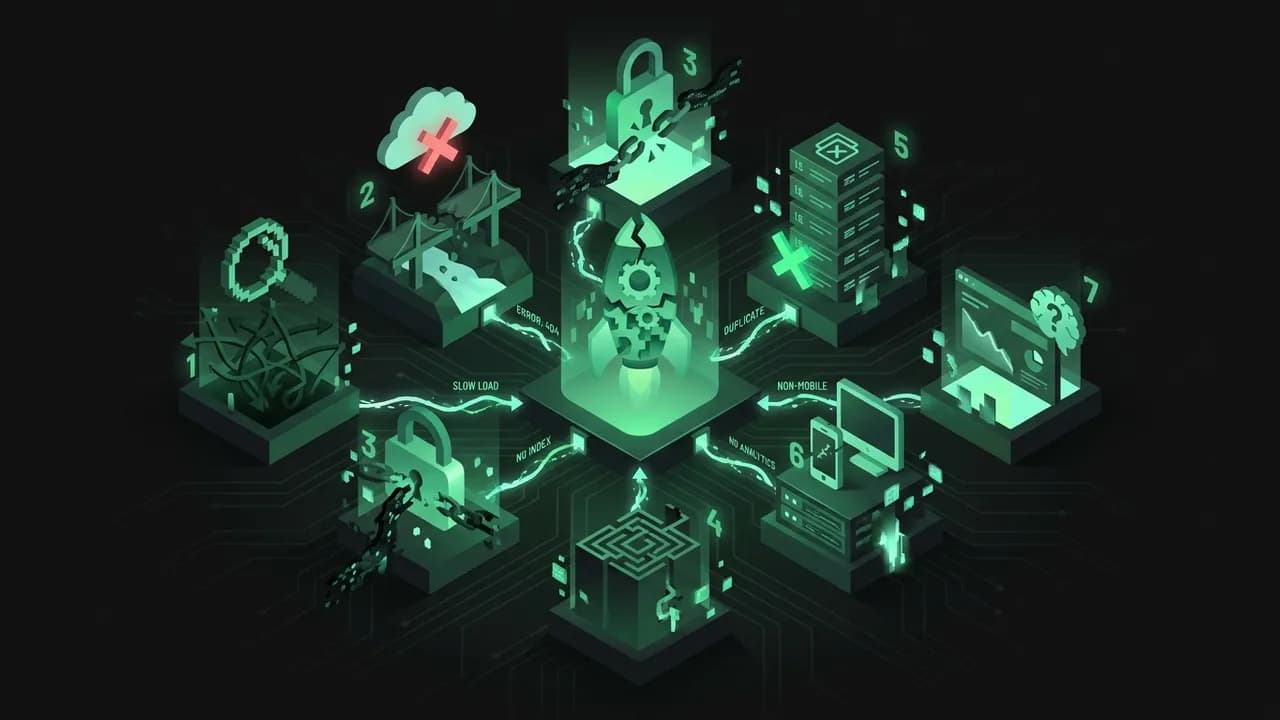
Pitfall 1: Writing for Bots, Not Humans
If your content reads like it was written by an AI summarizing a Wikipedia page, Google's helpful content system will bury it. In 2026, Google explicitly demotes content that lacks "first-hand experience." Add personal anecdotes, proprietary data, screenshots, and opinions.
Pitfall 2: Chasing Volume Over Intent
A blog post that ranks #1 for "what is project management" brings 50,000 visitors who will never buy your $299/mo tool. A page ranking #4 for "best project management tool for remote agencies" brings 200 visitors who are ready to buy.
Pitfall 3: Ignoring Technical SEO Until It's Too Late
Beautiful content on a slow website with broken structured data is invisible. Core Web Vitals, mobile responsiveness, and JSON-LD markup are table stakes in 2026.
Pitfall 4: Publishing 50 Thin Articles Instead of 10 Definitive Guides
Google's 2025 algorithm update explicitly rewards "topical depth." Five 800-word articles on related subtopics will lose to one 4,000-word definitive guide every time.
Pitfall 5: No Internal Linking Strategy
Every article is an island. Google uses internal links to understand topic relationships and distribute page authority.
Pitfall 6: Expecting Results in 30 Days
SEO compounds over 6-12 months. Founders who check rankings weekly and pivot after 4 weeks never build organic moats.
Pitfall 7: Not Updating Old Content
A guide published in 2024 with 2023 statistics will be outranked by a competitor who updates their guide with 2026 data. Google rewards freshness.
Key Takeaways
SEO still works for startups in 2026, but the prize is being the source AI Overviews cite, not just ranking first.
Build topical authority in one niche with pillar-and-cluster content before chasing broad keywords.
Start with long-tail, low-competition terms where a new site can realistically rank.
Structure content with clear definitions and FAQs so AI engines can quote you.
Commit for 6-12 months — SEO compounds slowly and rewards consistency, not quick wins.
Frequently Asked Questions
What is SEO for startups?
Is SEO still worth it for startups in 2026?
How do you do SEO for a startup?
How does AI (AI Overviews) affect startup SEO?
What are common startup SEO mistakes?
Your Turn: The Action Step
Long-Tail SEO Cluster Planner
Walk out with one pillar topic and 8-10 long-tail articles mapped to buyer intent, search volume and an effort/priority score you can hand to a writer this week.
Name one pillar topic
The single broad problem your buyer has. Everything else clusters under it.
Mine 8-10 long-tail keywords
Use autocomplete + 'People also ask'. List the literal phrases people type, with intent and rough monthly volume.
| Long-tail keyword | Intent (How-to/FAQ/Template/Product) | Est. monthly volume |
|---|---|---|
Score each by priority
Priority = (Volume x Intent fit) / Effort to rank. High volume + low competition + buyer intent wins.
| Keyword | Intent fit (1-5) | Effort to rank (1-5) | Priority score |
|---|---|---|---|
Pick the first 3 to ship
Choose the 3 highest-priority articles. These get written this month.
Draw the internal link map
Every cluster article links up to the pillar; the pillar links to your signup/product page.
Set a ranking checkpoint
Pick a date 4-6 months out and the metric you'll judge by (rank, clicks, signups).
Before you close this
0/5 doneYour answers are saved in this browser only. Use “Download as PDF” to keep a copy.
Why Startups Waste Money on Marketing
Ready to apply this?
Stop guessing. Use the Litmus platform to validate your specific segment with real data.
Launch Module 3