Mergers & Acquisitions: Buying vs. Building Growth
Learn how to master the 'Buy vs. Build' math and leverage acquisitions to accelerate your startup's growth and talent density.

The Problem: The 'Build at Any Cost' Trap

The Innovator's Ego
“We need a new AI-driven customer sentiment engine. Our engineering team estimated it would take 9 months and $400k to build from scratch. In that time, our competitors will have moved ahead.”
Startups often default to 'Building' because they value their own code and culture. However, the most successful tech giants (Google, Meta, Salesforce) didn't build everything themselves. They mastered M&A as a Feature.
Thinking your team can build everything better leads to missing critical windows of opportunity. Buying a company isn't just about the product; it's about Time-to-Market and Talent Density. In a fast-moving market, the cost of an acquisition is often less than the 'Opportunity Cost' of a late product launch.
Why Founders Default To Building
Most startup teams are culturally wired to build. Building feels noble, controllable, and aligned with product identity. Acquiring can feel expensive, risky, or somehow less authentic. But that instinct often ignores the strategic cost of delay, hiring friction, and repeated execution risk.
Time Is Often The Hidden Acquisition Price
When a market is moving quickly, the key comparison is not just cash spent on acquisition versus payroll spent on development. It is also the revenue delay, competitive loss, customer churn, integration backlog, and leadership distraction caused by taking too long to close a product gap.
M&A Is Not Just For Giants
Many founders assume acquisitions are only relevant for large public companies. In reality, small acquisitions, team acquisitions, asset purchases, and structured deals can be incredibly useful even for earlier-stage startups, especially when a capability gap is urgent and clearly defined.
Acquisitions Can Solve Three Different Problems
A startup may buy because it needs:
Those are different motives, and each changes how diligence and integration should work. The mistake is treating every deal as if it were the same type of strategic move.
The Real Risk Is Usually Post-Deal Failure
Most acquisition value is not destroyed at signing. It is destroyed after closing: talent leaves, code cannot integrate, customers churn, or internal politics turns the acquired team into outsiders. That means the real skill is not just finding targets. It is integrating value without killing it.
The Reality: To scale, you must master the 'Buy vs. Build' math and the art of the 'Acqui-hire.' You must move from 'Innovator's Ego' to 'Strategic Expansion'. The best acquirers are not lazy builders. They are disciplined capital allocators who understand when speed, talent, and market access matter more than pride.
Key Concepts: The M&A Vocabulary
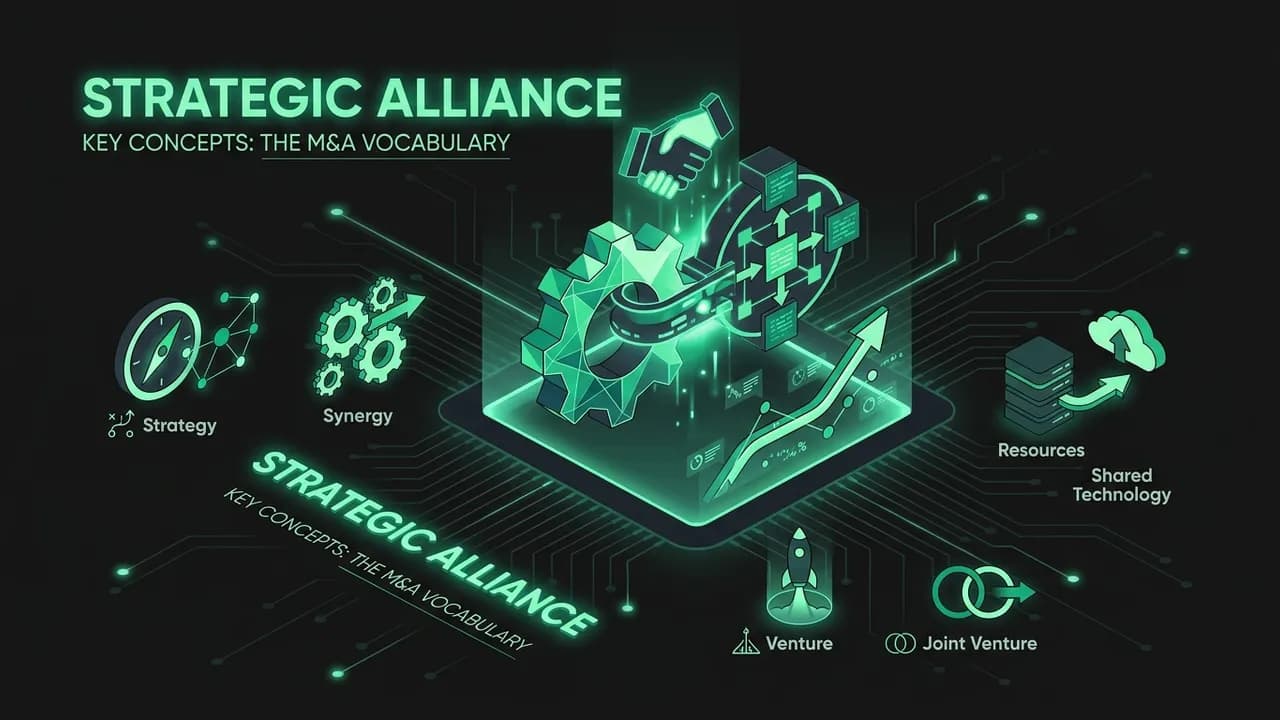
Before entering the arena, you must understand the language of acquisitions.
1. Acqui-hire
Buying a company primarily for its team and technical talent, even if the primary product is shut down. This is the fastest way to add a specialized engineering team (e.g., AI or Security) to your roster.
2. Product/Tech Acquisition
Buying a company specifically to integrate its technology into your existing platform. This fills a strategic 'hole' in your roadmap (Topic 15) without the 12-month development cycle.
3. Revenue/Market Acquisition
Buying a competitor primarily for their customer list and immediate market share. This is about consolidating the niche and reducing your overall CAC (Topic 102).
4. Due Diligence
The 30-90 day 'Audit' phase. You aren't just checking the bank statements; you are checking the Code Quality, the Legal Compliance (Topic 92), and the Internal Culture.
5. Earn-outs
A deal structure where the sellers only receive part of the purchase price if they hit specific post-acquisition milestones (e.g., retaining 90% of customers for 12 months).
6. Integration Risk
The #1 reason acquisitions fail. It's the high probability that different tech stacks or contrasting leadership styles will clash, destroying the value of the deal within the first year.
Why Vocabulary Changes Decisions
These terms are not financial theater. They shape how the startup evaluates price, risk, timelines, and post-close expectations. A founder who understands the vocabulary can structure better deals and avoid mismatching the acquisition type with the strategic objective.
Acqui-hires Are Mostly Talent Decisions
In an acqui-hire, the question is less about whether the product survives and more about whether the team can create more value inside your company than they could as a standalone business. Retention, role clarity, and founder psychology matter more than revenue multiples.
Product Acquisitions Depend On Technical Reality
A strong demo is not enough. The acquiring team must understand architecture quality, scalability constraints, dependency risks, documentation quality, and what it will actually take to integrate or re-platform the asset.
Revenue Acquisitions Depend On Retention Quality
Buying customers only works if those customers stay. That means understanding contract health, product overlap, churn patterns, onboarding friction, and whether the acquiring company can actually serve the acquired user base without destroying experience.
Earn-Outs Can Align Or Distort Incentives
Earn-outs are useful when uncertainty is high, but they can also create tension if the acquired founders feel they are being held hostage to metrics they no longer fully control. Good structures are clear, fair, and operationally realistic.
Integration Risk Starts Before Signing
If leadership cannot explain how the deal creates value after closing, the problem is not post-merger execution alone. It means the acquisition thesis was too vague from the start.
The Framework: The 'Buy vs. Build' Scorecard
Use this weighted scoring system to decide whether to acquire or keep building in-house.
1. Velocity Impact (Weight: 30%)
Does this acquisition save us more than 6 months of development and testing time? If the market window is closing, speed is worth a massive premium.
2. Strategic Fit (Weight: 30%)
Does this fill a critical hole in our product roadmap? Does it expand our Total Addressable Market (TAM) into a new vertical that we currently can't reach?
3. Culture Compatibility (Weight: 20%)
Would their lead engineers and founders thrive inside our organization? If the culture clash is too great, they will quit within 6 months, and you will have paid for 'ghosts.'
4. Financial ROI (Weight: 20%)
Is the 'Multiple' (Topic 102) reasonable compared to the cost of internal development + the 'Success Risk' of building it yourself?
The Rule: If the total score is <70, keep building. If it's >85, move to an LOI immediately.
Why A Scorecard Helps
Acquisition conversations are emotionally noisy. Founders can become excited by the target, the founder chemistry, the story, or the fear of missing out. A scorecard slows that down and forces the team to compare a deal against explicit criteria tied to strategy rather than hype.
Velocity Should Be Measured Honestly
Teams often underestimate internal build time and overestimate how quickly they can ship something production-grade. They also underestimate the cost of recruiting rare specialists. A good scorecard includes real delivery assumptions, not optimistic engineering narratives.
Strategic Fit Must Be Specific
“Interesting adjacency” is not strategy. The startup should be able to say exactly what gap the target closes, which customer problem improves, what cross-sell or upsell becomes possible, and why this matters now rather than later.
Culture Compatibility Is Economic
Culture is not a soft issue in M&A. If key people leave, context disappears, trust collapses, and the asset often degrades fast. Compatibility should be evaluated in terms of pace, decision-making, communication norms, incentives, and appetite for operating inside a larger system.
Financial ROI Must Include Opportunity Cost
The comparison is not only price versus internal development budget. It should include the probability that the build fails, the cost of delay, the revenue unlocked by speed, and the retention or market expansion upside if the acquisition works.
When To Walk Away
Even if a target is attractive, a low score on integration clarity or strategic fit should kill the deal. Great acquirers are defined as much by disciplined passes as by successful purchases.
Execution: The M&A Lifecycle
Step 1: The 'Pipeline' Phase
Always be 'Shopping,' even when you aren't ready to buy. Maintain a list of 5-10 small startups or open-source projects that solve niche problems in your space. Meet their founders for coffee once a quarter.
Step 2: The LOI (Letter of Intent)
This is the non-binding offer that starts the real clock. It should include the 'Macro' terms: Price, Structure (Cash vs. Stock), and the Exclusivity Period (preventing them from talking to other buyers for 45 days).
Step 3: Deep Technical Due Diligence
Don't just trust their screenshots. Perform a Code Audit. Check for:
Technical debt that will require a rewrite.
Open-source license violations (Topic 82).
Scalability bottlenecks that will break under your user load.
Step 4: The 'Unity' Integration
90% of mergers fail because the acquired team feels like 'second-class citizens.' On Day 1, give them a clear mission, a unified Slack/Discord, and ensure their equity vesting remains intact.
Why Pipeline Work Matters
The best deals rarely start cold. When founders know each other before the transaction, the conversation is more honest, diligence is smoother, and the buyer has better insight into how the team behaves under pressure. Relationship equity improves decision quality.
LOIs Should Protect Focus
A good LOI is not just a price marker. It defines the shape of the conversation. Clarity on scope, exclusivity, high-level structure, retention assumptions, and diligence expectations reduces confusion later when emotions and fatigue increase.
Diligence Must Go Beyond Finance
For startups, the highest-risk diligence areas are often technical, legal, security, and customer quality. The buyer needs to understand whether the codebase is real, the contracts are clean, the data handling is safe, and the customers are genuinely engaged.
Integration Starts Before Close
The acquiring company should decide before closing who the acquired team reports to, what happens to the product or brand, how customers will be communicated with, what success looks like in the first 30, 90, and 180 days, and which systems will merge first.
A Practical Integration Checklist
Strong integrations usually define:
The Goal Is Value Capture, Not Ceremony
An acquisition is not finished when the press release goes out. It is successful only when the promised value actually shows up in product velocity, retained talent, customer outcomes, or revenue expansion.
Case Study: Buying the Future
The Success: The CRM Platform
A mid-sized CRM company needed an AI email assistant. Instead of spending 12 months building it, they acquired a 2-person project for $800k in stock.
The Result: They launched the 'AI Assistant' feature 3 weeks later. The feature drove a 20% increase in their average seat price, paying for the acquisition cost in under 4 months. They bought speed and results, not just code.
Why This Worked
The buyer had clarity on the capability gap, bought a narrowly scoped asset, retained the key builders, and integrated the feature quickly into an existing distribution engine. The deal worked because the thesis was simple and execution was fast.
The Pitfalls: M&A Disasters
The 'Spaghetti Code' Nightmare: Buying a product that looks great in the demo but has zero documentation and a legacy database that cannot be integrated into your stack (Topic 77).
The 'Key Man' Risk: Buying a company where 100% of the institutional knowledge is in the head of a founder who doesn't want to work for you.
Over-paying for Hype: Buying a company based on their 'Waitlist' rather than their 'Retention' (Module 4).
Integration Drift: Signing a deal with no clear owner for combining roadmaps, systems, and team workflows. Fix: appoint an integration lead before closing.
Narrative Mismatch: Telling the market the deal is about product strategy while internally treating it as a talent tuck-in. Fix: align the internal and external thesis.
What Healthy Startup M&A Looks Like
Healthy startup M&A is thesis-driven, selective, and operationally grounded. The buyer knows why this target matters, what value should be captured, how the team will fit, and what must happen in the first few months after closing.
Questions Founders Should Ask
The Final Principle
Great acquisitions are not about empire-building theater. They are about compressing time, increasing talent density, and accelerating strategy. Founders who understand that use M&A not as a vanity move, but as a disciplined lever for growth.
Key Takeaways
Treat 'buy vs build' as a deliberate scorecard decision weighing time, cost, capability, and integration risk.
Run rigorous due diligence — financials, contracts, tech, and legal — before you commit to any deal.
Know which kind of acquisition you're making (acqui-hire, tech, or market) so you don't overpay for the wrong asset.
Budget as much energy for post-merger integration and culture as for the deal itself; that's where value is won or lost.
Don't build out of pride: when a target owns customers or tech you'd need years to replicate, buying can be the faster moat.
Frequently Asked Questions
What are mergers and acquisitions (M&A)?
How do you decide between buying vs building (the buy vs build decision)?
What is due diligence in an acquisition?
What are types of startup acquisitions?
What are examples of acquisitions as a growth lever?
What are common M&A mistakes?
Your Turn: The Action Step
Buy-vs-Build Scorecard
Decide whether to acquire a capability/company or build it in-house, with a side-by-side cost-time-risk comparison and a clear recommendation.
Name the capability precisely
What exactly are you trying to get — team, tech, customers, distribution? Be specific.
Cost out both paths
Fully-loaded cost for build vs buy, including integration. Formula: build = dev + marketing; buy = price + integration.
| Path | Cost (₹) | Time to result |
|---|---|---|
List the risks of each
Top 2 risks for building and top 2 for buying.
| Path | Risk 1 | Risk 2 |
|---|---|---|
Weigh what's scarcest for you
Is time, cash, or talent your binding constraint right now? That decides the path.
Write the recommendation
State buy or build and the one reason that tips it.
If buying, set the deal guardrails
Max price, earn-out, and retention terms for key people.
Before you close this
0/5 doneYour answers are saved in this browser only. Use “Download as PDF” to keep a copy.
Why 50/50 Partnerships Fail in Startups
Ready to apply this?
Stop guessing. Use the Litmus platform to validate your specific segment with real data.
Scale Your Empire